Showing posts with label Space Odyssey. Show all posts

Wednesday, October 13, 2021

Today's Blue Origin flight successful; this Shatner picture is now funny

This morning's suborbital Blue Origin flight, carrying 90-year old William Shatner, a/k/a James Tiberius Kirk, to the edge of space was a success (linking to CNN coverage), and all hands have returned to terra firma whole and intact.

Accordingly, now I can enjoy (and share) this picture:

(Photo obtained from Captain Kirk: The Man, the Myth, the Legend via Facebook.)

Wednesday, October 6, 2021

How are YOU celebrating World Space Week?

According to the United Nations, World Space Week runs this year, and every year, from October 4-10.

Why? Because on October 4, 1957, the old Soviet Union launched Sputnik 1. Then, on October 10, 1967, the Treaty on Principles Governing the Activities of States in the Exploration and Use of Outer Space, including the Moon and Other Celestial Bodies (sounds like something the UN might draft, doesn't it?) entered into force. (Yes, in case you're wondering, the United States has ratified this treaty.)

So... how are you celebrating this year?

For one of my favorite comic strips, Tim Rickard's Brewster Rockit: Space Guy!, pretty much every week is Space Week. But this week Mr. Rickard is recycling a plot first served up in Douglas Adams' The Restaurant at the End of the Universe and melding it with the sneering news coverage of billionaires venturing into space:

You may not immediately recall what happened to Ship B of the Golgafrincham Ark Fleet and its millions of telephone sanitizers, hairdressers, "tired TV producers, insurance salesmen, personnel officers, security guards, public relations executives, [and] management consultants" -- fully a third of the planet's population -- traveling in suspended animation. (They crash-landed on Earth two million years in the past, leaving the indigenous, evolving hominind population terminally depressed and bound for extinction.)

You likewise may not recall the sad fate of Golgafrincham. (Having conned all the useless members of their society off the planet with wildly varying stories about the planet being doomed -- my favorite was that an enormous mutant star goat was going to eat the planet -- the "other two-thirds stayed firmly at home and lived full, rich and happy lives until they were all suddenly wiped out by a virulent disease contracted from a dirty telephone.")

But even without catching the literary reference, most readers will probably smirk right along with the idea that billionaires should be banned from space or, if allowed to go at all, given one-way tickets only. Har har. And let's change the rules about who qualifies for official astronaut wings so that the person who bankrolled Blue Origin, Amazon's obscenely rich Jeff Bezos, can be denied his wings for putting his life at risk riding just past the internationally recognized boundary of outer space on his own rocket. Even though that meant that, once again, Wally Funk was denied official recognition.

In the first modern Age of Exploration, the analogs of the Bezoses and Bransons and Musks of today did not venture out in their wood and canvas ships in search of trade, gold, or glory. Oh, no, they limited their personal risk by staying home, directing affairs from London coffee houses and, in the course thereof, inventing the insurance business to limit their financial risks as well.

Who else -- besides governments -- could afford any sort of space exploration except for these flamboyant, egotistical billionaires? Hate on the uber-rich all you want, but governments have done a lousy job of space exploration because (surprise, surprise) they made it political: Richard Nixon couldn't wait to cancel the Apollo Program at the first possible opportunity precisely because it was perceived as the signature achievement of the Kennedy Administration. And the pattern hasn't changed any time the White House has changed hands: The new administration will announce its own grand plan -- and cancel those wasteful plans promulgated by its predecessor. It's a wonder the Space Shuttle ever launched or the International Space Station ever got built. But, by now, it must be no suprise to even the dullest among us that next year will mark the 50th anniversary of humankind's last trip to the Moon.

Compare that, if you will, to the development of aviation in the 50 years following Kitty Hawk. Governments contributed substantially to the development of aviation in that first half-century (see, World War I and World War II) but governments did not completely control it. As the governmental death-grip on spaceflight has lessened in recent years, even only slightly, the pace of development has finally quickened. And is becoming ever more rapid.

Which brings us back again to Wally Funk. This summer Funk became the oldest person ever to fly in space (at 82, she was five years older than was John Glenn, when he made his second trip to Earth orbit, in 1998, aboard the space shuttle Discovery).

If all goes as planned, Wally Funk's record will fall this coming Tuesday, October 12, when William Shatner, 90, better known as James Tiberius Kirk, will boldly go to space in a sub-orbital flight aboard another Blue Origin capsule.

Which leads to the funniest take I have seen about Shatner's upcoming flight. This is from an often funny, if sometimes juvenile, Facebook site called Captain Kirk, The Man, the Myth, the Legend:

OK... so I'm a nerd. But, if you got this far, maybe you are, too. In which case, live long and prosper, and enjoy the rest of World Space Week.

Tuesday, July 20, 2021

Congratulations to Blue Origin and Wally Funk and Jeff Bezos: New Shepard goes up, and comes down again, without a hitch

Logic students have a name for what is depicted in this cartoon, false dilemma or false dichotomy or something like that. Who cares? It's amusing. It's funny. It's just not true.

If only it were true. If only we could push a button -- or if Bezos or Musk or Buffett or Gates could just write a check -- and end child hunger.

Gazillionaire Jeff Bezos launched himself into space this morning, and returned safely, with his brother, the 18-year old son of a fabulously rich Dutchman, and an 82-year old woman (Wally Funk) who was part of a plan to shame NASA into taking women into space years before Sally Ride rode.

From a technology standpoint, today's Blue Origin launch is kind of primitive: Not only was the flight suborbital, the New Shepard capsule was of the Spam-in-a-can variety that our captured German rocketeers wanted to foist on the original Mercury astronauts (albeit with safeguards that couldn't have been imagined in the 1960s). The four persons launched this morning had no control over any aspect of their flight; they had no controls on their craft at all. The real Alan Shepard and his colleagues used their star power to acquire the power to navigate in their capsules -- which ultimately proved vital to the success of several subsequent manned flights. Go watch The Right Stuff again.

But Jeff Bezos, as you've perhaps read elsewhere, has a sense of history. Naming the suborbital craft New Shepard. Launching on Moon Day -- today is the anniversary of Neil Armstrong's one step for [a] man, one giant leap for mankind. Bringing Wally Funk along -- the historic and cultural significance of including a "Mercury 13" aspirant -- who finally gets her astronaut wings today, as the oldest person ever to go to space.

There will be those that criticize today's venture as a stunt, which it was, but it was an inspirational stunt and a true and courageous bet: Bezos did not send up some recycled NASA astronauts; he was daring enough to go himself. Because today's flight says volumes about how safe and reliable spaceflight can be -- where the billionaire funding the venture feels secure enough to put himself on top of the rocket.

Bezos is and will remain a controversial figure, just as is Elon Musk, his main competitor in the corporate space race.

Most of the rest of us will spend years recovering, if we ever do recover, from the financial disruptions of the COVID-19 pandemic. Thanks to his other company, Amazon, Bezos emerged from COVID-19 richer than ever -- even after the world's most costly divorce. And there is the scandal and shame of Amazon employees who have to take government food assistance or insurance subsidies because Amazon doesn't pay enough to live without these benefits. I hope he pays his Blue Origin employees better. I'll bet he does.

Yes, there are grounds on which to roundly criticize Jeff Bezos. In many ways he is a perfect symbol of corporate profits run amuck. He exemplifies the truly appalling wealth gap between himself and his least well paid employees.

And he'll probably wear his astronaut pin everywhere now. Maybe even in the shower. He could well be insufferable.

But stow those criticisms for tomorrow. Today is a day to celebrate the achievements of Bezos and his Blue Origin team. It was a textbook flight. It was, in the understated lexicon of the NASA pioneers, nominal.

I know there are those -- the artist who drew this cartoon, for one, and most of the people who shared it on Facebook, where I saw it -- who will question why anyone goes to space when we have so many problems to solve here. But remember the old days, when you would have to leave your house for work? Were all your problems at home solved first? Maybe you made your bed... but was the living room painted? Was the grass even cut? Why would you leave and do something else when there was still so much to do at home?

Why? Because you had to -- that's why. And we, as a species, have to explore the Universe God gave us. And, today, Jeff Bezos joins Elon Musk as one of those leading the way for all of us. Congratulations, Blue Origin.

Saturday, July 20, 2019

An anniversary tinged with regret


Some anniversaries make us nostalgic. Some just make us sad.

Today's 50th anniversary remembrance of humanity's first footsteps on the Moon falls, for me, in the latter category.

It might be different if tonight's commemorations were observed not just here on Earth, but in all the lunar cities, and in the Martian colonies, and among the asteroid miners.

But there are no lunar cities. And we've never been to Mars. The vast riches of the Asteroid Belt remain untapped.

It took just 54 years for humanity to advance from Kitty Hawk to Sputnik. Just 12 more to get from Sputnik to Apollo 11.

At that dizzying rate of progress, it was hard to imagine, then, how far the human race might have traveled by now, and what we might have discovered, and what we might have achieved.

I was still pretty young that Sunday night when Neil Armstrong took his one small step. So perhaps I can be excused for failing to imagine, even in my worst nightmares, how little humankind would achieve in Space in the coming half century.

We've gone nowhere.

Oh, we've sent some probes.

And we've collected mountains of data, seen millions of photos, all of which show that Space is even more thrilling, and more likely to contain life, or at least the building blocks of life, than any respected scientist might have imagined in 1969.

It's all still Out There. But we're all still Here.

Robert Kurson's recent book, Rocket Men, chronicles the Apollo 8 flight, the first manned flight to the Moon, at the end of 1968. He chronicles a great nation coming together in common purpose and hope, with hundreds of thousands directly involved in seeing that incredibly daring mission off the ground.

But it all went so terribly wrong -- even as things went so wonderfully right in Space. We actually put men on the Moon. And brought them home safely. And even when things went wrong in Space, the miraculous rescue of the Apollo 13 crew should have persuaded humanity that we could figure it all out, whatever challenges we encountered. And yet -- by December 1972 -- three short years later -- with Apollo 17 -- we were done.

We haven't built cities on the moon, though we now have reason to expect that there's water there to support them. We haven't been to Mars at all.

Some visionaries, and/or billionaires, talk about Mars. Or about mining asteroids. Or about seeing if there is life on Europa. But we haven't even gone back to the Moon.

So pardon me for not joining in the general merriment over tonight's anniversary.

It just makes me sad for the future we might have had, but didn't.

Monday, November 19, 2018

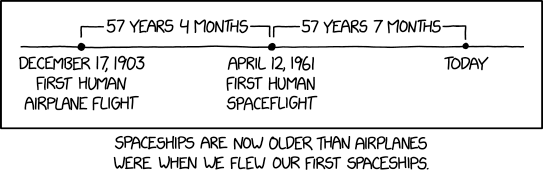
From Kitty Hawk to Gagarin to today

From the web comic XKCD.

Sometimes it seems like the world is progressing at an ever-more-rapid pace. But there are reminders, like this one, that human progress is, at best, uneven.

Thursday, November 7, 2013

I was really wondering how they could carry an open flame into outer space


Not all that surprising answer: They can't quite do that. Open flames are frowned upon in spacecraft. The Olympic Torch, however, is aboard the International Space Station, however, and will soon be carried on a spacewalk.

(Photo accompanying this post is taken from this NASA Tweet.)

Tuesday, January 8, 2013

NASA may launch unmanned Orion capsule in 2014

At least that's what NASA said in a December 13, 2012 post on its website. We still have to get through 2013 first.

Meanwhile, the rapidly graying believers in President Kennedy's promised "New Frontier" may be less than totally geeked to learn that NASA has awarded contracts to develop crew transportation systems.

It's perhaps for the best that NASA wasn't around in 1903. The Wright Brothers might have gotten some government money for their experiments at Kitty Hawk (Samuel Pierpont Langley, the secretary of the Smithsonian, got some government cheese for his unsuccessful "aerodrome" efforts), but would Orville and Wilbur ever have been able to meet NASA's certification standards?

The three lucky recipients of NASA contracts are Chicago's own Boeing Company, Sierra Nevada Corporation Space System, and Space Exploration Technologies Corp. (SpaceX).

The SpaceX Dragon capsule docking at ISS in May 2012
At this point, only SpaceX has successfully completed an (unmanned) cargo resupply flight to the International Space Station. Dragon, the SpaceX capsule used for the cargo supply flights, will eventually be fitted out for human flight. Meanwhile, our once proud astronauts have to hitch rides to lower Earth orbit on Russia's venerable Soyouz capsule from the Baikonur Cosmodrome in Kazakhstan.

NASA's list of planned 2013 launches shows SpaceX scheduled to make two more unmanned flights to the International Space Station (on March 1 and September 30). A competitor for the freight hauling business, Orbital Sciences Corporation, has two test flights of its Anteres launch vehicle planned this year; the second one, in April, is supposed to rendezvous with the International Space Station (but it's scheduled to burn up on the way back.

And what about the Sierra Nevada (SNC) and Boeing vehicles?

The SNC Dream Catcher is supposed to look
like this on its way to Earth orbit.
Well, they're not on the schedule for this year... but the SNC Dream Chaser is scheduled for more 'drop tests' (one was conducted this past May). Boeing's CST-100 has successfully tested its system of parachute deployment. In August, NASA reported that the Boeing vehicle had completed its first performance milestone.

John F. Kennedy's vision propelled America to do a lot in a decade. But he's gone 50 years this year; the last man left the Moon 40 years ago last month.

Wednesday, June 20, 2012

It really is an exciting time


From the webcomic xkcd by Randall Munroe.
Click on the link to read Mr. Munroe's embedded comment in situ.

A new Age of Exploration is underway. Will the United States participate?

Saturday, June 16, 2012

America Lost in Space - a continuing series


Three Chinese astronauts (or do you say taikonauts?) are in space this morning. The first Chinese woman to fly in space, fighter pilot Liu Yang, is part of the crew. Their mission, according to a Reuters account by Maxim Duncan in this morning's Tribune, is "to dock with the orbiting Tiangong (Heavenly Palace) 1 module launched last September, part of a 13-day mission crucial to China's ambition to put a space station in orbit around 2020."

Meanwhile, in the once-proud United States, we're still giddy about the private launching of a cargo rocket to provide supplies to the International Space Station, the place our astronauts get to by thumbing rides with the Russians.

One can only hope that the private sector will quickly find a way to achieve manned spaceflight, to get into space and stay there. Although... unsupervised corporate America or the Red Chinese in control of the ultimate high ground... is that a choice between the Devil and the deep blue sea?

Friday, May 25, 2012

"Looks like we've got us a dragon by the tail"


So said American astronaut Donald Pettit earlier today as he snagged the privately owned SpaceX Dragon capsule with the International Space Station's 58-foot robotic arm.

Gosh, this has been a long time coming. The pulpy sci-fi paperbacks of my youth have long ago crumbled into dust, but it was only today that their rosy predictions of private enterprise in outer space finally began to come true.

It's just a load of cargo on this trip -- food, clothing, new experiments -- but the AP's Marcia Dunn reports tonight (via Yahoo! News) that NASA and SpaceX are so encouraged by the success of this mission that a follow-up may come as soon as September.

-----------------------------------------------------------------------------
Video obtained from NASA.

Tuesday, May 22, 2012

Falcon launch succeeds; Dragon in orbit


The SpaceX Falcon 9 rocket was successfully launched to orbit this morning from Cape Canaveral, Florida. The Dragon capsule, perched atop the launch vehicle, is to dock with the International Space Station, bringing supplies and new experiments into orbit.

I was going to say that there are no astronauts aboard today's flight -- although SpaceX is touting Dragon as a vehicle that will carry astronauts in the future -- but that statement is not entirely accurate.

Some of the ashes of Mercury Astronaut Gordon Cooper were included in a container in the rocket's second stage. Also in that container, according to ABC News were the ashes of actor James Doohan and 306 others.

With the end of America's Space Shuttle program, American astronauts had been reduced to hitching rides into space aboard Russian Soyuz capsules. NASA Administrator Charles Bolden issued a statement this morning asserting that today's launch is "the beginning of a new era in exploration.... [W]e're working to promote competition and have multiple private sector partners so we don't find ourselves in the situation we are today -- having only one way to get to the space station."

-----------------------------------------------------------------------------------
Accompanying photo obtained from NASA.

Monday, April 30, 2012

Adrift in the Twitter stream: What happened to the Falcon 9 test today?

As a certified and certifiable space geek, and as one who is now dabbling tentatively in the Sea of Social Media, I couldn't help but notice that Space X Corp. was set to run a "static firing test" today of its $54 million baby, the Falcon 9 launch vehicle.

That's a picture of the Falcon 9 at the top of this post, taken during it successful launch into Earth orbit in June 2010 (you can find lots more pictures here.)

I don't know what a "static firing test" may entail, but I looked at the SpaceX website earlier today and saw this:

While this did not enlighten me on the nature, purpose or intent of a "static test" (I am pretty sure it's different from "static cling") it told me when and where to "tune in" on the Internet to see whatever it was there was to see.

Meanwhile, I opened up my Twitter page to keep up with anything pre-launch. (Yes, I have my own Twitter account. You could follow me -- @JackLeyhane -- only I don't know where I'm going so it would presumably be pointless to bother.)

But there was no launch -- and, now, I'm not sure if there ever was supposed to be one.

Look at this Twitter feed from @SpaceX (if I'm not using the terminology correctly, forgive the mistakes of a newbie):

The top tweet is the most recent in this screen capture, so you can see that the launch was aborted, that SpaceX was reviewing the data and might consider trying again later.

But... wait? What is this tweet further down the page (and earlier in time) from NASA Kennedy/KSC (@NASAKennedy)?
SpaceX having no issues ahead of static firing. Falcon 9 rocket is fueled, strongback is retracted. Exercise is rehearsal, no launch today.
That's slightly before a breathless tweet from SpaceX urging me to drop everything and watch the test.

I understand that 'stuff' will happen; tests will fail. Failures are inevitable in science. Bad things happen to good scientists; I get all that.

But... was there supposed to be a test or not? And, if not, why was SpaceX urging people to go watch?

Since this post was started, Elon Musk, the man behind SpaceX, has tweeted that "Flight computer aborted rocket hold down firing. Anomaly addressed. Cycling systems to countdown." This makes it sound like there may be a test today after all.

But shouldn't someone tell the nice folks at the Kennedy Space Center that it wasn't just "rehearsal" and that there might yet be a launch today?

Last week filmmaker James Cameron and Google CEO Larry Page were revealed to be part of a group that's planning to mine the Asteroid Belt. This is thrilling stuff -- but my enthusiasm is necessarily dampened when it appears that the people involved in the commercial space program today can't tell a rehearsal from a malfunction.

----------------------------------------------------------------------------------
UPDATE: Shortly after 3:15pm, SpaceX announced, via Tweet, that there'd been a successful two second burn.

Two seconds?

Really?

Thursday, April 19, 2012

Hopefully the setback in human progress is only temporary

A tweet last week by astrophysicist Neil deGrasse Tyson is kind of frightening:
April 12, 1961: first human in orbit. April 12, 1981: first flight of SpaceShuttle. April 12, 2012: Snooki in 2nd trimester.

Wednesday, April 4, 2012

Let's be honest: The text here is really just an excuse to run the pictures

Over the past few years a number of reporters and editors have referred to President Obama as a "Vulcan." This May 26, 2009 editorial from the Chicago Tribune is representative:
After an interview in which President Barack Obama confronted the economy, the Middle East and a lot of other Vital Issues, a Newsweek correspondent actually elicited an important new piece of information about the president.

He's Spock. As in Star Trek's famous Vulcan with the pointy ears and the computer-like brain.
The reference, I believe, is to a May 2009 Newsweek article, "We're All Trekkies Now."

And a June 20, 2010 editorial in the San Antonio Express News recounted:
The first well-known reference to Obama as a Vulcan came in a June 2008 NPR interview with Henry Jenkins, then a professor of humanities at Massachusetts Institute of Technology. "There's something in the mythology that surrounds Barack Obama that seems, to me, echoes some of our assumptions about Spock," Jenkins said. "He's someone who's been able to bridge worlds."

This fascinating commentary chugged along on impulse power until March 2009, when New York Times columnist Maureen Dowd gave it warp speed. "Mr. Obama has a bit of Mr. Spock in him (and not just the funny ears)," she wrote. "He has a Vulcan-like logic and detachment."
And the Vulcan rumors did not appear only in newspapers or magazines. Silly pictures, like the one at the top of this post, started appearing on the Internet. For awhile there I would not have been surprised if a survey had shown that, just as some ridiculous number of Tea Partiers thought Mr. Obama to be a Muslim, an equivalent percentage of young men living in their parents' basements thought him an alien. Really, really alien.

But 2012 is upon us and Mr. Obama is intent on securing another four year lease at 1600 Pennsylvania Ave. And, clearly, the President and his advisers believe it's time to put those troubling rumors to rest, once and for all.

Thus it was on February 29 that Mr. Obama met with Nichelle Nichols in the Oval Office and posed for this picture, now appearing everywhere on-line (this copy obtained from the Huffington Post):

How does posing with Lt. Uhura prove that the President is not a Vulcan?

Ask any Trekker: Can't you see he's smiling?

Saturday, December 17, 2011

More exciting news about America's future in space exploration

I saw this story first on Yahoo! News (a December 14 AP story by Donna Blankinship and Seth Borenstein), but this article, on Space.com, by Denise Chow, is likely to be available longer.

What you're looking at in the photo above is an artist's conception of a giant airplane carrying a rocket.

How big is the plane? The wingspan will be 385 feet -- 66 feet wider than the prior record-holder, Howard Hughes' Spruce Goose. The plane is to be built by Scaled Composites, the company founded by Burt Rutan, the aerospace engineer who, according to Wikipedia, designed the record-breaking Voyager, "the first plane to fly around the world without stopping or refueling, and the sub-orbital spaceplane SpaceShipOne, which won the Ansari X-Prize in 2004 for becoming the first privately funded spacecraft to enter the realm of space twice within a two week period."

The plane would be powered by six 747 engines. The Falcon 9 spacecraft to be carried by this giant will be supplied by SpaceX, the company that will attempt to send a supply mission to the International Space Station in February 2012 (see, this Page Two post).

The idea of an airplane carrying a rocket to a mid-air launching point may be unfamiliar to younger readers, but the rest of us remember how the X-15 reached the edge of space with the aid of a B-52 bomber.

"Mating and integration" for the Stratolaunch project is to be provided by Dynetics, a company whose website boasts the ability to deliver "high-quality, high-value engineering, scientific, and information technology (IT) solutions" to its customers.

I'm not certain what that leaves for Microsoft co-founder Paul G. Allen to actually do, but he is the "name" attached to the Stratolaunch project and I gather that he is the one putting these corporate pieces together. If he puts the pieces together well, it could be the start of an exciting future... and a real boost to the American economy, too.

-------------------------------------------------------------------------
For more information: Stratolaunch press release (pdf)

Saturday, December 10, 2011

Maybe America isn't lost in space yet

When President Obama mothballed the Space Shuttle program, he told the nation that America's private sector would quickly take up the challenge of travel to and from low Earth orbit.

Many scoffed. I scoffed.

But today comes word that SpaceX has reached agreement with NASA to launch a supply mission to the International Space Station with an unmanned, reusable Dragon capsule (like the one pictured above). The target date for this historic attempt is February 7, 2012. (AP coverage per Yahoo! News).

Alex Knapp writes today on Forbes.com about that mission:
The first phase will begin after the Dragon capsule achieves orbit. NASA has set forward several milestones for the capsule to meet, including a flyby of the space station. If those objectives are met, then the capsule will rendezvous with the ISS, using the station’s robotic arm as operated by the ISS crew.

If the flyby, rendezvous and release are successful, this will mark the first successful docking of a private spacecraft with the International Space Station – a huge leap forward for the future of commercial spaceflight.
SpaceX hopes to get the Dragon capsule rated for human transport -- which means American astronauts would no longer be obliged to hitch rides to the International Space Station with the Russians.

And then SpaceX (a company run by PayPal co-founder Elon Musk) will be able to boldly go wherever it darn well pleases.

Maybe we will back to the Moon in my lifetime. But, first, we have to get by February 7. Put it on your calendar.

------------------------------------------------------------------
Corrected 12/17/11

Thursday, July 21, 2011

Welcome home, Atlantis. Now what?

You're looking at a NASA photograph of Shuttle Atlantis returning to Florida's Kennedy Space Center early this morning after successfully concluding the final Shuttle mission, STS-135.

Is this the end of manned American space exploration?

There are still plans to keep American astronauts on board the International Space Station. However, for the foreseeable future, in order to get to and from, Americans will have to hitch a ride on board a Russian Soyuz spacecraft. Indeed, NASA astronaut Mike Fossum just joined the space station crew (currently denominated Expedition 28) after a July 8 launch from the Baikonur Cosmodrome in Kazakhstan.

But that's not exactly boldly going where no one has gone before. It amounts to taking a cab.

Astrophysicist Neil deGrasse Tyson, the Director of the Rose Center for Earth and Space of the American Museum of Natural History in New York City, tweeted earlier today, "Lament not the shuttle's end, but the absence of rockets to supplant it. Who shed a tear when Gemini ended? Apollo awaited us."

Dr. Tyson hits the nail exactly on the head. Not only does America lack a plan for further space exploration, it lacks the will to execute any plan. There's some vague notion that, some day, maybe, we might think about mounting an expedition to Mars. Maybe we'll go to an asteroid first....

Tyson's tweets note that President Kennedy's original target date for the lunar landing would have been during his second term. (As it happened, the landing was pushed back to 1969 because of the Apollo 1 fire.) Dr. Tyson notes, "One US President can never [actually] commit the nation to a goal that requires fulfillment by a President 'to be named later.'" Case in point: President Bush proposed returning to the Moon as a stepping stone toward Mars. President Obama killed that.

Are we ceding leadership in the exploration of the cosmos because it is too costly?

Again, I look to Dr. Tyson for some perspective (from his July 8 tweets):
  • The entire half-century budget of NASA equals the current two year budget of the US military.
  • The US bank bailout exceeded the half-century lifetime budget of NASA.
  • The US military spends as much in 23 days as NASA spends in a year - and that's when we're not fighting a war.
The United States can afford space exploration; what we can't afford is to stop.

Meanwhile, the private sector is expected to step up and take over flights to low Earth orbits -- but there's some question as to whether private enterprise can rise to the challenge.

In an AP report carried this morning by HuffPost AOL News, Marcia Dunn reports that the STS-135 crew left an American flag on board the space station. This was a flag that was flown on the very first Shuttle flight in 1981. It was left behind as a prize for the first private company that can fly up and claim it in person. Dunn's article continues:
SpaceX maintains it can get people to the space station within three years of getting the all-clear from NASA. Station managers expect it to be more like five years. Some skeptics say it could be 10 years before Americans are launched again from U.S. soil.
Let's hope the skeptics are wrong.

------------------------------------------------------------
For Further Reading:

Why America Needs to Explore Space, by Neil deGrasse Tyson (from Parade Magazine, August 5, 2007.

Now is not the time to quit, by Storer H. Rowley, Chicago Tribune, July 21, 2011.

Saturday, May 15, 2010

Is America lost in space?

(The final planned launch of Shuttle Atlantis,
May 14, 2010. From NASA.)

After STS-132, now in orbit, there are just two more planned American civilian spaceflights left. (The Air Force still has the unmanned X-37B program; a successful launch of the new vehicle was made on April 23.)

There will still be Americans in space, for a time at least, after the Shuttle is retired: American astronauts will continue to rotate to the International Space Station as passengers on board Russian vehicles. And President Obama says our outer space goals should be reconfigured: Instead of returning to the Moon and going next to Mars, as President Bush had proposed (and Congress had approved), we should head straight to Mars. Future flights in Low Earth Orbit should be privatized, with NASA becoming more FAA than the owner-developer-operator of all American space technology.

But this is a cloudy vision. While Mr. Obama's plan has some support among space scientists, many of our surviving lunar explorers are strongly opposed. (Here is a link to Neil Armstrong's written testimony before the Senate Committee on Commerce, Science and Transportation this past week.)

The problem with Mr. Obama's vision -- aside from the fact that it flushes billions of dollars already spent on developing vehicles and logistics for the now-scrapped return to the Moon -- is that it comes with no guarantees whatsoever. The Mars program is off in the distant future. The only upcoming tangible goal is for a new 'heavy lift' rocket to come on line in 2015 -- and that's because the development of this vehicle was part of the lunar program. Eugene A. Cernan, the last man to walk on the Moon, who testified with Armstrong before the Senate this week, said, "Nowhere do we find a commitment in dollars to support this national endeavor.... [T]his budget proposal presents no challenges, has no focus, and in fact is a blueprint for a mission to nowhere."

And then there's the question of privatizing LEO flights. In theory, this is a fabulous, long overdue idea. But... who will be allowed to fly? Low Earth Orbit is a crowded place; it's not just Hubble Telescope and the International Space Station up there, there are lots of satellites and lots of debris, too. Traffic has to be regulated to prevent collisions. Also... there's no place to go in LEO. There's up... and there's down. Entrepreneurs aren't being invited to hook up their own modules to the ISS... which would be the outer space equivalent of building a trading post outside the fort.

If you follow all the links here, you'll read that Mr. Obama's plan proposes an increase in NASA funding. But politicians do weird and wonderful things with budgetary numbers. Mr. Armstrong says the prior plans were never funded as they should have been, so comparisons are unfair. And who's to say whether Congress, in a time of soaring national debt, will supply the dollars Mr. Obama has requested.

By the way, this is not a Republicans vs. Democrats issue -- at least not for me. I think it just has to do with rotation in office: It was Richard Nixon who scrapped the last several moon flights. I suspect that each administration comes into office determined to undo everything its predecessor has done. Kennedy wanted to go to the Moon, so Nixon wanted to stop going (at least after he'd milked the PR value of Apollo XI). Bush II wanted to return to the Moon, so Obama was against it.

There is an attitude in this country that our manned spaceflight program is simply an obsolete relic of the Cold War. That's the attitude taken by Sun-Times columnist Neil Steinberg yesterday. He concluded:
Will it sting us to see Chinese astronauts joyously waving streamers attached to sticks, doing that running dance of theirs on the surface of the moon? Absolutely. Does that mean we must be square dancing one crater over? No way.
As an old history major, all I know is that, in the 1490s, the Pope divided the whole unknown world between the Spanish and the Portuguese. These were the major world powers then, and the leaders of global exploration. They quibbled over the Pope's line of demarcation, eventually moving one of the lines west, which may... or may not... have given Portugal its claim on Brazil.

Meanwhile the Dutch and, soon after, the English, were ramping up exploration programs of their own. And England set up shop in North America where our forefathers brought forth a new nation, conceived in liberty, and dedicated to the proposition that all men are created equal. Portugal regrouped. It consolidated. Bottom line: Portugal stopped exploring; England did not. We are -- America is -- the result. Today, Portugal is a lovely place that exports cork and wine and constitutes the next biggest threat to the euro after Greece.

America may not control space. No terrestrial nation will, not in the long term, because all of us here are at the bottom of a big gravity well and space is the ultimate 'high ground.' But we can choose whether we want to be England... or Portugal.

I vote for England.

Tuesday, November 17, 2009

Chicago surgeon aboard Atlantis

Dr. Robert "Bobby" Satcher, of Oak Park and Northwestern University is now, officially, the first orthopedic surgeon in space, having lifted off yesterday as a mission specialist on STS-129 aboard the Space Shuttle Atlantis on a mission to the International Space Station.

He's not going to be setting up a Sick Bay on the ISS; rather, as explained in this article on the WGN9 website, Satcher "will use his surgical training in joint replacements to help repair two robotic arms on the station's exterior."

And, of course, in keeping with the times, Dr. Satcher is supposed to be providing updates via Twitter. Dr. Satcher 'tweets' as "Astro_Bones." I assume this is an homage to a certain fictional space-going doctor, pictured at right. If it isn't, please don't tell me. I don't want to be disillusioned.

For more on Dr. Satcher's flight, see the official NASA site or any of these articles:


----------------------------------------------------------------------
Update 11/23/09: Apparently Dr. Satcher tweets (or twitters, or whatever) as both Astro_Bones and ZeroG_MD. I'm not sure whether you have to subscribe to both... but then I'm no rocket scientist.

Other Chicago area astronauts

Dr. Robert "Bobby" Satcher, now en route to the International Space Station aboard Space Shuttle Atlantis, has strong Chicago roots.

But he is not the first or only astronaut that has ties to this area.

John Mace Grunsfeld is a 1976 graduate of Highland Park High School. He went out of town (MIT) for his undergraduate work, but has MS and PhD degrees from the University of Chicago. Grunsfeld is a former NASA Chief Scientist and, according to Wikipedia, a veteran of five shuttle flights, including the Hubble repair mission this past May. Grunsfeld's father still lives in the Chicago area, according to Wikipedia.

Daniel M. Tani is a 1979 graduate of Glenbard East High School in Lombard. He is a veteran of three shuttle flights and served a hitch as flight engineer aboard the International Space Station. He was supposed to be on the station from late October to mid-December 2008 but, according to Wikipedia, the shuttle flight that was to relieve him was "delayed due to engine cutoff sensor issues during countdown." You may recall that Tani's mother died on December, 19 2008 a traffic accident at a Lombard railroad crossing -- and astronaut Tani was obliged to mourn his mother from space.

Joan Higginbotham is a 1982 graduate of Whitney Young High School in Chicago. She flew as a mission specialist on board Space Shuttle Discovery, STS-116, in December 2006.

Dr. Satcher isn't even the first Chicago doctor to go into space. That honor belongs to Dr. Mae Jemison. Jemison is a 1973 graduate of Morgan Park High School. Jemison flew on Space Shuttle Endeavour with STS-47 in 1992. According to Wikipedia article Dr. Jemison said, "The first thing I saw from space was Chicago, my hometown.... I was working on the middeck where there aren't many windows, and as we passed over Chicago, the commander called me up to the flight deck.... Looking out the window of that space shuttle, I thought if that little girl growing up in Chicago could see her older self now, she would have a huge grin on her face."

Jemison said her inspiration to join NASA was African-American actress Nichelle Nichols, who portrayed Lieutenant Uhura on Star Trek. After Jemison's historic flight, she also became the first real astronaut to appear in an episode of Star Trek: The Next Generation.

The last man to walk on the Moon, Eugene Cernan, was born in Chicago and graduated from Proviso Township High School in Maywood.

James A. Lovell, of Apollo 13 fame, wasn't born in Chicago -- but he's very definitely associated with the Chicago area because of a family owned restaurant, Lovells of Lake Forest. According to Wikipedia, Lovell's son Jay is the executive chef at the restaurant.

Is there anyone I've missed?