Showing posts with label Personal Opinion Clearly Labeled As Such. Show all posts

Wednesday, October 7, 2020

Ken Griffin has dropped over $46 million in opposition to the Fair Tax Amendment -- and I have a question

Rich Miller reported on CapitolFax.com that Ken Griffin recently contributed $26+ million to the Coalition to Stop the Proposed Tax Hike Amendment. The exact amount of Griffin's September 30 contribution was $26,750,000, according to the Illinois State Board of Elections website.

This was in addition, Miller reports, to a $20 million donation that Griffin previously made. So... over $46 million.

That's a lot of money -- and it raises, for me at least, a question.

Before asking my question, I should point out that I am not now and (unless I hit it big in Powerball or Megamillions) not likely to be a millionaire during this lifetime. I am also, as FWIW readers know, no politician. So there's a whole bunch of this high-stakes, big money, power politics stuff I don't understand. Most of it, in fact.

Still, I am a registered voter, and a citizen, and I hope I am as entitled as anyone to ask a question here.

And my question is... why?

Why would a rich person, or in Mr. Griffin's case, a very rich person, be opposed to a graduated Illinois income tax rate?

Don't laugh at me. Stay with me just a minute.

I'm no prophet, but here's what I think the future may hold: The tax rate for rich people will go up, as promised, if the Fair Tax Amendment passes. In which case the Illinois tax return, which is now extremely easy to complete, will become increasingly more complex with each passing year. Many lobbyists will find full employment getting particular exemptions from the new, higher rates that benefit these rich people, and other lobbyists will make small fortunes seeking different exemptions for those rich people. Accountants and tax lawyers will also prosper.

So the tax rates will go up... but will rich Illinoisans really pay more? History and precedent suggest otherwise.

By 1918, just five years after the adoption of the 16th Amendment, Wikipedia says (footnotes omitted), "the top rate of the income tax was increased to 77% (on income over $1,000,000, equivalent of $16,717,815 in 2018 dollars) to finance World War I. The average rate for the rich however, was 15%. The top marginal tax rate was reduced to 58% in 1922, to 25% in 1925 and finally to 24% in 1929. In 1932 the top marginal tax rate was increased to 63% during the Great Depression and steadily increased, reaching 94% in 1944" during World War II. These days, the top rate, again according to Wikipedia, is 37%. Which is a lot less than 94% -- but still a lot higher than the 4.95% flat tax rate in Illinois today.

Who actually pays those high Federal tax rates? Does anyone? Take an extreme example -- Donald Trump is almost always an extreme example -- according to the New York Times, Trump paid only $750 in federal income tax in the year he was elected and no tax at all in 11 of the 18 years of returns the Times reviewed (source). That's with a progressive, graduated federal income tax, too. Somehow, no matter what the rates are, many rich people finds ways to avoid paying their "fair" share. That's part of the secret of their success.

Seems to me, Mr. Griffin would have been better off spending his millions hiring Trump's accountants, or paying his own accountants to study the methods employed by Trump's accountants. But Mr. Griffin didn't ask me.

Friday, September 13, 2019

You know... there might just be something wrong with national elections besides the Electoral College


In 2015-2016 about 25 Republicans -- or maybe, more accurately, about 24 Republicans and Donald J. Trump -- staged a reality TV show to see who would be the Republican presidential nominee.

Look what that got us.

Well, he had experience in the one area that was apparently important to the process: He was a reality TV host.

The Democratic Party's first response to this national tragedy was to say -- hey, let's get our own reality TV host!

But Oprah said she wasn't interested.

So now, for 2020, the Democrats have given us something like 50 wannabes -- some of whom have already been voted off the island -- in an even more glitzy and frivolous game show format.

In my email this morning, and also on Facebook, are breathless inquiries: Who won last night?

Who will move on? Who will get the rose? Why don't we just add a phone number to call during the show to cast our votes for best snappy comeback? Or biggest burn?

Can we make this process any more trivial? Any more farcical?

And yet, somehow, the problem with our presidential election system is the Electoral College?

Really?

If you want a serious President, you need a serious process. A truly national leader can not be a hyper-partisan. He or she will have to try to appeal to everyone -- try to build a national consensus -- try to bring us together as a nation.

It can't happen, of course.

I mean, Lincoln couldn't get everyone behind him... even in the North.

Even George Washington was slandered, viciously, at least in his second term.

But they tried. They understood that their job was to lead a nation, not just a party, and certainly not just a wing or faction of that party.

Today, in 2019, We the People have apparently stopped looking for persons willing to undertake the thankless task of building a national consensus. Trying to build a national consensus is just too hard. Or maybe its boring. Instead, we're looking to pick our national leader in game shows.

The fault, dear readers, lies not in our stars, and not in our Constitution, but in ourselves.

We are better than this. We can do better than this. We must insist that our politicians do better than this.

Tuesday, August 20, 2019

Thankfully, the practice of law does not always involve fighting for justice

This is what is known as a "hot take" headline.

But now that you've taken the clickbait, let me explain.

I was at a birthday party for one of my granddaughters recently. My daughter must have told one of her guests, one of her neighbors, that I am a lawyer. He approached me in the kitchen as I was fetching something, or putting something away, and introduced his daughter. Like my granddaughter, she'd just turned five, he told me, adding, "I think she's going to be a lawyer, too, someday. She's always telling me that she wants to fight for justice."

Well. To my ear that sounded more like the little girl was thinking more of being a superhero than a lawyer. Very young children don't know that some career ambitions are not really attainable -- Meghan Markle notwithstanding, there can only be so many new princesses. And the otherwise admirable Doc McStuffins does not really explain to its young viewers that there are very limited opportunities for toy doctors. But you know what? There's plenty of time to find that stuff out. If five-year olds want to be princesses, or unicorn herders, or princesses who herd unicorns, or dragon tamers, or superheros -- I say, good for them.

But this was a party. I did not challenge the proud father's perceptions. Instead I said, "That's wonderful! I'm sure she'll be a great one." And the kid found another handful of chips and all was well with the world.

A few months before, though, I was part of a panel discussion for pre-law students at a local college. There were several distinguished practitioners, from various backgrounds -- and then there was me. I was a last-minute substitute for a much more distinguished practitioner who had to cancel because of a work-related emergency.

At the end of the discussion there was a little meet-and-greet in the lobby of the auditorium, where the students could talk one-on-one to the presenters. As a bitter, crusty solo, I did not expect to deal with a lot of questioners, and I was not disappointed. But I was surprised to see that the former prosecutor turned white-collar criminal defense attorney and the commercial real estate attorney who had made deals for skyscrapers were nearly as lonely as I was. The attorney who was championing voting rights causes attracted all the attention.

I am pretty certain that the eager young men and women who crowded around the public interest lawyer no longer believed in unicorns or dragons or superheros -- but they all wanted to "fight for justice."

But lawyers don't really fight for justice. At least, except in the broadest sense, we don't fight for justice all the time.

I don't mean to suggest that lawyers fight against justice, although some do. ARDC will always be with us.

Rather, all of us, whatever our role, even crusty solos, are part of the justice system. And our system of laws and justice is part of the glue that binds our increasingly fractured society. Sometimes it seems like the law is all we have left holding us together.

Still, we're not fighting for justice every day. We represent our clients, zealously, but within the bounds of professional ethics. We handle specific cases, not causes.

When I was just out of law school, I handled an inordinate number of property damage subrogation cases -- car hits garage, car hits fence -- that sort of thing. And I'd have to deal with the other side raising affirmative defenses like contributory fault. Wait a minute! Are you saying the garage moved? Oh, I was fighting, alright, but I'm not sure it counted as "fighting for justice."

Some lawyers help make bigger profits for giant corporations. When they do this in accordance with their ethical obligations, they are as much helping to do justice as the lawyers who might be arrayed against them in a given case. Even the lawyers who help evict widows and orphans or who try to collect debts from persons who are broke are doing justice in the broadest sense, as long as they do their work according to our profession's ethical standards, although those pre-law students I saw earlier this year might not think so. The persons who defend the vilest criminal fiends are also doing justice in the broad sense, protecting our rights as well as the rights of their clients, just as the persons who try and incarcerate those same persons are likewise doing justice. Mostly what we do as lawyers is help our clients -- some who are good people, or good companies, some who most definitely are not -- get a better deal, or avoid a worse one, than they might get without our assistance.

There's a reason why the motto of the Illinois Supreme Court is Audi Alteram Partem (Hear the Other Side). And, no, the reason is not because all the good mottoes had already been claimed.

The real reason is that there almost always is another side.

Rare indeed is the case where all the facts, all the law, and all the equities point only one way.

I have had such cases, or I thought I did at one time, and these have always made me unfailingly miserable.

When you are all that stands between your client and rank injustice, it feels as if the whole weight of the world is on your shoulders.

You expect the other side to realize the hopelessness of his case, to graciously acquiesce to your righteousness. Or you expect opposing counsel to at least withdraw if her evil client will not fold.

But this does not always happen.

OK, this never happens.

It may be because the lawyer on the other side is not interested in doing justice, but in milking his client, or fleecing yours, or both. ARDC caught up with one of my opponents from one of these awful cases some years back -- years, unfortunately, after my case with this person had concluded (although, in the case that led to his disbarment, he was doing the same stuff he did in my case -- I got some satisfaction from that). There are still a couple of more names I expect to see someday in the Supreme Court's disciplinary orders.

But... you know what? It may be that the other side doesn't see things the way you do because there is another side. Puny, weak, and pitiful perhaps, but maybe just the barest gossamer thread of good faith. And sometimes, possibly, just a wee bit more substantial than you understand.

But let's say, for argument's sake, that your opponent is bereft of morals and decency and ethics, and his or her client is worse, and you are 1,000% in the right. Surely the judge will immediately grasp the virtue of your cause and swiftly see that justice prevails?

Uh, no.

This does not mean that the judge is a political hack, or corrupt, or ignorant of the law, or uncaring, or any of the other things you may mutter, hopefully to yourself, as you head back down the elevator from another status hearing where the scales did not fall from the judicial eyes.

He or she may be all of these things and more -- and you and your client got the fuzzy end of the lollipop once again.

But... there is some belief among psychologists that indigenous persons, looking from the shore for the first time at the large wood and canvass ships of European explorers, did not actually see them. Or, at least, they did not see them until the ships anchored and the longboats came ashore and their reality could no longer be denied.

Why? Because the indigenous person had no experience of ocean-going vessels. He could not process what he was looking at. She had no frame of reference with which to understand what she was seeing.

So it may be also with judges. You have the perfect case; you have the moon, the stars, the planets, the laws, the ethics, and the equities all lined up in your favor. But the judge, who sees thousands, or tens of thousands, of cases where each side has something to legitimately talk about, can not instantly recognize your case as so fundamentally different, even though the judge is truly learned, and wise, and caring, and empathetic, and all the other judicial virtues personified. She doesn't see it. Or he sees it and cannot process what it is.

Now, in such a case, you really are fighting for justice.

And it is a lonely, miserable, even frightening place to be. You can't grab the judge by the front of his or her robe and shout sense into the judicial noggin. You can't hit opposing counsel smack across the head with your righteous file. (For you non-lawyers out there, whatever you may have seen in movies or on TV, you really, really can't do these things.) Instead, you must somehow recapture your sense of professional detachment and find a way to lead the court to its own discovery of the truth you hold so desperately dear.

And that's hard. Really hard.

And that is why I say thank goodness we don't have to fight for justice in every case, although I hope we do justice always.

Monday, April 9, 2018

Paying for journalism -- and refusing to pay -- and why

I am obviously in favor of writers getting paid for their work.

What writer would be, could be, against that?

But, when it comes to newspapers, I have a problem.

For 30 years I was a loyal subscriber to the Chicago Tribune. I could pick it up off the front porch and read it on the train going to work. Sometimes I had more to read going home.

But, one day, some years back, when finances were unusually tight at home, even for me, I got mad. I stopped paying for my subscription.

I'd just received a bill for my annual renewal. The Tribune wanted $400 I didn't have. (If that's not the actual amount, it's close -- whatever it was, I didn't have it.)

Now anyone who is not a billionaire knows that sometimes, even when one doesn't have the funds, if the object is of sufficient import, priorities will be arranged to find a way to pay. As I was scheming about how I'd come up with the scratch for Mother Tribune.

But then one day my wife came home from school (she's the Spanish teacher at the parish grade school) and told me what her colleague had done to resolve her big renewal bill from the Tribune. Catholic grade school teachers can teach 40 years and never make what a rookie CPS teacher does. So, as pressing a problem as 400 smackers was for me, it was an even greater problem for my wife's colleague. And my wife's colleague did something about it, too. As my wife recounted the story, her friend called the Tribune subscription office and complained about the price -- and, lo and behold, she got it knocked down by more than half.

In hindsight, I've come to realize that my wife was telling me the story so that I, too, might call and complain and knock down the price. But, at that moment, I could only see red. This is how the Tribune treats loyal customers? I'd paid cheerfully and without complaint for all these years, despite the real sacrifice that the subscription cost required, when all I really had to do was beef loud enough and get the price knocked down by more than half? How much money had I wasted over the years?

If the price of a subscription is something that can be bargained for, like a piece of cloth in the bazaar, what was its real value? How could I know that I was not getting swindled at $200? At $150?

So I refused to pay the bill and I refused to call and barter.

I made do for awhile, picking up the Incredibly Shrinking Sun-Times at the L station in the morning -- by this time, the Tribune had stopped, or was just about to stop, selling on the street -- but, eventually, even the Sun-Times stopped selling through street vendors. Over time, I've gotten news increasingly from online sources -- the Tribune included -- but the erection of pay walls and monthly article limits has made this an increasingly difficult challenge. Instead of reading a newspaper -- the product of an industry that I am highly motivated to support -- I am ruining my eyesight reading Twitter posts on my phone.

The Tribune is desperately marketing its online product -- but still with fluid pricing. Why the heck should an 'introductory' subscriber get one price, while a returning customer must pay more -- and perhaps considerably more?

Another paper that allegedly covets my online subscription -- the Washington Post (the illustration here is from a recent email I received) -- apparently uses the same seemingly random pricing method.

And I am resisting. Why is it OK for me to pay $80 if the next guy has to pay $100 for the exact same product?

I sometimes fantasize about trying to make a living off my own writing. And I know I'd have to find a way to get paid in that case. As I said at the outset, I'm entirely in favor of writers getting paid for their work. Meanwhile, newspapers, with their subscription by negotiation policies, are vanishing like the dodo. I wonder if, in the years to come, when historians ponder the decline and fall of the newspaper industry, they will agree that arbitrary pricing was a factor in the industry's extinction.

Monday, March 19, 2018

A few words about "judicial temperament"

If you've been browsing through the bar association narrative candidate evaluations in the Organizing the Data posts here and on page one, you've no doubt noticed the term "judicial temperament."

The Chicago Bar Association says that "judicial temperament" is one of the eight criteria it considers when reviewing the merits of a judicial candidate (for the record, the eight categories are "integrity, legal knowledge, legal ability, professional experience, judicial temperament, diligence, punctuality, and health factors").

The Chicago Council of Lawyers likewise considers "judicial temperament" as one of the 12 factors it considers in regards to judicial candidates (the CCL's 12 categories being "fairness, including sensitivity to diversity and bias; legal knowledge and skills (competence); integrity; experience; diligence; impartiality; judicial temperament; respect for the rule of law; independence from political and institutional influences; professional conduct; character; and community service").

But what is judicial temperament and how important is it to determining a person's ability to serve (or continue to serve) as a judge?

For What It's Worth endorses no candidates and makes no recommendations about candidates. But I've been around, practicing in courts around this state for 38 years.

I can tell you that a temperate judge treats all persons in front of the bench with respect and courtesy and that a temperate judge expects and usually receives courtesy and civil behavior from those who appear in his or her court.

Nobody likes being bullied. But, sadly, a judge with a poor temperament is often a bully, pushing people around simply because he or she can, embarrassing lawyers in front of their clients, and in general not treating the people who appear in court with the respect and civility which one might expect.

On the other hand, I've appeared in front of judges who had awful temperament... and were good judges... and I've appeared in front of judges who were the distilled essence of excellent judicial temperament... and were terrible judges.

No, I'm not naming names. But one judge comes to mind -- and this was a long time ago and not in Cook County -- who was grouchy, irascible, sour, and even downright mean to everyone. In that county, at that time, some judges treated Cook County lawyers with disdain, openly favoring the members of the local bar. Not this judge. This judge didn't seem to like anyone, no matter where they maintained an office.

Now, don't get me wrong: I didn't exactly enjoy my visits to this courtroom. But, temperament aside, I thought this was a pretty good judge: From what I could observe, the judge's rulings were based on the law, sound, and understandable -- even when they went against me. I could live with that.

It beat the heck out of the alternative.

Again, years ago, there was a judge who was good temperament personified. I appeared on a regular basis in front of this judge and was always treated civilly and with respect. But I often left that courtroom coming thisclose to losing my temper. (There were a number of incidents in this courtroom where other lawyers actually did lose their tempers.) The problem was that, while this judge was a decent, nice, caring person, this judge was also indecisive, inconsistent and unpredictable.

No, the law is not an exact science. One can never predict with absolute certainty that this motion will be granted or that another motion will be denied. This is one of the many reasons why lawyers can not ethically guarantee results in any case. But many things in most cases are pretty predictable -- or should be. Judges are guided by statutes and the common law, as set out in the reported cases. In many instances, therefore, when judges follow the law, the results should be fairly predictable.

Clients hire lawyers because of the lawyer's perceived expertise and skill. A lawyer who tells a client she has a great case -- and then loses -- will likely not get more business from that client. But how do we know what is a 'good case' or a 'close case" or a 'great case' or a 'tough case'? We know the law (or we've looked it up) and we evaluate how a court or jury should respond to the facts and the governing law. I've done a lot of insurance coverage work in my time. Much of my career has been spent evaluating how a court should rule in particular circumstances and recommending client actions based on those evaluations. When I think my client has a close case, I say so, and the client decides how, or whether, to proceed. But when I evaluate a case as a strong one, one in which the statutes and cases predict victory, I expect to win.

From my perspective, therefore, if a judge doesn't follow the law and rules unpredictably, especially when I believe (in the best exercise of my professional judgment) that I have a strong case, I don't care how nice the judge may be, or how good his or her temperament is: Legal knowledge, ability, skills and respect for the law and precedent trumps temperament, in my opinion, every time.

Given my druthers, of course, I'd take both.

-------------------------------------------------------------------
What 2018 Cook County judicial race are you interested in?

Monday, November 6, 2017

Solving the Pro Se Revolution, and putting lawyers back to work, too


The October 2017 issue of the Illinois Bar Journal features an article by Ed Finkel, "The Pro Se Revolution," concerning the May 2017 Strategic Plan issued by the Supreme Court's Commission on Access to Justice.

There have always been pro se litigants. In days of yore, it seemed like pro ses were mostly party plaintiffs, rumpled men or women with piercing stares and unshakable confidence in the merits of the most dubious cases. As a young lawyer, I knew, when arriving for a Law Division morning motion call, that if three or four deputy sheriffs were present, there was a pro se case on the call that day.

But if there are still pro se litigants like this, and there are, they are far outnumbered, these days, by normal, average people who simply can't afford, or who believe they can't afford, legal representation. From Mr. Finkel's article:
Data from the Administrative Office of the Illinois Courts ("AOIC") show that in 2015, nearly two-thirds of total civil cases outside Cook County - 65.2 percent - had at least one self-represented litigant. For certain types of cases, this figure rises as high as 80 percent. In addition, the court system is facing the facts that one out of five Illinois residents speaks a language other than English at home according to U.S. Census data, the number of Illinois residents below the poverty line has grown, and the number of pro bono attorneys has not kept pace.
Finkel quotes Appellate Court Justice Mary K. Rochford, who chairs the ATJ Commission, as saying "people cannot afford legal representation for many reasons beyond our control, and often parts of our state do not have enough legal aid attorneys - and legal aid attorneys are facing their own economic issues.... Our focus is on how we can help the self-represented litigant navigate the court system, and have a full opportunity to present their claims and defenses. We wish everybody could afford a lawyer."

There is a way.

But it will take a lot more than merely streamlining existing procedures.

Why have legal services been priced beyond the reach of so many civil litigants?

In a word, discovery. Largely unfettered, "routine" discovery grossly inflates the cost of any litigation. Frequently deployed as a strategic weapon -- the pious admonitions against this practice in the cases notwithstanding -- discovery too often bleeds an opponent into either submission or bankruptcy.

The word discovery appears twice in the ATJ's Strategic Report, first at page 2 of the Executive Summary:
If more than half of the users of the civil court system are unrepresented by counsel, is it still feasible to require strict adherence to rules of civil procedure, discovery, and evidence?
The second and final appearance of the word comes at p. 27 of the Report, under Initiative 5, concerning the possible simplification or streamlining of existing court processes. The Commission report notes that, in civil cases in which less than $10,000 is sought, the Illinois Supreme Court has, by rule, done away with discovery except as permitted by court order (Supreme Court Rules 281-289), and in other cases, in which less than $50,000 is sought, imposed some limitations on "routine" discovery (Supreme Court Rule 222).

These rules are on the books now and the pro se crisis is growing. The ATJ Commission "proposes to gather information about simplification efforts in Illinois and in other jurisdictions, with the goal of evaluating the potential benefits of such efforts in additional areas of law" (p. 27).

But further nibbling at the edges of the monster that is unfettered discovery will prove unavailing.

What is required is a fundamental shift in the attitude of judges and lawyers toward discovery. We need to go back to the future.

In Lincoln's day, a lawyer seeking discovery in a tort or contract case had to file a separate chancery action, a bill of discovery, in order to -- possibly -- obtain discovery. We don't need to go back to that model exactly.

But we do need to make judges the gatekeepers -- skeptical gatekeepers -- as to what sort of discovery may be allowed in any case. I call this zero-based discovery.

Right now, discovery is supposed to take place largely off stage. The filing of discovery requests and discovery responses is actually prohibited (Supreme Court Rule 201(m)). The success of discovery depends on the cooperation of counsel (or counsel and any self-represented parties). In other words, it is a system that too often fails on contact with unhappy reality.

When it comes to discovery matters, judges are like parents driving kids on a long-distance trip. Discovery is what goes on in the back seat -- and when the inevitable squabbling takes place, judges don't know who started it, or why, but they need it to stop, and stop now! Order was usually restored when Mom or Dad threatened to pull over, but justice was not necessarily served. So it is with discovery disputes.

On the other hand, the judge who agrees that certain interrogatories will advance the conclusion of case for either trial or settlement, and who agrees on the formulation of those interrogatories, has an expectation of what will be asked and how it will be answered. The discovery manipulator who is never satisfied with any response will be cut off quickly when the allegedly offending party shows that he or she has met the court's expectations.

I know that many of my colleagues may blanch at the prospect of so limiting discovery. Discovery is often the chief means for associates to bill hours -- and fuel partner bonuses. And senior partners, at mid- or big-sized firms, are riding in the front seat along with the judges when it comes to discovery matters: They're often not paying attention to what goes on in the back seat either... unless one of their associates gets sanctioned.

But, even with zero-based discovery, judges would not always have to say no to discovery: When big firms, representing well-heeled clients, want to go after each other a bit, jostling for advantage, it's common sense not to get between them. But the judge who turns the lawyers loose on each other will have an expectation of what will emerge from the joust before it begins. Meanwhile, in most cases, the cost of litigation could come down -- way down -- with judges asking simple questions about why this deposition is necessary, or what a party expects to find in her opponent's documents. Imagine being the judge who, for the first time ever, gets to ask why a party needs his opponent to identify "with particularity, each and every data or document source" that opponent has "searched in responding to" a proposed production request. Imagine a judge sitting down with the parties at the outset of a case, asking what do you need, plaintiff, to prove your case that you don't already have? What do you need, defendant, to establish your defense, that you don't already have? What are the most efficient ways to get what you need?

Bring down the cost of litigation, bring back employment opportunities for lawyers. With zero-based discovery, maybe everybody can afford a lawyer. Less lawyers answering discovery... but more handling cases? That increases access to justice, does it not?

-----------------------------------------------------------------------
For more on zero-based discovery, see:

Saturday, September 10, 2016

Creating real confidence in the legal system begins with admitting its limitations

We urge our clients to have confidence in the legal system.

But do we lawyers share that confidence?

I don't pretend to speak for all lawyers, or even any group. But I can say that my most honest answer is yes... and no.

First, the 'yes' part.

I was already practicing law when Operation Greylord exploded into the headlines in the mid-1980s. For those too young to remember, 15 Cook County judges were convicted as a result of this extensive FBI undercover investigation. Greylord trials showed that cases were 'fixed' by willing judges, aided by court personnel, including clerks and deputy sheriffs as 'bagmen,' taking payoffs from corrupt lawyers.

To be honest, I miss the days when lawyers could more or less freely wander the corridors behind the courtrooms, visiting chambers, schmoozing. I really didn't know any judges then; most of my acquaintances were law clerks -- you know, kids my age. But just in visiting with the clerks I could learn a little law and, I suppose, feel more a part of the greater legal system.

Now, of course, chambers are mini-fortresses, the back corridors more moats now than highways. With limited exceptions---usually scheduled---a lawyer's penetration of the inner sanctum these days is typically viewed with suspicion, if not alarm, and generally supervised.

But the trade-off is that our judges today are above reproach. Greylord could have shattered confidence in our judicial system; instead, it had a cleansing effect. We lament the lack of wider public participation in the judicial election process, but there is indisputably more public scrutiny of judicial hopefuls now than there was a generation ago. There is also greater involvement and attention from the bar generally. The Alliance of Bar Associations for Judicial Screening did not exist during Greylord; it is an integral part of the judicial selection process now (if still sometimes observed more in the breach). It is both right and reasonable to believe wholeheartedly in the personal integrity and honesty of the members of our judiciary.

But... and herewith we start on the 'no' part... not all judges are equally gifted. Some are more learned in the law, some are more practical, some are more diligent than others. Some have many of these gifts; others seem to have very few. And not all cases are created equally. That makes a difference: The scholarly judge may be less able to accurately determine which witness is lying and which is telling the truth. The judge who adheres strictly to the rules might be manipulated by a lawyer intent on abusing discovery. The absence of personal corruption is by no means a guarantee that a judge will achieve an appropriate result in any given case.

Judges are human, too, you know, and therefore prone to err.

So when we urge clients to have faith in the system, we must also not over-promise what the system can do.

We can safely promise an honest result in a given case; we can not promise that the result will be appropriate.

So we have confidence in the system -- but we know results are unpredictable.

We have confidence in the system -- but we caution that litigation is often cripplingly expensive, even for the eventual 'winner.'

We have confidence in the system -- but not so much confidence that we do not encourage settlement. Or ADR.

I know many non-lawyers find this difficult to understand. Clients sometimes accuse us of not having the courage of our convictions. If we believe in the system, why would we recommend compromise? Are we being inconsistent? Are we trying to have things both ways?

Contrary to the suspicions of some, this is not post-modern, relativistic angst. In the middle of the 19th Century, a prominent Downstate lawyer had this advice for his colleagues:
Discourage litigation. Persuade your neighbors to compromise whenever you can. Point out to them how the nominal winner is often a real loser -- in fees, expenses, and waste of time. As a peacemaker the lawyer has a superior opportunity of being a good man. There will still be business enough.
The Downstate lawyer offering that advice? Abraham Lincoln.

Of course, there are some lawyers who think that the question of settlement should be reserved until the last tenth of a billable hour has been wrung from the case. That's incredibly wrong -- but that's a story for a different day.

Monday, May 30, 2016

Recycling motto a load of hot garbage

I recycle.

I thought it was particularly stupid of the City of Chicago and Waste Management to ban plastic bags from recycling carts this year -- plastic, you may have heard, is recyclable -- but we can, and do, save our plastic bags separately at our house. The local Jewel still takes them.

But stupid, bureaucratic, short-sighted recycling is better than no recycling at all, right? And I strive to comply. At family parties, the kids may not adequately rinse their beer bottles before putting them in our recycling bin -- so after the party is over I go fish them out and rinse them myself. My daughters often arrive for a visit with a Starbucks container in hand -- some sticky, icky confection that only vaguely resembles coffee -- and I've had to pull inadequately rinsed plastic cups out of the recycling, too, and clean them off. And, you know, my oldest grandkid is not yet four. Sometimes the grandkids will put garbage in the recycling and recycling in the garbage and I'll have to sort it all out later. And I do.

So we set the stage for this past Friday. My wife and I just got rid of the old window coverings on our patio door. After 20 years, five kids, and now four grandkids, the plastic strips did not pull back or rotate any more, except by hand, and many of the plastic strips had actually fallen off, giving the patio door opening a gap-toothed appearance.

Have I made the point yet that these were plastic strips, about seven feet long and maybe two-and-a-half or three inches wide? Made of plastic?

Supposedly, by 2050, according to the World Economic Forum (the link is to a WGN-TV news site), there "will be more plastic than fish in terms of weight in the world’s oceans."

So recycling plastic would be a good thing to do, right?

And, therefore, in with the milk jugs and fruit juice bottles and junk mail this past Friday, yours truly added in those plastic window strips. The ones made of plastic. Lots and lots of plastic.

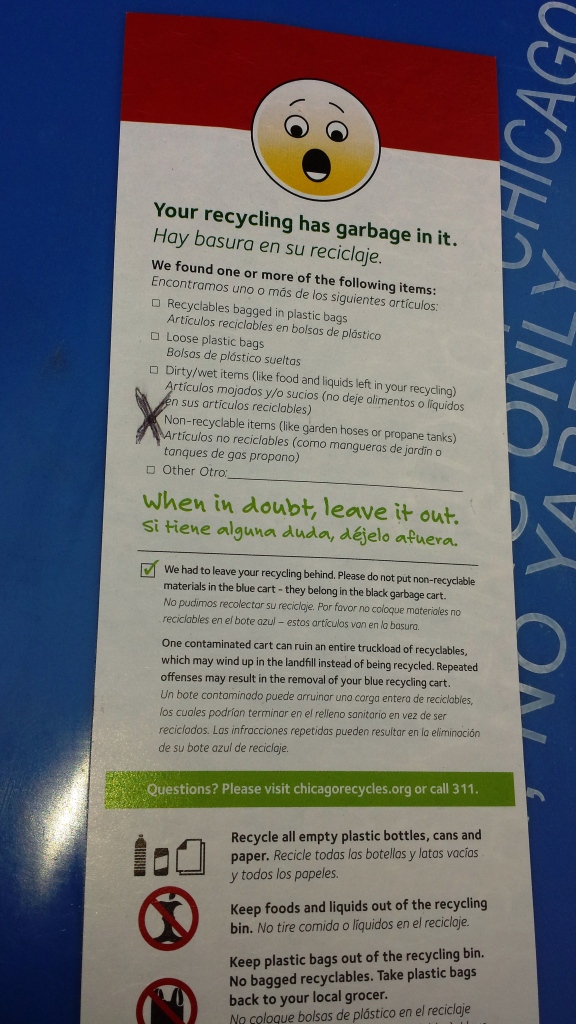
And the City of Chicago and its designated 'recycling' contractor, Waste Management, refused to pick it up. I got a sticker on my blue bin instead:


The big 'X' on the sticker claims that my recycling was rejected because it contained "[n]on-recyclable items (like garden hoses or propane tanks)."

Now I ask you: Do these look like propane tanks to you?

Could these plastic strips possibly be confused with garden hoses?

But the inability of the Waste Management driver to distinguish these strips from propane tanks is not the thing that made me really upset.

Have you noticed yet?

Look at the pithy slogan on the sticker again: "When in doubt, leave it out."

When in doubt, leave it out?

Seriously? Humanity is choking in its own waste and a recycling company, so called, is urging people to choose landfills whenever there's the slightest question about whether this item or that one meets City standards? What a load of garbage.

According to a recent story on WGN-TV news, "only about 10 to 12 percent of what is picked up [by Waste Management] is meeting the standards for the city’s recycling program. The garbage that doesn’t meet standards goes straight to the landfill."

Maybe some of my fellow citizens are not as fastidious as I am when it comes to separating recyclables from trash and preparing said recyclables for future re-use. OK, maybe. But, after last Friday, I am seriously beginning to wonder whether this recycling contractor is just being far too choosy. Waste Management's contract should be recycled.

Wednesday, November 5, 2014

What Mr. Rauner should have said to Mr. Madigan last night and other unsolicited advice to the Governor-elect

We have about 24 to 48 hours to digest the results of last night's election results before the mayoral race swings into high gear....

Photo of Mr. Rauner voting yesterday,
taken from the Glenview News website.
Bruce Rauner's own campaign workers booed during his victory speech last night when he mentioned that he had called House Speaker Michael J. Madigan and Senate President John Cullerton. The TV Talking Heads were quick to praise Mr. Rauner's gesture, unpopular as it may have been in the hotel ballroom, pointing out that Mr. Rauner, who had until that moment put Messrs. Madigan and Cullerton on a par with Beelzebub in all of his public pronouncements, will need their cooperation if he is to have any chance to accomplish anything in his gubernatorial term.

But the Talking Heads didn't speculate, at least on the channel I watched, about what Mr. Rauner may have said.

Don't you wonder?

Here's the gist of what I imagine Mr. Rauner might have said: Since I know you are bound and determined to have the General Assembly make the "temporary" 5% income tax rate permanent, could you please get this done before I'm sworn in? Yes, I know Mr. Rauner expended millions on commercials prophesying that Gov. Quinn would do just this were he to be re-elected. And Mr. Rauner swore he'd insist on the rollback -- but that was never realistic. He simply does not have the votes in the legislature to accomplish this. Messrs. Madigan and Cullerton could wait until the new year to make the 5% tax rate permanent, forcing new-Gov. Rauner to veto the plan -- he absolutely would have to -- but a veto override, though it would render Rauner an irrelevancy at the outset of his term, may not be so sure a thing, even in a supposedly veto-proof General Assembly. Legislators who barely survived tight reelection races may be understandably skittish. Were the veto of the 5% income tax rate to somehow succeed, the plutocrats who run the credit rating agencies, Mr. Rauner's natural allies, would have no choice but to further downgrade the state's already terrible bond ratings. On the other hand, if a lame duck General Assembly makes the tax rate no-longer-temporary, Mr. Rauner can fulminate to his heart's extent from the sidelines, but without necessarily incurring potentially fatal damage to his credibility.

But that's just my imagination. Mr. Rauner may not have asked. But Mr. Rauner has stated ambitions for school funding, for property tax freezes, and other things that will cost money. Putting the income tax rate back to 3%, as much as he says he wants to, would presumably deprive Mr. Rauner of the opportunity to do much of anything except cut and prune spending and services. As an experienced corporate takeover specialist, Mr. Rauner may feel he knows all there is to know about cutting and pruning. But he may find that the lessons of the private sector do not readily translate to the public sphere.

If Mr. Rauner's budget plans remain somewhat nebulous, Mr. Rauner nevertheless packs for Springfield with two fully-formed ideas, both of them stinkers.

Even last night, Mr. Rauner was plumping for his term limits plan. Actually, we have a perfectly good term limits plan in place in this country already. It's called an election. Elections don't work very well as a term limits plan in Illinois most of the time -- but the problem here is not with elections per se, the problem we have is that Speaker Madigan is such a gifted map-maker. He has redrawn legislative districts in such a way as to prevent meaningful election contests just about everywhere, maximizing the strength of the State's Democratic voters, minimizing the impact of the state's Republicans. This does not make Mr. Madigan bad or evil; he is merely taking advantage of what the current law allows him to do. Mr. Rauner's term limits plan would, if it could be enacted (which it can't), force Mr. Madigan to give up the post of House Speaker. But it would not take the map-drawing pen from Mr. Madigan's hand. A truly non-partisan map drawing commission, on the other hand, just might succeed. The recent attempt to put a constitutional amendment allowing just such a commission failed in court, but the court may have provided a road map showing how the defects in the proposal can be cured.

The other truly bad idea Mr. Rauner floats is his service tax proposal. Basically, he would extend the sales tax on tangible goods to intangible services... like attorney's fees or hospital bills. Maybe some of the big law firms could absorb such a tax -- it might require only a software tweak -- assuming that well-heeled corporate clients are still willing to pay whatever Big Law requires, but a service tax would be a disaster for small service businesses generally (and small law firms in particular). Good Lord, we have enough trouble getting clients to pay bills now -- and Mr. Rauner would have us try and collect an extra 5 or 6 or 9% for the benefit of the State? Impossible.

And, of course, a service tax, like a sales tax, is just about as regressive a tax as one can imagine. That means it impacts poor people far more harshly than rich folks. If Mr. Rauner wishes to buy a new Timex to replace the one he wore out in his commercials, the sales tax on that item is a negligible portion of his vast income. But the poor person who buys the same watch pays a far greater share of his income as sales tax even though he pays the same sales tax as does Mr. Rauner.

Please, Mr. Rauner, drop this talk of term limits and service taxes.

Thursday, October 25, 2012

State court efiling is nearly upon us. Let's have two cheers for efiling. Maybe one-and-a-half.

I find myself unable to work up a great deal of enthusiasm about the Illinois Supreme Court's announcement yesterday that brings us one step closer to efiling in all Illinois counties.

Chief Justice Kilbride says Illinois "is behind on using e-business and e-filing in its courts" and I won't argue the point.

My experience in federal cases reassures me that efiling has some advantages, chief among them the ability to file and serve a motion or brief by pressing a button. That is a distinct advantage for solo practitioners -- and I am one -- who otherwise have to endure 'down time' copying, assembling, sending, and filing documents.

But I have never used efiling in a Cook County case -- Cook County had a pilot efiling program predating yesterday's Supreme Court announcement -- and I hope I won't now be forced into using it anytime soon. Not when it costs $4.95 to file a document and the payment of any filing fee automatically incurs another 4% surcharge.

In the Federal system PACER seems to function well enough without massive per document surcharges. If we must go down this road -- and I fear we must -- why not go toward a PACER model?

But my tepid response to yesterday's announcement is not motivated solely by personal parsimony.

But I keep reading -- online and on paper -- that studies continue to show that people don't read things on screens the same way as they read paper. A quick Google search this morning (because that's how things are done now, right?) pulled up these interesting articles (none of which I'd seen before) on the topic: "Do E-Books Make It Harder to Remember What You Just Read?", by Maia Szalavitz, posted on Time Health & Family, March 14, 2012; Does the Brain Like E-Books?, New York Times, October 14, 2009; "Our 'Deep Reading' Brain: Its Digital Evolution Poses Questions", by Maryanne Wolf on Niemann Reports, Summer 2010.

I would sum up my reading (today and previously) this way: Most of us -- even those of us who live increasingly online -- feel, on some level, that screens are for ephemera -- LOL cats and water-skiing squirrels, bad jokes, inconsequential emails and, yes, blog posts. Serious stuff needs to be on paper. At least, a lot of us read paper more carefully and more critically.

Now, of course, those of us who feel this way may be a dying breed -- or, more optimistically, perhaps we can look forward to working through a transition period from which we will ultimately emerge able to read screens with the same intensity and care as we now read paper.

Great.

And in the meantime, our most carefully thought-out work product, the briefs and motions that we lawyers prepare, will be reduced to pixels on a screen, to be read by a judge who may or may not have mastered this hoped-for digital transformation.

Can this really be good for us lawyers... or for our clients?

Also, I could not help but note the restrictions on discovery filings. In Cook County, a lot of us still file our discovery responses with the court -- it saves arguments down the road about who served what when. That may no longer be possible under any standardized efiling regime. Yes, it works in Federal court, but in Federal court one denies receiving documents that he or she has in fact received at some substantial peril.

I said I would not argue that our courts are behind in matters of e-business and e-filing. But I am tempted to believe that this is not necessarily bad.

Sunday, October 7, 2012

You can't believe everything on the Internet... or on TV... or in the newspaper, for that matter. Now what?


State Farm has an amusing commercial in heavy rotation these days poking fun at its Internet-dependent competitors -- and making the more general point that not everything you see online is credible.

Yeah, who'd have guessed, right?

But TV news is no better. Watch two TV stations tonight and you'll see different stories covered or, frequently, the same story covered with two different spins. Sometimes the differences are subtle. Other times, though....

I've often heard it said that the closer one is to a news story, the more errors one finds in the news coverage. Many lawyers have had the experience of becoming involved in a case only to see news coverage that, in the lawyer's opinion, completely distorts the facts of the case. (The converse of this rule is also true: The further away one is from a story, the easier it is to believe the news coverage. This is why presidential candidates know all about how to solve problems in Iran, Afghanistan or Guantanamo -- and why presidents often find the same problems extraordinarily difficult. This principle is also an extension of the more general one, "where you stand depends on where you sit.")

In these days of YouTube and Hulu and iTunes it is often possible to diagnose the "spin" that this reporter or that columnist or blogger puts on a speech or news conference. If a person could only take the time to investigate the original sources on any interesting event, he or she could reach a truly informed opinion. He or she would also be unable to hold a job... or sleep much.

The temptation is to think that this sort of news 'spinning' is new.

It is not.

Some of the terms are new, but news reporting has never been an exact science. Here is a case in point.

I found these clippings among my late father's effects. His mother had saved these when her husband died -- in March 1946. I can't tell you which newspapers these clippings are from. Only these scraps were saved.

But look at the discrepancies in these three accounts of the same event. In reporting my grandfather's death, my grandfather's brother is named Daniel Lyons; in another, Daniel Leyhane; in the third, Daniel is given no last name at all. Actually, Daniel's surname was Lyons and my grandfather was really named Leyhane -- and, no, they weren't half-siblings, the family name was changed by my grandfather's parents at some point, perhaps -- so family legend has it -- to enhance another of my great-uncle's chances to enter the Seminary). My grandfather's age varies from story to story. His age is given variously as 42, 48 or 51. My father's age is mentioned only in one story. There, his age is given as 18; actually, he was then 20.

It's just a little story, a sad reminder of the risks that firefighters take, but really important only to the families involved. There was no interpretation needed here, no 'spin,' just objective facts that could have been ascertained. And weren't. Not quite.

Just something to think about as you watch the news or read a newspaper.

---------------------------------------------------------------------------------


See also, Chicago Fire Department Line of Duty Deaths.

Thursday, July 19, 2012

On political blogging: choosing a role model

There are a great many Benjamin Franklin Baches out there -- but a bare handful of Benjamin Franklins.

If you aspire to be a political blogger, which one should you imitate?

And, if you don't even know who Benjamin Franklin Bache was, should you really be inflicting your opinions on the Blogosphere?

Tuesday, February 14, 2012

Arbitration cases are tried under very different rules

Judge Russell W. Hartigan, who is unopposed in his bid for the countywide Moran vacancy in Cook County, nevertheless took the time to respond to a questionnaire propounded by the Illinois Civil Justice League. One of the questions posed was this:
Are there civil litigation reforms that you would like to see enacted to remedy particular problems that you have detected, either as a practicing lawyer or as a sitting judge? Are there reforms that would benefit the civil justice system? What needs to be changed? Should the enactment of any such changes be the province of the legislature, the Supreme Court or by Constitutional amendment?
Judge Hartigan responded:
If an arbitration award is rejected and the case goes on to a jury trial, if the verdict does not exceed the arbitration amount, then some fine or penalty should be assessed. Too many rejections of arbitration awards for no legitimate reason are clogging the court system. The legislature would have to address this issue.
With respect, this approach would make some sense if plaintiffs were routinely rejecting arbitration awards and trying for larger awards before juries. It would make even more sense if plaintiffs were securing larger awards from allegedly generous Cook County juries.

But this is not how things work in Cook County.

Instead, contrary to Judge Hartigan's supposition, it is more often the defendant that rejects the arbitration award, forcing the plaintiff to the expense of trial. (I have observed this pattern of automatic rejection for years because I've served as an arbitrator in the Cook County Mandatory Court-Annexed Arbitration system since it started here, many years ago.) Not all defendants reject arbitration awards, of course, but litigants whose defenses are controlled by sub-standard insurers almost always do.

And the plaintiff, who has already been punished by being saddled with the extra expense of preparing for trial as a result of the rejection, typically winds up with less at trial than he or she was awarded at arbitration. Many times he or she winds up with nothing at all.

Kind of puts the fabled generosity of Cook County jurors into question, doesn't it?

But there's actually a very good reason why plaintiffs tend to recover less in Cook County jury trials than they do at arbitration: The arbitration and the trial are conducted under very different rules.

At arbitration, the plaintiff's medical records and bills are presumptively admissible under Supreme Court Rule 90(c). The original rule has been refined to require a plaintiff to specify whether a given medical bill is paid or unpaid, the latter opening the door, at least, to the argument that the amount of a particular bill is unreasonable. But this is a far lower burden than a plaintiff faces at trial, where the testimony of some medical provider must be provided, either live or by evidence deposition, to secure the admission of these vital pieces of evidence. The stack of paper that we practitioners call a 90(c) packet is not subject to cross-examination. The medical professional that generated those records and bills, the one who must be produced for trial, can be cross-examined. The 90(c) packet cost the plaintiff whatever the doctor charged for reproducing his or her records; you can bet that the doctor charges lots more than that to appear for trial or even for an evidence deposition. These additional costs are penalties enough for going to trial.

Whether judges, lawyers, or litigants like it or not, there is a very good reason why the sub-standards routinely reject arbitration awards: They can expect better results at trial. Imposing still another penalty on the party who recovers a meaningless award at arbitration will not deter sub-standards from the automatic rejection of arbitration awards; indeed, it would provide only another economic incentive for the sub-standards to be intransigent.

If the Supreme Court wishes to line up arbitration results with those reached after jury trials, it should think instead about tightening the requirements for admissibility under Rule 90(c). Of course, that would defeat the cost-savings that arbitration is supposed to provide over trials, but that's an issue for a different day.

----------------------------------------------------------------------
Related: ICJL begins posting responses to questionnaires

Wednesday, January 4, 2012

Proposed statewide ban on cellphone use while driving a generational issue? I think not

Mr. Gregory Tejada, the proprietor of the Chicago Argus, writes a thoughtful piece today about a proposed statewide ban on using a cellphone while driving entitled, "We're in for generational warfare, and I'm on the side of the 'old farts.'"

Mr. Tejada would support a statewide ban. The Capitol Fax blog, however, reports this morning that State Senate President John J. Cullerton has "kind of gotten away from being the main sponsor" of a statewide ban, though, he adds, he thinks such a ban may be "inevitable."

When such a ban does come before the General Assembly, Tejada writes, "we're in for a serious battle of the generations. I couldn't help but notice in the couple of hours after stories started cropping up on the Internet about Cullerton's comments, one anonymous person went so far as to characterize a ban on cellphones while driving as being the same as banning breathing while driving."

Mr. Tejada supposes that people on his side of the generation gap would favor such a ban.

I would not. Herewith my reasons:

We allegedly have a ban on cellphone use while driving here in the City of Chicago. I have stood outside City Hall, however, waiting to cross LaSalle Street, watching driver after driver cruise by, cellphone in hand. I've seen policemen in squad cars chatting on cellphones. I challenge anyone to drive down any arterial street or expressway in the corporate limits of the City of Chicago and compare the number of drivers talking on the phone with those apparently not talking on a phone. I'd suggest you'd find that, many times, a clear majority of drivers are chatting away merrily.

I can't imagine who all these people are talking to. Like Mr. Tejada, I see little reason to use a phone while driving. I will admit, however, to answering the phone, if it rings, or even, on occasion, to making short calls -- "I'm running late," for example, or, "I'm stopping for gas before I get home." If the call will require more attention than that, however, I have no problem telling a caller, "Look, I'm in the car. I'll call you back in a bit."

Mr. Tejada writes that he has noticed on a number of occasions "drivers who were busy yakking away on their hand-held communications devices" who "weren't paying attention and would have hit me had I not managed to engage in a sudden maneuver."

So have we all.

That is the reason why the City ban was imposed and the statewide ban proposed.

But the proposed solution fails to address the problem.

Cellphones are not the problem.

Distracted driving is the problem.

Mr. Tejada writes about generational disagreement. Let's get generational here. A generation ago, when I was preparing for my driver's license exam, the instructors warned me not to turn on the car radio during the road test. "That's an automatic fail," I was told.

Why? Because the grumpy old people in those far-off days feared that idiot kids like me would pay more attention to the radio than the roadway -- pushing buttons between WLS and WCFL to avoid an acne commercial or to catch a snippet of some new-favorite 45 rising up the charts.

Distracted driving.

I'd bet that, like me, Mr. Tejada has seen drivers applying makeup behind the wheel, or shaving, or eating, or even reading a book or newspaper. If the Kennedy is moving slowly enough, it is even possible that these actions aren't necessarily all that dangerous.

Driving requires concentration. The degree of concentration required varies with the weather. On mornings when I drive, for example, I like my cup of coffee. If road conditions are hazardous, the coffee must be put aside, however.

We can't ban everything that might distract a driver. Yes, "yakking" on a cellphone might be distracting, but a crying baby or a talkative car pool passenger who wants you to attend his church "just this once" might be just as distracting -- yet we don't propose to ban carpools or transporting babies.

I agree that texting while driving is necessarily distracting, even for young drivers who can change focus far faster than their elders: When someone is looking at a keypad, he can not be looking at the road. But even texting is not an evil per se. I might have heard a beep while driving and taken a quick peek at the screen when stopped at the next light. I might have even punched out a quick acknowledgement -- "OK," for example -- while waiting for the light to change. Nobody has to "engage in a sudden maneuver" to avoid me at that moment, since we are all stopped at the light. Yet, if a policeman happened to be observing me at just that moment, I could be ticketed under the Chicago ordinance.

In other words, I can violate the law without engaging in the kind of conduct the law was designed to prevent, namely, distracted driving.

In that sense, the law is overbroad.

And cellphone and texting bans are necessarily enforced only selectively. Clearly these laws are not always enforced, which opens any attempted enforcement up to claims that the law was purposely enforced on any given occasion simply to harass (pick any or all) young people, persons of a certain ethnicity, or persons of a particular sexual orientation. Yet there is no way to enforce these bans regularly or uniformly. Aldermen or legislators can pass all the bans they please but, unless the clear majority of the public is favor of the ban, it will be ignored (see, Prohibition). It is my observation that the cellphone ban is largely ignored in the City of Chicago. What's yours?

Laws that are not, or can not be, enforced consistently and uniformly and which are ignored, undermine public confidence and respect for the law generally. As a lawyer, I consider this the most harmful and dangerous thing of all.

Yet, I agree with Mr. Tejada that distracted driving is an evil that the state should attempt to prevent. I'd suggest we reconsider specific bans about doing certain acts that may or may not be distracting and create instead a blanket offense of distracted driving. A police officer who observes a driver whose erratic movements, drifting, or velocity (too slow or too fast) is causing other drivers to 'engage in sudden maneuvers' can pull that driver over. Maybe the driver is distracted by an intense phone conversation. Maybe the driver is texting. Maybe the driver is distracted by an argument with a passenger or by a radio program expressing views diametrically opposed to those of the driver. Maybe the driver is distracted because he is carrying a large quantity of illegal drugs. Who cares? The danger to the others on the roadway is the same regardless; it stems from the driver's distraction, not from the cause of that distraction. (If the police officer has a dashboard video, he or she may even have the opportunity to document the behavior before making the stop -- but that's another essay altogether.)

------------------------------------------------------------
See also: Chicago Argus on banning cell phone usage for drivers... (essay by Levois on It's My Mind)

Saturday, April 23, 2011

Mommie Dearest: Earth can be one mean mama

This beautiful photograph of Mother Earth was taken earlier this month by NASA astronaut Ron Garan, now in residence aboard the International Space Station. Mr. Garan is currently blogging from space on a site called Fragile Oasis, a site he shares with three other NASA veterans. I learned about Garan's efforts (and obtained this photo) from Denise Chow's April 21 article posted on OurAmazingPlanet.com. Chow writes that by "shining a light on Earth from space, Garan and his colleagues hope to mobilize people to improve the conditions on our fragile planet."

This is a wonderful goal and entirely appropriate for this Earth Day weekend.

We should work together to protect our home.

But we must also worry about how to protect ourselves from our home -- and this Earth Day season seems as good a time as any to remember this.

A lot of politicians and pundits are obsessed with "climate change." This used to be called "global warming," but "climate change" tests better in markets experiencing unusually cold weather, such as we've had in Chicago of late.

Climate change was before the U.S. Supreme Court just this week, in American Electric Power v. Connecticut, No. 10-174. The Court was reportedly skeptical about whether courts are proper places to address such complicated issues.

The Court's apparent skepticism seems quite appropriate to me. I am no climate change denier; the one constant of Earth's climate throughout time has been change. At different times in pre-history, Earth has been completely covered in ice and completely ice-free. Inasmuch as we weren't here yet, humans had nothing to do with these extremes. Climate fluctuations in the relatively brief time that humans have clung to this floating rock have been linked to any number of human tragedies, including the French Revolution, the Viking terror raids on Britain and elsewhere, and the collapse of the Mayan Golden Age. Humans were not driving SUVs during any of these events. If everyone switches to Priuses tomorrow, Toyota stock might soar, but climate change would continue.

Interestingly, while the courts, the EPA and the states wrestle with how best to regulate carbon dioxide (fingered, not so many years ago, by a still-nascent science as the key culprit in climate change), science may have moved on to another suspect: Soot. A nearly invisible layer of soot, released into the atmosphere from autos, trucks, airplanes and coal or wood-burning all over the world, is collecting in the Arctic, absorbing sunlight and contributing to record warmth (and ice melt) in that region. The AP reported just a couple of days ago that scientists now believe "that cutting the concentration of short-lived pollutants, such as soot, will reduce the rate of warming in the Arctic faster than cuts in carbon dioxide and other greenhouse gases, which last far longer in the atmosphere." This one seems obvious in retrospect. Anyone who's watched the difference in the rate of snow melt on asphalt as opposed to grass could figure it out -- if they knew that soot was accumulating in the Arctic.

But if all the soot from every car and power plant in the world could be scrubbed from the sky tomorrow, climate change would still continue. The Earth may be our mother, but she's often an indifferent one.

And, of course, she might kill us at any time, too. Folks in Japan recently received a harsh reminder of this sad truth.

And earthquakes, tsunamis, hurricanes, tornadoes and even plain old ordinary volcanoes (e.g., Mt. St. Helens) aren't the worst things that Mother Earth can hit us with. The eruption of the Toba supervolcano in Sumatra, around 74,000 years ago, seems to have caused an immediate global winter followed by an ice age of a thousand years or so. Some scientists believe that the Toba eruption may have also caused the near-extinction of the human race. The event has been linked, by some, to a 'bottleneck' in human evolution.

There's a supervolcano in our own backyard which erupted 1.2 million years ago and 640,000 years ago. We call it Yellowstone National Park. Scientists recently announced that the "gigantic underground plume of partly molten rock that feeds the Yellowstone supervolcano might be bigger than previously thought."
The volcanic plume of partly molten rock that feeds the Yellowstone supervolcano.
Yellow and red indicate higher conductivity, green and blue indicate lower
conductivity. Made by University of Utah geophysicists and computer scientists,
this is the first large-scale 'geoelectric' image of the Yellowstone hotspot.
Credit: University of Utah.
Eventually (though presumably not next week) Yellowstone will erupt again.

So let's celebrate Mother Earth on Earth Day and every day and do what we can to preserve our home. But let's not forget the need to keep learning how to figure out how best to preserve ourselves and our posterity from Mommie Dearest.

Thursday, January 6, 2011

Baseball Writers blow it again: Baines dropped from HOF ballot

Hawk Harrelson will have to get some new talking points when the Sox play the Twinkies henceforth, now that Bert Blyleven has been admitted into Baseball's Hall of Fame. By now, everyone in the world who cares knows that Messrs. Blyleven and Roberto Alomar are slated to be enshrined in Cooperstown. Both are worthy, deserving inductees.

But less well reported is the fact that the BBWA, the Baseball Writers of America, the self-righteous guardians of baseball's Valhalla, saw fit to give Harold Baines only 28 votes this year, only 4.8% of the vote, meaning he'll be dropped from the Hall of Fame ballot.

Here are the 2011 Hall of Fame voting results (source; click image to enlarge and/or unblur):


Bill Veeck took credit for 'discovering' Baines, but I believe it was Paul Richards who first predicted that Baines was destined for Cooperstown. Now, sadly, he'll have to wait for the Veterans Committee. If Ron Santo were still around, Santo could give Baines an earful about that process.

Yet, Baines has 1,628 career RBI, the most of any player eligible for the Hall who has not been enshrined. A six time All Star and winner of the Silver Slugger in 1989, Baines had a 22 year career in the major leagues. He had 2,866 hits.

Of course, the knock on Baines is that he was a DH for most of his career -- and this, sadly, is true. After 1986, until his retirement in 2001, Baines played only 81 games in the field.

But let's look at that: Baines played only 81 games in the field in his final 14 years in the majors because his knee was gone. In other words, most of Baines' 2,866 hits came from an essentially one-legged batter.

There are few players in Major League history who had better careers than Harold Baines. Nearly all are in the Hall of Fame. And they had two legs.

The Baseball Writers of America have blown it again.

Friday, August 27, 2010

Technology may be the ruin of baseball

And don't get me started on video games... you haven't lived until you've been to one of your kids' games and the kids refuse to adjust to the umpire's strike zone -- because the umpire's strike zone that day isn't the one defined in the rulebook -- and built into the microchips.

And instant replay would not be any better.

In my opinion.

----------------------------------------------------------------------
Pardon My Planet appears in the Chicago Sun-Times. This image is from the Houston Chronicle.

Saturday, July 10, 2010

This would be funny -- if it weren't so true

From the webcomic xkcd, by Randall Munroe.

Saturday, May 15, 2010

Is America lost in space?

(The final planned launch of Shuttle Atlantis,
May 14, 2010. From NASA.)

After STS-132, now in orbit, there are just two more planned American civilian spaceflights left. (The Air Force still has the unmanned X-37B program; a successful launch of the new vehicle was made on April 23.)

There will still be Americans in space, for a time at least, after the Shuttle is retired: American astronauts will continue to rotate to the International Space Station as passengers on board Russian vehicles. And President Obama says our outer space goals should be reconfigured: Instead of returning to the Moon and going next to Mars, as President Bush had proposed (and Congress had approved), we should head straight to Mars. Future flights in Low Earth Orbit should be privatized, with NASA becoming more FAA than the owner-developer-operator of all American space technology.

But this is a cloudy vision. While Mr. Obama's plan has some support among space scientists, many of our surviving lunar explorers are strongly opposed. (Here is a link to Neil Armstrong's written testimony before the Senate Committee on Commerce, Science and Transportation this past week.)

The problem with Mr. Obama's vision -- aside from the fact that it flushes billions of dollars already spent on developing vehicles and logistics for the now-scrapped return to the Moon -- is that it comes with no guarantees whatsoever. The Mars program is off in the distant future. The only upcoming tangible goal is for a new 'heavy lift' rocket to come on line in 2015 -- and that's because the development of this vehicle was part of the lunar program. Eugene A. Cernan, the last man to walk on the Moon, who testified with Armstrong before the Senate this week, said, "Nowhere do we find a commitment in dollars to support this national endeavor.... [T]his budget proposal presents no challenges, has no focus, and in fact is a blueprint for a mission to nowhere."

And then there's the question of privatizing LEO flights. In theory, this is a fabulous, long overdue idea. But... who will be allowed to fly? Low Earth Orbit is a crowded place; it's not just Hubble Telescope and the International Space Station up there, there are lots of satellites and lots of debris, too. Traffic has to be regulated to prevent collisions. Also... there's no place to go in LEO. There's up... and there's down. Entrepreneurs aren't being invited to hook up their own modules to the ISS... which would be the outer space equivalent of building a trading post outside the fort.

If you follow all the links here, you'll read that Mr. Obama's plan proposes an increase in NASA funding. But politicians do weird and wonderful things with budgetary numbers. Mr. Armstrong says the prior plans were never funded as they should have been, so comparisons are unfair. And who's to say whether Congress, in a time of soaring national debt, will supply the dollars Mr. Obama has requested.

By the way, this is not a Republicans vs. Democrats issue -- at least not for me. I think it just has to do with rotation in office: It was Richard Nixon who scrapped the last several moon flights. I suspect that each administration comes into office determined to undo everything its predecessor has done. Kennedy wanted to go to the Moon, so Nixon wanted to stop going (at least after he'd milked the PR value of Apollo XI). Bush II wanted to return to the Moon, so Obama was against it.

There is an attitude in this country that our manned spaceflight program is simply an obsolete relic of the Cold War. That's the attitude taken by Sun-Times columnist Neil Steinberg yesterday. He concluded:
Will it sting us to see Chinese astronauts joyously waving streamers attached to sticks, doing that running dance of theirs on the surface of the moon? Absolutely. Does that mean we must be square dancing one crater over? No way.
As an old history major, all I know is that, in the 1490s, the Pope divided the whole unknown world between the Spanish and the Portuguese. These were the major world powers then, and the leaders of global exploration. They quibbled over the Pope's line of demarcation, eventually moving one of the lines west, which may... or may not... have given Portugal its claim on Brazil.

Meanwhile the Dutch and, soon after, the English, were ramping up exploration programs of their own. And England set up shop in North America where our forefathers brought forth a new nation, conceived in liberty, and dedicated to the proposition that all men are created equal. Portugal regrouped. It consolidated. Bottom line: Portugal stopped exploring; England did not. We are -- America is -- the result. Today, Portugal is a lovely place that exports cork and wine and constitutes the next biggest threat to the euro after Greece.

America may not control space. No terrestrial nation will, not in the long term, because all of us here are at the bottom of a big gravity well and space is the ultimate 'high ground.' But we can choose whether we want to be England... or Portugal.

I vote for England.

Monday, January 25, 2010

What I've learned... or what I think I've learned... from the 2010 judicial campaign

Taking a Republican ballot on Groundhog's Day effectively deprives a voter of the opportunity to vote for judges in Cook County. There are only two Republicans who filed for any Cook County judicial vacancy (both in the countywide McCarthy vacancy, in case you want to look). That means, with that sole exception, the winners of the Democratic primary races on February 2 are effectively elected. (There are no Green candidates either.) I think that this situation strongly indicates the need to make judicial primaries non-partisan -- so that anyone voting in the primary can vote for any judicial candidate.

Voters who do take the time to investigate the credentials of Cook County judicial candidates will, on balance, be pleasantly surprised at the overall quality of the people offering to serve. In some races, voters may find it genuinely difficult to choose from among several good candidates. While this year, as always, there are some candidates who have shunned the bar evaluation process, the trend seems to be toward participation. That's a good thing.

Even in uncontested races, candidates have submitted to bar association screening. That hasn't always been the case: In prior elections, some candidates who knew they'd be uncontested didn't bother to seek evaluations. In three of the four uncontested judicial races this year, though, the candidates not only participated, they were found recommended or qualified by each of the investigating bar groups. These candidates are Daniel Gallagher in the Democratic primary for the McCarthy vacancy and Judges Thomas V. Lyons (countywide O'Malley vacancy) and Daniel J. Pierce (14th Subcircuit "A" vacancy). The fourth uncontested candidate, Bonita Coleman-John (1st Subcircuit "A" vacancy), also participated in the bar screening process and was found recommended by the Cook County Bar Association and the Black Women Lawyers Association of Greater Chicago.

This is the second time I've tried to cover a Cook County judicial primary on For What It's Worth. I undertook this project because I did not think that most Cook County Circuit Court candidates had the opportunity to get their messages out to the voters and most voters did not have anywhere to look for information about Cook County Circuit Court candidates as a whole.

This landscape has changed -- for the better -- since 2008. In 2008, there was IllinoisJudges.net and For What's It's Worth. We're both still at it this year. But there's a lot more available this time around. This year, the Tribune not only collected questionnaires from judicial candidates seeking the paper's endorsement, it published these online. And a new service, eVoter.com has sprung up this year. The site compiles a list of all the candidates in all the races. For a fee, candidates can post all their information right there on the eVoter sample ballot. In December, when I first wrote about it, only one Cook County judicial candidate had signed up for eVoter. By the time I finished compiling my Organizing the Data posts this weekend, several more candidates had jumped in. I wouldn't be surprised if more do between now and the primary next week. I'll predict right now that, if eVoter survives, most judicial candidates in 2012 will participate.

------------------------------------------------------------
Related posts:
Endorsements versus Evaluations
What Circuit Court race are you looking for?


See also:
Alliance of Bar Associations - updated grids
Chicago Bar Association 2010 Green Guide
Chicago Council of Lawyers Report on Judicial Candidates in the February 2, 2010 Primary