Showing posts with label Chicago. Show all posts

Thursday, February 22, 2024

Looking at the Bring Chicago Home "mansion tax" proposal

The first rule of taxes is, once they are invented, they never go away.

The proposed increase to transfer taxes by the pols behind the "Bring Chicago Home" movement illustrates this proposition perfectly. But to demonstrate this, we must first jump back in time some 259 years.

In 1765, representatives of nine of Britain's North American colonies met in New York City to discuss ways in which they could protest the British Parliament's imposition of several new taxes on the colonies. Perhaps the most unpopular of these, the Stamp Act, required colonists to buy stamps that had to be affixed to any document, including deeds, playing cards, and newspapers. This act was enshrined forever in the name historians gave to this first continental gathering, the Stamp Act Congress.

You may recall hearing about this during your school days. You may even recall that the British Parliament repealed most of their colonial taxes, including the Stamp Act, the following year.

But the Stamp Act never really went away. It no longer applies to playing cards or newspapers, and it is no longer paid to the British Crown, but every time a piece of property is sold in the City of Chicago, taxes are imposed, and stamps printed and affixed to the deed, showing that the transfer tax has been paid, in order for the transfer to be legal. (The County has its own stamps, too.)

It is this tax that Bring Chicago Home proposes to increase... but only on properties sold for more than a million dollars. The tax currently is $3.75 for every $500 of sales price -- or $7,500 on a million dollar sale.

The tax would go down to $3.00 for every $500 of sales price for sales up to a million -- so $6,000 on our hypothetical $1 million sale.

But the tax would go up to $10 for every $500 of sales price for betweeen $1 million and $1.5 million. Under existing law, the City gets $11,250 from a $1.5 million sale. Under the Bring Chicago Home proposal, the City would get $16,000 -- $6,000 on the first million, $10,000 on the next $500,000.

The transfer tax would go up still more for sales of more than $1.5 million. For each $500 of sales price north of $1.5 million, the City would get $15. So, assuming a sales price of $2 million, the City would get $15,000 in stamp tax under existing law, but $31,000 under Bring Chicago Home -- $6,000 on the first million, $10,000 on the next $500,000, and $15,000 on the $500,000 after that. (For more, see this WBEZ summary of the proposal).

Anyone can see how these new numbers could add up quickly. But, if the tax only impacts folks like Gov. Pritzker, should he decide to sell his Chicago mansion, who cares, right?

A lot of people on either side of the graduated transfer tax proposal are calling this a "mansion tax." But it will apply to a whole lot more than just mansions.

A quick search this morning of chicagorealestatesource.com, a Coldwell Banker site, shows that a 58-unit SRO hotel at 2847 W. Washington Blvd. has just gone on the market for $1.74 million. A 9-unit building at 3039 N. Harlem is on the market for $1.375 million. Another 9-unit building, at 3145 N. Nordica, is also available for $1.375 million.

This 6-unit building (one storefront and five apartments) at 904 N. California, pictured at left, is available for $1.319 million. An 8-unit building (two storefronts and six apartments) at 2232 W. Irving Park Road is new on the market at $1.599 million.

For $2.2 million, according to chicagorealestatesource.com, you can buy a 9-unit building at 1143 N. Rockwell St. A 7-unit building at 3226 W. Potomac is available for $1.599 million.

There's not a Pritzker or a Rauner or a Ken Griffin living in any of these.

Not all the multi-unit buildings on chicagorealestatesource.com are listed for more than a million. A separate page of 2-5 unit buildings seems to show most Chicago listings are priced under a million. A 9-unit building at 3064 E. 79th St. is listed for $950,000. Another 9-unit building, at 7363 S. Coles, is on the market for $975,000. A six-flat, at 1854 S. Fairfield, is on the market for $875,000.

But this is more a six-flat tax than a mansion tax. And it will be people who buy and sell apartment buildings, and, ultimately, the people who rent from people who buy and sell apartment buildings, who will shoulder any burden from this proposed new tax.

The linked WBEZ article, above, links to a paper issued by some experts at the University of Chicago. The paper claims, according to WBEZ, the "tax increase’s impact on rent would be minimal with 'a unit that currently rents for $1,000 per month... likely to see an average rent increase of less than $1.'"

These are some experts. Where can anyone get an apartment in Chicago for $1,000 a month? Apartment.com recently said, "As of February 2024, the average rent in Chicago, IL is $1,777 per month. When you rent an apartment in Chicago, you can expect to pay about $1,421 per month for a studio, $1,777 for a one-bedroom apartment, and around $2,249 for a two-bedroom apartment. If you opt for a three-bedroom rental, you could pay $2,742 or more."

Opponents of Bring Chicago Home, like Protect Chicago Homes, a group of Realtors, offer a parade of horribles, about who will be taxed next, and how much, and question whether we can trust the current City administration.

And maybe these are all valid questions.

But maybe the question for Chicago voters on March 19 is not 'who will pay the next tax' but, rather, who will really pay this one?

Thursday, September 7, 2023

Musing about Committeepersons in the Bad Old Days and their role today


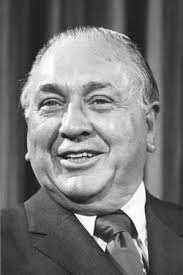
Letters. If people remember anything about what Democratic Party Committeemen (they weren't "committeepersons" then) did during the Bad Old Days (for our purposes we'll use this phrase to refer to the reign of Richard J. Daley, pictured here), they'll remember letters.

A letter from one's home committeeman was necessary in order for one to be considered for any public sector job -- and not a few private sector jobs, besides. (What? You think Madigan was the first pol to place people with ComEd?)

Of course, there were LETTERS and there were letters back in the day. The latter got you an interview, but no guarantee of a job, and no guarantee you'd keep the job if you did get it. Some people moved up in public careers without ever getting a new letter after the first one. Persons with particular skills were always needed (still are) to decipher the books, or keep the machines running -- but, if you went back far enough in the employment history of anyone of a certain age, there was sure to be some sort of a letter in there somewhere. If not every one of them, darn near anyone who ever wrote letters at one time had a letter of their own.

And, of course, those persons blessed with LETTERS were pretty much assured of guaranteed employment from the person to whom the letter was directed. Some didn't even need to show up for work at all in the Bad Old Days -- not as long as they worked their precinct anyway, and so long as they didn't run afoul of their clout.

But letters, as important as they were, were not the currency of the Old Machine. They were just a means to an end, that end being: Jobs. Every Committeeman in the good graces of Richard J. Daley had a certain number of jobs that could be doled out to top precinct captains or assistants. The number varied from ward to ward. Critics of the patronage system have correctly noted that committeemen in certain ethnic communities had control of more and better jobs than other committeemen, though the voters in these less favored neighborhoods were no less numerous, and perhaps even more reliable. The 11th had more jobs than anyone, of course, because that was Da Mare's ward.

A committeeman might distribute his jobs solely to relatives and friends, or perhaps to those willing to give the committeeman a 'taste' of every paycheck. This was corruption, surely, and some people eventually went to jail over this kind of misbehavior but, more important, from a party organization standpoint, it was bad politics.

The purpose of any party organization in our system, in the Bad Old Days and now, is to win elections.

In the Bad Old Days, the committeeman was supposed to use his jobs to build a reliable cadre of precinct captains. One was not supposed to waste a LETTER on someone who did not know how to work his assigned precinct or precincts.

And while there may have been (and often were) all sorts of other activities (good, bad, criminal, or merely questionable) involved in precinct work, one core function was what today we would consider "polling." The committeeman was expected to find out how his ward would perform before the election; his captains would tell him what the results would be before any votes were cast. And they'd all better be right. All their jobs depended on it. (I have used 'ward' here on purpose; there were committeemen in the townships even in the Bad Old Days -- Da Mare rather quaintly referred to them as the county towns -- but the expectations, and the corresponding opportunities, were far fewer.)

I was still in college when Richard J. Daley died (December 20, 1976 for those of you who might have grown up elsewhere). I'd been at a prayer breakfast he attended just a couple of weeks before he dropped dead in his doctor's office. But there had been 3,000 or so others present for that same breakfast, and I was seated about a mile away from the head table, so I believe I can confidently disclaim any blame.

Anyway, someone decided that the 1977 St. Patrick's Day Parade would be a proper vehicle for public mourning of the fallen Boss. I gather that every Committeeman was asked to do their part. Certainly the 49th Ward, where Neil Hartigan was Committeeman, wanted to make a big impression. The net was cast so wide even I got hauled in.

Hartigan (not yet Attorney General -- he'd just been defeated for reelection as Lieutenant Governor) wanted to involve Loyola students in the 49th Ward's parade unit. I was the student body president. The head of the Loyola College Democrats, who was a neighborhood guy and active in the 49th Ward Organization, thought it would be a good idea for me to accompany him to a meeting with Hartigan. I guess my participation would supposedly make the school's participation more official. Looking back, I can only imagine what the Jesuits would have said about that.

But I went to the meeting, at the old Elks Club, at Ridge and Thome, right behind Misericordia. I'd helped build floats for Homecoming parades when I was in high school in the suburbs so I knew something about twisting paper napkins in chicken wire and making it look like something. More or less, anyway. I'd never been to the St. Patrick's Day Parade, but this all seemed like great fun until Hartigan asked me point-blank, "How many students will you turn out?"

I was heading to law school by then, although I don't recall whether I'd been accepted or not. I gave, what seemed to me, to be a good, lawyerly answer, "Well, sir, it depends."

I prefer to think that Hartigan regarded me more with pity than with scorn. But it might have been either. He tried again, more slowly this time: "How many students will you turn out?"

Completely rattled by the fact that what I thought was a good and sufficient answer had obviously fallen so flat, I babbled on (and on) about, well, the parade would take place right around midterms, and then there's the weather, of course, more if the weather's nice, but not so many if it's cold or rainy.... Finally, the guy who brought me elbowed me, or stomped on my foot, or gave me some other, similarly subtle signal to please shut up, and, as soon as I paused, blurted out "250."

Hartigan, satisfied at last, moved on to whatever other business needed attention.

I kept my temper until my host and I were headed back to campus. "Why the Hell did you say we'd get 250 people?" I might have used other adjectives and adverbs, but this was the 1970s and language was kinder and gentler then.

"It'll be alright," my host assured me. "He just needed a number." He elaborated: "This wasn't an important number -- like how many votes you'd turn out in your precinct on Election Day -- it was just a number." (In the end, we did turn out at least 250 people, not all of them capable of standing on their own by the time the parade actually started, but these were shunted into the middle of the mass of flesh moving down State Street. Honor was satisfied.)

That was as close as I ever came to providing numbers for the Old Machine, important or otherwise. I also never got to be a judge. There may be -- I begin to think, after roughly 30 years of considering the subject -- some correlation.

For better or worse, party organizations were intimately connected to their communities in the Bad Old Days. That's how good organizations knew which races they would win, and by exactly how much. We can catalog all the bad things about the Bad Old Days some other time. (Yes, we would need to set aside a lot of time.)

But let's stay close to the topic: Are party organizations as 'wired-in' to their communities today?

In running FWIW all these years, I've become familiar with a lot of ward or township groups that give every outward appearance of being very democratic -- small 'd' intended. They enroll members and sometimes charge dues, the members elect officers, and the members vote on the organization's endorsements (which don't always match what the county Party has slated). More than once I've reported about differences between a ward or township's endorsements and the recommendations made by the Committeeperson. How can you get more democratic -- small 'd' intended -- than having an organization that doesn't even agree with its titular leader?

But it occurs to me that all the members of these modern organizations are self-selected. They come out of interest and stay out of affinity with their like-minded fellows. Obviously, the volunteers, however they arrived, have been sufficient to get the petitions signed. But... are they representative of the community as a whole?

In the modern age, with real pollsters ringing our phones every night at dinnertime, all the many direct mail pieces, and a steady stream of commercials helping to guide the formation of our collective opinions, does it really matter who the Committeeperson is, or how the ward or township organization is structured?

In any given election cycle, for somewhere around 20 or 25 people, namely, the slated countywide judicial candidates and the alternates, the 80 ward and township committeepersons are the most important persons in the world. But are these 80 individuals important to anyone else? (I'm not talking about Committeepersons who hold other elected offices, too -- these persons would have importance in those other roles, presumably. Hopefully.) But as Committeepersons? Do Committeepersons still matter? How? Why?

I'll hang up now and listen to your answer.

Thursday, October 7, 2021

October 8: The 150th Anniversary of the Great Chicago Fire

This is an edited reprint of a post that I first ran here on October 7, 2014. Not only is this the 150th anniversary of the Great Chicago Fire, I just put up a review of a new book by a college classmate on page one that suggests that Chicago was burned by a band of Confederate die-hards. So, naturally, this post does not address that theory -- but it does provide a number of other anecdotes that the reader may enjoy. Links have been updated or removed where necessary. A lot of the original links are no longer active, seven years down the road.

Currier & Ives lithograph obtained from the Chicago Historical Society

You probably remember that October 8 is the anniversary of the Great Chicago Fire.

State and Madison after the Fire
School children are probably not required to memorize the gruesome statistics of the fire anymore, but they are readily accessible on Wikipedia: The fire destroyed an area about four miles long, averaging averaging 3/4 of a mile in width. Roughly 17,500 buildings were destroyed; property damage was estimated at $222 million. One in every three Chicago residents -- roughly 100,000 of the City's total 300,000 population -- was made homeless by the fire. There were 120 bodies recovered after the fire, but authorities estimated the actual death toll at up to 300.

Most folks don't remember this, but the Chicago fire destroyed the records of two Illinois counties -- Cook, of course, but also DuPage. In 1871 Naperville and Wheaton were literally up in arms over which town should be the seat of DuPage County and the county records were removed to Chicago for safekeeping.

Ooops.

And yet -- believe it or not -- the Great Chicago Fire was, in many ways, the smallest of three major fires in the Midwest on October 8, 1871. Over on the Lower Peninsula of Michigan, a number of cities, including such widely scattered burgs as Holland, Manistee, and Port Huron, were damaged or lost entirely in a series of fires collectively referred to as the Great Michigan Fire. There were not as many lives lost in the Michigan fires, but more land and timber was damaged in these fires.

Mass grave at Peshtigo. © Deana C. Hipke.
There may have been 300 people killed in the Great Chicago Fire, but the mass grave shown in this picture, in a picturesque cemetery next to the converted church that serves as the Peshtigo Fire Museum, is the final resting place of roughly 350 unidentified victims of the Peshtigo Fire.

At least 1,200 people died in the Peshtigo Fire, some 800 in the town of Peshtigo alone (roughly half the population of the town); the total death toll may have been as high as 2,500. Whole families were wiped out; in many cases there was no one left, after the fire, to remember who'd been lost.

The firestorm was so intense that the flames jumped right across Green Bay, damaging large portions of the Door Peninsula. It also spread into the nearby Upper Peninsula of Michigan, ultimately damaging an area twice the size of Rhode Island.

One area that was not involved in the Peshtigo Fire, though it was in the path of the flames, was the Shrine of Our Lady of Good Help, in New Franken, Wisconsin.

Many believe that the Virgin Mary appeared at this site on October 9, 1859 to Adele Brise, a young Belgian woman. A church and school were built there because the Virgin told Brise to teach religion to children. In 2014, when this post originally appeared, the website of the Catholic Diocese of Green Bay recounted:
When the Peshtigo Fire spread across Green Bay on Oct. 8, 1871, area residents walked around the chapel grounds all night praying the rosary and carrying a statue of Mary. Everything outside that five-acre area was burned.

Every year on Oct. 8 people reenact the procession at the Shrine.
A church was also saved from disaster in Chicago, too, but that story is somewhat less impressive.

Fr. Arnold Damen, S.J. founded Holy Family Church in 1860 and St. Ignatius College in 1870 (the immediate ancestor of both St. Ignatius College Prep, which is still at the original site, and Loyola University Chicago) in what was then the middle of nowhere. But that isolated location was uncomfortably close to the infamous O'Leary barn when the Great Chicago Fire broke out, only about 3/4 mile away. Cecil Admams picks up the story in a Chicago Reader Straight Dope column from 2009 (emphasis in original):
When the Great Fire began, the wind was blowing out of the southeast. Holy Family and Saint Ignatius were directly west, and arguably would have escaped the flames had conditions remained unchanged, but Father Damen was taking no chances. In the version of the story I initially heard, he stood on the front porch of Saint Ignatius and prayed to the Almighty to spare his life's work. This was embroidery. In reality his prayer was offered up in Brooklyn, where he was preaching at the time. No matter; the Lord could hear him there just as well. Father Damen vowed that if his prayers were answered, he would keep seven vigil lights burning before an image of the Virgin.

The wind shifted. Formerly it had been driving the fire toward the outskirts of town; now it began to blow out of the southwest, pushing the fire northeast. You see the implications of this. The church and school were saved. Instead, the conflagration burned down the rest of Chicago.
But, Adams adds, the City Council did not hold a grduge: Damen Avenue was eventually renamed in Fr. Damen's honor.

Friday, May 24, 2019

Red Grange makes the Bears Top 100 List in more ways than one

In conjunction with their 100th anniversary, the Chicago Bears have released a list of the top 100 Bears players of all time.

I've appended the list to this post (Hall of Fame members are indicated with "*"). For heated arguments concerning who was overvalued, or undervalued, or wrongly included, or wrongly excluded, turn to the sports radio station of your choice. I am not qualified to contribute meaningfully to that discussion. Still, from an historical perspective, I am surprised that Red Grange is only No. 36 on the list.

College football was far and away the dominant branch of the sport in the early 1920s and Red Grange was at that time the biggest star in the college game.

Pro football may be the biggest sport in America today, but it was then at most a regional sport, and rather disreputable. Players wishing to continue their football careers after college often played under assumed names, so as not to embarrass their families or themselves. Hardly anyone made a living solely from football in those days.

The Chicago Bears may now be one of the most valuable franchises in any sport, but in 1925 the Bears weren't even the dominant pro football team in Chicago. The Chicago Cardinals were the NFL champions that year.

In his history of the Chicago Cardinals, When Football Was Football (Triumph Books, 1999), Joe Ziemba spends a lot of time detailing Grange's decision to turn pro -- recounting how Papa Bear George Halas negotiated with C.C. Pyle, who would become Grange's manager, for Grange to join the Bears immediately after his last college game, play the remaining games on the league schedule, and go off with the team on a nationwide barnstorming tour. Grange would get 30% of the gate receipts, giving him earnings of perhaps $100,000 at a time when most pros did not get $100 a game.

And -- while the contracts weren't actually signed until after his last college game -- these negotiations apparently took place while Grange was still paying football for the University of Illinois. How about that?

Anyway, the tour was a great success, but it was grueling -- there were four games played in one five day stretch toward the end of it -- and Grange was increasingly limited by injury. Ziemba recounts how Pro Football Hall of Famer Jimmy Conzelman, later the coach of the Chicago Cardinals, but then the owner of the Detroit Panthers, had to refund 10,000 tickets after he told the press that Grange would be unavailable for the game with his team. Ziemba quotes from Conzelman's book, Pro Football's Rag Days:
A few hours before the game was about to start, I looked out the window and saw a long line at the box office. I remembered thinking to myself, "What a great sports town. Grange isn't going to play but they're still lining up to buy tickets." Then I got the news from the ticket man. They were lining up to get refunds.
Despite the injuries, the Bears' tour with Grange is widely recognized as putting pro football on the map as a legitimate sport, launching it on the road to the dominance it enjoys today. Grange's signing also tipped the pro football balance of power in the City of Chicago, starting the Cardinals on a long decline and eventual moves to St. Louis and, more recently, Arizona.

(Of course, even the road to fame and fortune has twists and turns: One stop on the barnstorming tour was Washington, D.C. Illinois Senator William B. McKinley took Grange and Halas to the White House to meet President Calvin Coolidge. According to Halas, McKinley said, "Mr. President, this is George Halas and Red Grange of the Chicago Bears." "Glad to meet you fellows," said the President. "I always did like animal acts.")

Although Grange left the Bears to found his own league, he returned when that league folded, playing for the Bears from 1929-1934.

ESPN ranked Grange No. 28 in its list of the Top 50 athletes of the 20th Century. In an online profile preserved as part of this Sports Century Series, Larry Schwartz writes that George Halas said that no player has had a greater impact on the game of football, college or professional, than Red Grange.

The ESPN profile also contains this anecdote from Chris Berman:
I was interviewing George Halas and I asked him who is the greatest running back you ever saw. And he said, "That would be Red Grange." And I asked him if Grange was playing today, how many yards do you think he'd gain. And he said, "About 750, maybe 800 yards." And I said, "Well, 800 yards is just okay." He sat up in his chair and he said, "Son, you must remember one thing. Red Grange is 75 years old."
It in no way diminishes the greatness of the other players on the Bears' Top 100 List to suggest that, without Red Grange, there probably is no list.

The Top 100 Bears of All Time
  1. Walter Payton*
  2. Dick Butkus*
  3. Bronko Nagurski*
  4. Sid Luckman*
  5. Gale Sayers*
  6. Mike Ditka*
  7. Bill George*
  8. Bulldog Turner*
  9. Doug Atkins*
  10. Danny Fortmann*
  11. Dan Hampton*
  12. Richard Dent*
  13. Jimbo Covert
  14. Brian Urlacher*
  15. Mike Singletary*
  16. Bill Hewitt*
  17. Stan Jones*
  18. Jay Hilgenberg
  19. Steve McMichael
  20. Devin Hester
  21. Joe Stydahar*
  22. George Connor*
  23. George McAfee*
  24. Joe Fortunato
  25. Ed Sprinkle
  26. Ed Healey*
  27. Olin Kreutz
  28. Lance Briggs
  29. Rick Casares
  30. Gary Fencik
  31. Charles Tillman
  32. Paddy Driscoll*
  33. George Trafton*
  34. Matt Forte
  35. George Musso*
  36. Red Grange*
  37. George Halas*
  38. Link Lyman*
  39. Harlon Hill
  40. Ken Kavanaugh
  41. Neal Anderson
  42. Richie Petitbon
  43. Wilber Marshall
  44. Johnny Morris
  45. Otis Wilson
  46. Doug Buffone
  47. Dave Duerson
  48. Fred Williams
  49. Ray Bray
  50. Mark Bortz
  51. Keith Van Horne
  52. Joe Kopcha
  53. Jim McMahon
  54. Ed Brown
  55. Johnny Lujack
  56. Roosevelt Taylor
  57. Jim Osborne
  58. Wally Chambers
  59. Julius Peppers
  60. Khalil Mack
  61. Willie Galimore
  62. Robbie Gould
  63. Mike Brown
  64. James Williams
  65. Dick Gordon
  66. Mike Hartenstine
  67. Ed O’Bradovich
  68. Dick Barwegen
  69. Bill Wade
  70. Matt Suhey
  71. Kevin Butler
  72. Mark Carrier
  73. Tommie Harris
  74. Kyle Long
  75. Akiem Hicks
  76. J.C. Caroline
  77. Bennie McRae
  78. Donnell Woolford
  79. Dennis McKinnon
  80. Alshon Jeffery
  81. Brandon Marshall
  82. George Blanda*
  83. Willie Gault
  84. Tom Thayer
  85. Jay Cutler
  86. Allan Ellis
  87. Luke Johnsos
  88. Joey Sternaman
  89. Mike Pyle
  90. Beattie Feathers
  91. Bob Wetoska
  92. Bill Osmanski
  93. Herman Lee
  94. Jim Dooley
  95. Larry Morris
  96. Eddie Jackson
  97. Bobby Joe Green
  98. Trace Armstrong
  99. Doug Plank
  100. Patrick Mannelly

Monday, May 30, 2016

Norwood Park observes Memorial Day -- Part II

For more pictures of today's Norwood Park Memorial Day Parade, see this post on Page One.

This year, it seemed as if the politicians were interspersed among the various school groups and Boy Scout and Girl Scout troops. I don't know if that was to minimize inter-school competitiveness or political rivalries....

For example, a car carrying signs for Republican State Rep. Michael McAuliffe and County Commissioner Peter Silvestri was followed by a group of marchers from Garvey School....


A unit for 41st Ward Alderman Anthony Napolitano came next...


...followed by Cub Pack 3926 from Immaculate Conception School...


... and then by a group for 41st Ward Democratic Committeeman Tim Heneghan...


...a group joined by Merry Marwig, challenging Michael McAuliffe's reelection bid in the 20th legislative district.


And there were plenty of other groups participating in today's Norwood Park Parade....

Leading a group for Lutheran Unity School....
The Norwood Park Historical Society participated.

The Taft High School Navy Junior Reserve Officer Training Corps had a large contingent in today's parade.


I never did find out what these Disney-themed marchers were all about -- but my granddaughter was definitely interested in these marchers.


The Immaculate Conception School Girl Scouts had a sizeable contingent.

This 1930 Model A may have been the oldest vehicle in the pararade.
Cub Scout group from St. Juliana's


Cub Scout group from Norwood Park Lutheran Church

The group from St. Thecla's had a classic car leading their way


Here's the Cub Scout Pack from St. Monica's.


The parade ended today, as it has in past years, with a parade of classic cars.  I have mixed feelings seeing a Mustang that I remember from my youth being included in the parade of antiques....

Not your father's Oldsmobile.  Maybe your grandfather's....

Recycling motto a load of hot garbage

I recycle.

I thought it was particularly stupid of the City of Chicago and Waste Management to ban plastic bags from recycling carts this year -- plastic, you may have heard, is recyclable -- but we can, and do, save our plastic bags separately at our house. The local Jewel still takes them.

But stupid, bureaucratic, short-sighted recycling is better than no recycling at all, right? And I strive to comply. At family parties, the kids may not adequately rinse their beer bottles before putting them in our recycling bin -- so after the party is over I go fish them out and rinse them myself. My daughters often arrive for a visit with a Starbucks container in hand -- some sticky, icky confection that only vaguely resembles coffee -- and I've had to pull inadequately rinsed plastic cups out of the recycling, too, and clean them off. And, you know, my oldest grandkid is not yet four. Sometimes the grandkids will put garbage in the recycling and recycling in the garbage and I'll have to sort it all out later. And I do.

So we set the stage for this past Friday. My wife and I just got rid of the old window coverings on our patio door. After 20 years, five kids, and now four grandkids, the plastic strips did not pull back or rotate any more, except by hand, and many of the plastic strips had actually fallen off, giving the patio door opening a gap-toothed appearance.

Have I made the point yet that these were plastic strips, about seven feet long and maybe two-and-a-half or three inches wide? Made of plastic?

Supposedly, by 2050, according to the World Economic Forum (the link is to a WGN-TV news site), there "will be more plastic than fish in terms of weight in the world’s oceans."

So recycling plastic would be a good thing to do, right?

And, therefore, in with the milk jugs and fruit juice bottles and junk mail this past Friday, yours truly added in those plastic window strips. The ones made of plastic. Lots and lots of plastic.

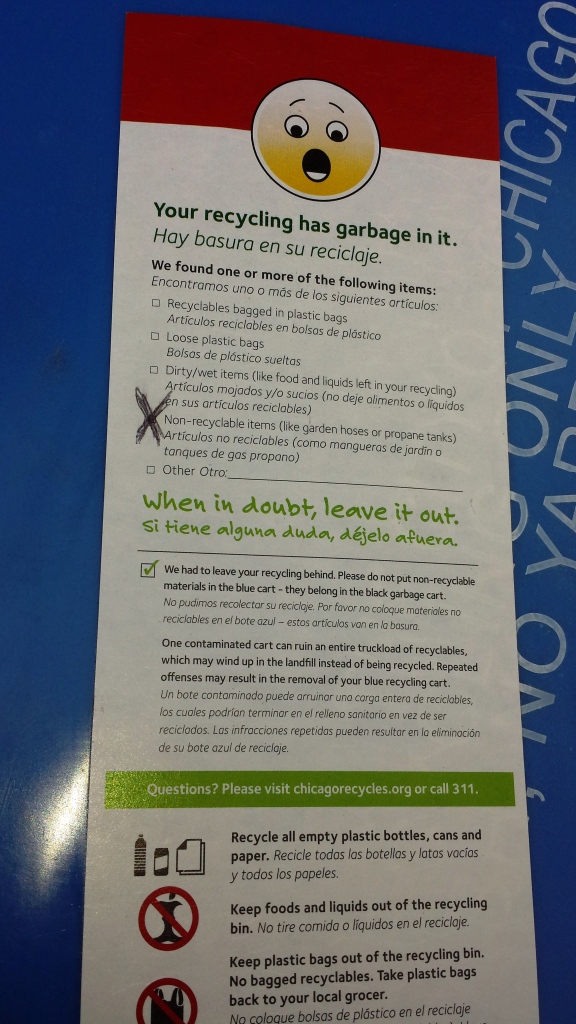
And the City of Chicago and its designated 'recycling' contractor, Waste Management, refused to pick it up. I got a sticker on my blue bin instead:


The big 'X' on the sticker claims that my recycling was rejected because it contained "[n]on-recyclable items (like garden hoses or propane tanks)."

Now I ask you: Do these look like propane tanks to you?

Could these plastic strips possibly be confused with garden hoses?

But the inability of the Waste Management driver to distinguish these strips from propane tanks is not the thing that made me really upset.

Have you noticed yet?

Look at the pithy slogan on the sticker again: "When in doubt, leave it out."

When in doubt, leave it out?

Seriously? Humanity is choking in its own waste and a recycling company, so called, is urging people to choose landfills whenever there's the slightest question about whether this item or that one meets City standards? What a load of garbage.

According to a recent story on WGN-TV news, "only about 10 to 12 percent of what is picked up [by Waste Management] is meeting the standards for the city’s recycling program. The garbage that doesn’t meet standards goes straight to the landfill."

Maybe some of my fellow citizens are not as fastidious as I am when it comes to separating recyclables from trash and preparing said recyclables for future re-use. OK, maybe. But, after last Friday, I am seriously beginning to wonder whether this recycling contractor is just being far too choosy. Waste Management's contract should be recycled.

Monday, May 25, 2015

Norwood Park remembers -- 2015 Memorial Day Parade, continued

This post continues from a post on Page One.

Here are more pictures from today's Norwood Park Memorial Day Parade. For even more parade pictures, scroll down this page or click this link.


State Rep. Michael McAuliffe and Cook County Commissioner Peter Silvestri had a vehicle in the parade

A group from Garvey School


 A group from Onahan School


An anti-O'Hare noise group, fairchicago.org, had a contingent... and a pretty clever sign: "Ground Control to Mayor Rahm."


A group from Resurrection High School participated.


Cub Scout Pack 3958 from Norwood Park Lutheran Church