Showing posts with label Sports. Show all posts

Tuesday, November 15, 2022

Pete Rose seeks reinstatement for the 4,256th time

A Cincinnati television station has this latest story and a link to the above letter, which it says was obtained from TMZ Sports.

Don't hold your breath waiting for MLB to respond favorably.

MLB is much, much too busy watching its stake in Draft Kings, one its "co-exclusive" official betting partners (along with BetMGM), to respond to the increasingly desperate pleas of one old man who gambled on baseball before MLB decided to plunge headlong into gambling itself.

Even if that desperate old man does have more hits than any other man who ever played the game.

Look, I get it: Pete Rose has done nothing to endear himself to the Lords of Baseball. According to a great many accounts, Rose hasn't been an endearing sort. If there were a Top 10 list of "Nice Guys in Baseball," Rose wouldn't be in the top 4,256. What does (what should) that have to do with his amazing baseball résumé?

Now that professional gamblers and MLB have openly entered into a myriad of lucrative professional partnerships, Rose -- whose unforgiveable sin, remember, was gambling, not being a jerk -- belongs in the Baseball Hall of Fame. Otherwise Commissioner Manfred looks sillier than Claude Rains did in this scene from Casablanca:

The only thing I ask -- and I ask this only because the record does not support that this individual actually compromised his performance one iota, even when gamblers' money was allegedly strewn about his hotel room -- is that Joe Jackson, a member of the White Sox (the same team that is now the official sports betting partner of Caesars Sportsbook and the exclusive casino partner of Caesars Entertainment), be reinstated and enshrined in Cooperstown before Rose.

Thursday, February 24, 2022

Julio Cruz dead at 67; scored division-clinching run for 1983 Chicago White Sox

Today, on the 85th day of the current MLB Lockout, Shia Kapos notes Julio Cruz has died. Her Illinois Playbook post this morning links to this Tribune article.

The game was not on broadcast TV that night; there was, as yet, no cable TV in Chicago. Cable came to my Northwest Side neighborhood in time for the 1984 season. I remember asking the salesman, "Do the White Sox games come with the basic package?" I remember the salesman being a bit flummoxed, too. "Nobody's asked about that before," he said. And no wonder. It would be years before cable was even an option for homes on the South Side.

Yes, the White Sox owners were television geniuses all right. Everybody (everybody outside of Chicago, that is) said so. Supposedly. Anyway, when you think about how smart it was to keep your telecasts out of the living rooms and dens of your core fans, it's a lot easier to understand how we are at Day 85 of the current baseball lockout.

It takes exceptional wealth to own a professional sports franchise. But great intelligence does not automatically come with great wealth.

The White Sox television geniuses did allow Channel 32 to cut in for the 9th inning of the clinching game. (Channel 32 had those occasional games that the Sox did allow to be broadcast in those days.) So some of us did get to see this much, at least, live:


SABR has an extensive game recap of that September night in 1983, if you care to remember.

But take your time. There's no hurry. It's not like there's going to be new baseball to enjoy any time soon.

Julio Cruz is dead. And Major League Baseball is self-destructing.

Wednesday, January 26, 2022

Baseball's Hall of Fame is officially a joke now

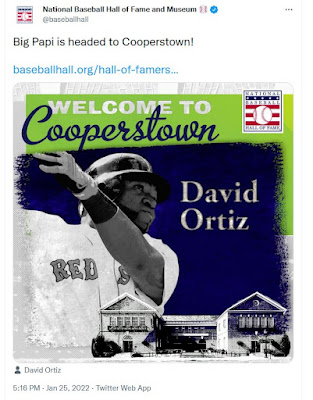
Don't get me wrong. I'm happy for David "Big Papi" Ortiz. He was a very gifted player; his stats are very good. A career WAR of 55.3 puts him 29th on the list of all-time great first basemen (which is where he played on the field, when he played on the field, which was not all that often). Behind many all-time greats, ahead of a few.

But Big Papi's career WAR of 55.3 pales besides the career WAR of 162.7 put up by Barry Bonds. Big Papi finished in the top 10 of MVP voting seven times; Bonds won the MVP award seven times. Big Papi finished with 541 career home runs, good for 17th place on the all-time list. Bonds, of course, is the all time home run leader, with 762.

David Ortiz got elected to the Hall of Fame yesterday -- the first time he was on the ballot. But Barry Bonds did not get elected to the Hall of Fame yesterday, on his 10th, and last, year of eligibility.

This makes no sense to me. None.

Also denied entry into the Hall of Fame yesterday, on his 10th and final time on the writers' ballot, was 354-game winner and seven-time Cy Young Award-winner Roger Clemens, the most dominant pitcher of his generation. Perhaps any generation. In 1986 he won the Cy Young and the MVP.

Oh, sure, you say. You know how to explain the difference between Ortiz, on the one hand, and Bonds and Clemens on the other: In a word, Steroids.

Except... David Ortiz tested positive for steroids in 2003. In a clear HIPAA violation, which to my knowledge was never investigated or prosecuted, the results of confidential steroid tests taken voluntarily by several players in 2003 (including Ortiz and his current Fox Sports studio partner Alex Rodriguez) were leaked to the press in 2009.

And, again, I'm not raining on Big Papi's parade. I'm happy he's in. In a piece this morning on Yahoo!sports, Hannah Keyser writes (and I agree),

None of this is to cast aspersions on Ortiz’s election. He played well into the current era of regular standardized drug testing and, after that survey testing in 2003, “I never failed a test,” as he said. “So what does that tell you?”

Bill Madden, in today's New York Daily News, does rain on Big Papi's parade:

In his 2018 book “Baseball Cop”, Eddie Dominguez, a high ranking Boston police detective and former FBI and DEA task member who was part of MLB’s since-abolished internal investigation unit, chronicled his three-year investigation of Big Papi and the Red Sox’s DH’s close association with an alleged Dominican drug dealer called “Monga,” who was in the U.S. illegally.

As part of the investigation of “Monga” and his involvement with PEDs, it was discovered that he was a frequent visitor to a Dominican barbershop in Boston with a gambling parlor in the basement, where witnesses said, he was placing large bets on Red Sox games in 2005. Just after Ortiz was presented with this information by MLB investigators, the barbershop abruptly closed. Dominguez reported that he was finally able to get “Monga” banned from the Red Sox clubhouse (where he’d been Ortiz’s constant companion), only to see him on TV, on the field at the 2006 All-Star Game Home Run Derby in Pittsburgh, toweling off Big Papi and the other Dominican players. When Dominguez voiced his outrage to his superiors at MLB, he was informed that Ortiz had told then-Commissioner Bud Selig and his deputy, [current Commissioner Rob] Manfred, that if “Monga” and his posse were not allowed on the field, he would not participate in the Home Run Derby. Not long after, “Monga” was arrested at Ortiz’s house, where he was staying, and deported for immigration violations.

But so what? People in New York are always hating on Boston players.

Besides, that's not the point.

The point, if you read Madden's linked column, is that he eliminated all the "PED cheats" from his ballot before making any selections.

Just like a significant number of his sportswriting brothers and sisters.

Sanctimonious hypocrites all.

Look, I lived through the Steroid Era. I remember. I remember the hype when Sammy Sosa and Mark McGwire both went for 60 home runs in a season. Baseball officially promoted the heck out of this. I remember the ad campaigns -- like "chicks dig the long ball." I remember Sosa showing up to Spring Training one year looking more like the Michelin Man than a baseball player and the sportswriters asking him where he got his new muscles. "Flinstones Vitamins," he said, and all the sportswriters guffawed.

But they knew. They knew then. José Canseco did not have to write his book for the sportswriters to know. Anybody with eyes could see how enormous Sosa had become, and Bonds, and others.

The writers didn't care. The owners didn't care. The sponsors didn't care. They celebrated home runs and the man-mountains that hit them. Because these behemoths brought the fans back to the National Pastime after the 1994 strike.

Look: I am not saying steroids are good. Or that they should be legal for players to take. Or that taking steroids wasn't cheating, even during the Steroid Era.

Obviously, taking steroids is bad. When not medically necessary, steroids are bad for the persons taking them. Looking the other way at steroid users was not fair to the persons who didn't take them, and who were forced out of baseball by walking chemistry experiments. It was, in fact, cheating.

So is throwing a spitball. And, yet, the most successful spitball pitcher of the modern era, Gaylord Perry is in the Hall of Fame. He never got caught -- nudge, nudge, wink, wink -- and, yet, somehow, everybody knew.

Baseball was never a gentleman's game. There has always been a notion in many sports, and in baseball in particular, that if you ain't cheatin' you ain't tryin'. Eventually, some things may be ruled beyond the pale. As has happened now with steroids. And that's all well and good.

But sportswriters should not pretend to be shocked or appalled or outraged or even a teensy bit upset about players accused of juicing during the Steroid Era, not when they were celebrated and admired and lauded and applauded even as they looked less and less like standard-issue humans. You might contend that some of the sportswriters having ballots now were not sportswriters then and this is undoubtedly so. But they should know, better than most, that their predecessors ignored or at least winked at steroid usage until MLB finally decided to clamp down for real.

The bottom line is this: You have this museum supposedly honoring the greatest players ever to play baseball -- and then you deny entry to baseball's greatest players because maybe they juiced. Oh... and maybe they were jerks, too, especially to the writers. If this is the standard, let's change the name from Hall of Fame to Hall of Sportswriters' Favorites.

And one more thing. What with FanDuel and DraftKings and every casino and sportsbook in the nation having official sponsorship deals with MLB or MLB teams... does it make any sense to still keep Pete Rose out? How about Joe Jackson?

No... it doesn't.

Today, the Hall of Fame is a farce, now more than ever. That doesn't mean Big Papi isn't a Hall of Famer. He is. And was, before yesterday's votes were announced. But so is Barry Bonds. And Roger Clemens. And Joe Jackson (who, even if his share of the gamblers' money was left on his hotel bed, never did one thing to hurt the White Sox in the 1919 World Series). And even Pete Rose, who bet on baseball before it was permitted. Put 'em all in the Hall. Put asterisks on their plaques if you must. But tell the whole story. Or close the Hall down.

Tuesday, June 8, 2021

Ten steps to save Baseball

Ken Levine is mostly a playwright these days, but he has written books, movie screenplays, and for any number of TV shows including some of the best known TV shows of all time, such as M*A*S*H, Cheers, Frazier, and The Simpsons. A former Top 40 DJ, Levine has also worked as a TV director and, more relevant to this post, as an MLB announcer, broadcasting games for the Baltimore Orioles, Seattle Mariners, and San Diego Padres.

White Sox announcer Jason Benetti mentioned Levine and specifically Levine's baseball-themed "Dancin' Homer" episode (written with David Isaacs) during a recent broadcast.

In addition to his many other accomplishments, Levine writes a hugely popular blog. He sometimes jeopardizes his vast national and international readership by indulging in an occassional post about baseball, such as this June 3 post, "How I would fix Major League Baseball."

This post started off as a comment to that one -- a comment that, when concluded, exceeded the limits allowed by Blogger for such things. At some point, Blogger reasons, if you have so much to say, you should get your own blog. Which I already have.

Unfortunately, as a stand-alone article, my prior comment didn't make that much sense. (I would appreciate your not going for the obvious response to that sentence. Instead, read on for 10 steps to save baseball.)

A lot of these 10 steps boil down to this: Make the game shorter. But where's the clickbait in having only one step? And there are, as you will see, more than one way to shorten the game.

Some of these steps are negative -- don't do this or don't do that -- mainly because a lot of well-intentioned people, like the aforementioned Mr. Levine, have made suggestions that would make baseball into some other sport altogether. I only want to "change the game" for the better -- not "change the game" into something baseball fans might no longer recognize. Herewith, then, 10 steps to save Baseball:

  1. Don't ban the shift! The reason teams shift is because they know where the batter will hit the ball. So batters should adapt and not hit the ball as expected. I know the skill has been lost, especially with power hitters, but a bunt down the third base line by a left-handed power hitter would be a double every time. Hit 'em where they ain't. Otherwise, stop moaning about it.

  2. No clocks in baseball! Actually this might be better phrased as "no more clocks in baseball." When the bases are unoccupied, a pitcher has 12 seconds, from the time he receives the ball back from the catcher, to throw his next pitch. See, Rule 5.07(c) of the Official Baseball Rules, 2021 edition. You've never heard of that one, have you? Neither, apparently, have most umpires. But every time the pitcher violates the rule, the ump is supposed to call a ball.

    The first time this is called, the offending pitcher would lose his mind and his manager's head would explode. But if the umps rigorously enforced this rule it would speed up the game right there.

  3. Make the umpires accountable for the pace of the game. They already are, according to the rule book, but you'd never know it to watch. Or, watching, you might think MLB umpires get paid by the hour.

    In his post, Mr. Levine suggests firing Angel Hernandez. A lot of fans have umpires they love to hate. I don't know if the players or owners would like it if I were Commissioner, but I am dead certain sure that the umpires would hate it. Because I would fire umpires who let games drag on too long. You want a playoff assignment or to call a World Series? Get your games finsihed in three hours or less -- or get another job.

    Some of you reading this may think that an unfair and unreasonable demand. But I say it can be done, by the umpires, starting today, and without changing a single rule. How?

  4. Stop the staring contests. I blame this one on TV. When TV coverage became more sophisticated, cameras could zoom in on the faces of the pitcher and the batter, and we could see all the grimacing and glaring and way too much of the scratching and spitting. Then the pitcher would step off the rubber and then the batter would step out of the box and the announcers would fill the dead air with riffs on the 'drama' of the moment. At one point... the 1970s perhaps... this staged drama was interesting. It has long since lost any appeal it might have had. And while this slow-motion dance routine is going on... and on... the ump just stands there like a mannequin.

    The umpire has the power to tell the batter to get in the box and get ready to swing. He can call a strike on a batter for not stepping in. He can call more than one if a player is not appropriately responsive to the demand he get back in and hit. A player can call 'time' all he wants -- but the ump does not need to grant it. See, Rules 5.04(b)(2)-(4). We've already mentioned the 12-second rule. When there are runners on base, a pitcher can also be called for a balk if, in the umpire's view, the pitcher takes to long to pitch. See, Rule 6.02(a)(8). The umpire is anything but a helpless bystander.

  5. Call strikes in the whole strike zone. Take a look at this:
    This illustration of the strike zone is taken straight from the rule book. The written definition is as "that area over home plate the upper limit of which is a horizontal line at the midpoint between the top of the shoulders and the top of the uniform pants, and the lower level is a line at the hollow beneath the kneecap. The Strike Zone shall be determined from the batter’s stance as the batter is prepared to swing at a pitched ball."

    I've had it up to here with a ball at the belt-buckle being described as a "high strike." No wonder we have so many uppercut-swinging behemoths these days -- but when they strike out enough times in a row they'll figure out that they'd better start looking somewhere else than shins to kneecaps.

    Yes, I know that strikeouts slow the pace of play. But walks are worse. Baseball has too long preferred players who can hit the ball far (chicks dig the long ball... remember?) over players who can hit the ball often. With a rulebook strike zone, though, making contact will again be important and pace of play will improve. (And... don't tell the stat heads... but, if in April, when it's barely above freezing, I for one will not complain if the strike zone goes from the nose to the toes. But, then, I also have a suggestion about playing games in April when it's barely above freezing... keep reading on.)

  6. Baseball has to invest in its future. Mr. Levine and I are prototypical baseball fans these days. We are both of, well, a certain age. If baseball is to survive the eventual passing of us Baby Boomers, it is going to have to figure out how to attract younger fans. Faster games will help, I am certain, but there are other things we must do besides.

    Play more day games, for example. Even with faster games, kids may not be able to watch night games. A lot of kids on the East Coast have only heard rumors of Mike Trout. This is a shame.

  7. Kids have to be able to actually watch games. I'm not saying games have to go back on free, broadcast TV. I'm not even sure that, these days, most kids live in households that actually can get the local broadcast stations.

    But teams are looking to set up their own networks. They should be able to, and required to, stream them, free, gratis, and for nothing in their home markets. They won't make money that way with carriage fees to cable, sattelite, or other streaming services, or at least not as much, but they will control the airtime and get all the commercial revenue from their own networks. Maybe the teams could make more in other ways -- probably this is so. But not every household can pay $200 a month for cable/satellite/streaming packages and kids who grow up without baseball in their daily lives will not suddenly mutate into fans as adults.

  8. Kids have to be able to attend games in person. I understand that there's no going back to 50-cent or one dollar bleacher tickets, even adjusted for inflation, such as existed when I was a kid. Players aren't going back to selling life insurance or automobiles during the off-season either.

    But a family needs to be able to go to a game without putting a second mortgage on the house. Mom or Dad should be able to buy a beer in the park for less than the price of a case outside.

    But it's not entirely about the money. That's owner-thinking. Attendance has to be made affordable in order to hook that next generation of fans.

    Even with access on TV, or some sort of screen, kids need to experience the big league game in person. There's no grass greener than at the ballpark. The sky is bluer, the lights are brighter, and the noise is something that you don't just hear with your ears, but feel in your bones. These kids may some day grow up able to afford full price -- but they won't come out unless they fall for the game as kids. They need to have a memorable---and memorably good---experience.

  9. All future MLB stadiums must have retractable roofs. I can understand blowing up the old Metrodome in Minneapolis. I can't understand MLB allowing the Twins to build a replacement stadium that did not have a roof. It's not that Minneapolis doesn't have beautiful weather in the summertime. It just doesn't have 81 good days. A couple of years ago, the White Sox got snowed out of an entire early season series in Minnesota.

    The weather in Chicago can be gorgeous in the Summer. And cold, damp, and misearable early in the season and (sometimes this is relevant, you know) late in the season as well. A retractable roof, open to the elements on nice days, and closed otherwise, would give teams (and fans) a high degree of confidence in getting their 81 games played on time and on schedule, with no rain delays. And teams could hope for as many bodies in the seats in April as in August because conditions at the park would be optimal for baseball at either time. Maybe teams could even set aside a few dates to get their future fans in for reasonable amounts....

  10. No work stoppage in 2022. All the signs and portents are ominous. The current collective bargaining agreement will expire December 1 and players and owners seem headed for yet another strike. Baseball has lost ground to football, it is losing ground to basketball, and if it keeps losing fans and market share owners and players alike are going to wind up derailing the gravy train. Permanently.

    If only MLB had a Commissioner. Someone who could step in and bang heads together and make owners and players see their mutual advantage in going forward together. Alas....

But we still have this year. If only we could get rid of the dumb man-on-second rule for extra innings....

Monday, January 11, 2021

Next Sunday evening: Tom Brady v. Drew Brees

Updated January 12, 2021

OK, to no one's real surprise, the Bears are out of it. But that sets up this Game for the Ages. Or is that the Game for the Aged? Whatever, somewhere George Blanda is smiling.

Update: Messrs. Brady and Brees have apparently embraced the gag:

(Here is the link to the original Tweet.)

Monday, August 26, 2019

Strictly Personal: Did Adam Schefter really have to break the Andrew Luck story Saturday night?

The whole family was over Saturday evening. The older grandkids were grumbling that the TV was tuned to the Bears game (such as it was), with sidetrips only for the Sox game (fewer and fewer as the evening wore on) and the University of Miami vs. University of Florida tussle on ESPN.

It was while watching the college game that we first saw news of Adam Schefter's tweet about Andrew Luck's retirement. My sons and sons-in-law had their phones out in an instant -- they all follow Schefter -- and instantly confirmed that Schefter had made this report. "He'd better be right," said one. "If he misses on this one, it's a possible career-ender."

"Well, he just doubled down," said another, reading Schefter's latest tweet.

(I had my phone out, too, but I seemed to only have tweets from Popehat's Ken White. Nothing about Indianapolis quarterbacks at all.)

We flipped back to the Bears game, where Schefter's tweets were under discussion by the broadcasters -- and, apparently, by many of the fans. There was quite a bit of exaggerated gesticulation going on in the stands that appeared unrelated to any action on the field.

"Try NFL Network," someone suggested, and we flipped over there next, but a different, though equally meaningless preseason game was unfolding there.

Millennials flip channels way too fast for me, but somewhere in the back and forth, supplemented by phone data, it was determined that Luck would address the media following the Bears game. And that Luck was booed by the fans in the Lucas Oil Stadium stands as he left the field for perhaps the last time.

One of my sons-in-law is an Indianapolis native. It would be too much to say that he was actually distraught, but he was a bit in shock. "They're not booing Luck necessarily," he finally said. "They're angry at the team for squandering Luck's talent. For failing to get a capable offensive line. The Colts ruined him."

I don't think they quite made it to halftime of the meaningless game on the NFL Network before the network cut away to show young Mr. Luck, choking up at the podium. They did a split screen for a minute or two, then just put Luck up full frame.

This wasn't how he wanted to go out at all.

He had talked to management about his decision to retire before the game. He wanted to break it to the team after the game, then have a press conference to explain it to the world on Sunday.

Obviously, somebody blabbed. A family member, perhaps. A team employee. Whoever the blabber was no doubt thought that he or she had extracted a promise from the blabee not to spread the news further.

Thus illustrating the old Ben Franklin maxim, "Two people can keep a secret so long as one of them is dead."

But why did Schefter have to tell the world so quickly?

Who would have been hurt by sitting on the news for an hour or so? That would have given Luck time to tell his teammates. It was evident, watching Luck's premature press conference, that he was devastated that he was not permitted to tell the team his news his way.

The Vegas bookies had to quickly recalibrate the odds of Indy getting to the Superbowl. Someone on Twitter posted a receipt from a sports book in Iowa -- do they really have sports books in Iowa? -- allegedly showing a wager made on Indianapolis to go to the Super Bowl made not five minutes before Schefter's first tweet.

But did we all really have to know Luck was going right then? The good people who bought Colts season tickets in reliance on Andrew Luck's return had already done so.

It was hardly a matter of life or death. I guess revealing the information when he did burnished Schefter's reputation as a knowledgeable insider.

I think it would have been better for all concerned, however, better even for Mr. Schefter, if the news had been withheld until after Luck had the chance to tell his locker room.

I guess I would never have made it in journalism.

-----------------------------------------------------------------
Andrew Luck photo obtained here.

Friday, May 24, 2019

Red Grange makes the Bears Top 100 List in more ways than one

In conjunction with their 100th anniversary, the Chicago Bears have released a list of the top 100 Bears players of all time.

I've appended the list to this post (Hall of Fame members are indicated with "*"). For heated arguments concerning who was overvalued, or undervalued, or wrongly included, or wrongly excluded, turn to the sports radio station of your choice. I am not qualified to contribute meaningfully to that discussion. Still, from an historical perspective, I am surprised that Red Grange is only No. 36 on the list.

College football was far and away the dominant branch of the sport in the early 1920s and Red Grange was at that time the biggest star in the college game.

Pro football may be the biggest sport in America today, but it was then at most a regional sport, and rather disreputable. Players wishing to continue their football careers after college often played under assumed names, so as not to embarrass their families or themselves. Hardly anyone made a living solely from football in those days.

The Chicago Bears may now be one of the most valuable franchises in any sport, but in 1925 the Bears weren't even the dominant pro football team in Chicago. The Chicago Cardinals were the NFL champions that year.

In his history of the Chicago Cardinals, When Football Was Football (Triumph Books, 1999), Joe Ziemba spends a lot of time detailing Grange's decision to turn pro -- recounting how Papa Bear George Halas negotiated with C.C. Pyle, who would become Grange's manager, for Grange to join the Bears immediately after his last college game, play the remaining games on the league schedule, and go off with the team on a nationwide barnstorming tour. Grange would get 30% of the gate receipts, giving him earnings of perhaps $100,000 at a time when most pros did not get $100 a game.

And -- while the contracts weren't actually signed until after his last college game -- these negotiations apparently took place while Grange was still paying football for the University of Illinois. How about that?

Anyway, the tour was a great success, but it was grueling -- there were four games played in one five day stretch toward the end of it -- and Grange was increasingly limited by injury. Ziemba recounts how Pro Football Hall of Famer Jimmy Conzelman, later the coach of the Chicago Cardinals, but then the owner of the Detroit Panthers, had to refund 10,000 tickets after he told the press that Grange would be unavailable for the game with his team. Ziemba quotes from Conzelman's book, Pro Football's Rag Days:
A few hours before the game was about to start, I looked out the window and saw a long line at the box office. I remembered thinking to myself, "What a great sports town. Grange isn't going to play but they're still lining up to buy tickets." Then I got the news from the ticket man. They were lining up to get refunds.
Despite the injuries, the Bears' tour with Grange is widely recognized as putting pro football on the map as a legitimate sport, launching it on the road to the dominance it enjoys today. Grange's signing also tipped the pro football balance of power in the City of Chicago, starting the Cardinals on a long decline and eventual moves to St. Louis and, more recently, Arizona.

(Of course, even the road to fame and fortune has twists and turns: One stop on the barnstorming tour was Washington, D.C. Illinois Senator William B. McKinley took Grange and Halas to the White House to meet President Calvin Coolidge. According to Halas, McKinley said, "Mr. President, this is George Halas and Red Grange of the Chicago Bears." "Glad to meet you fellows," said the President. "I always did like animal acts.")

Although Grange left the Bears to found his own league, he returned when that league folded, playing for the Bears from 1929-1934.

ESPN ranked Grange No. 28 in its list of the Top 50 athletes of the 20th Century. In an online profile preserved as part of this Sports Century Series, Larry Schwartz writes that George Halas said that no player has had a greater impact on the game of football, college or professional, than Red Grange.

The ESPN profile also contains this anecdote from Chris Berman:
I was interviewing George Halas and I asked him who is the greatest running back you ever saw. And he said, "That would be Red Grange." And I asked him if Grange was playing today, how many yards do you think he'd gain. And he said, "About 750, maybe 800 yards." And I said, "Well, 800 yards is just okay." He sat up in his chair and he said, "Son, you must remember one thing. Red Grange is 75 years old."
It in no way diminishes the greatness of the other players on the Bears' Top 100 List to suggest that, without Red Grange, there probably is no list.

The Top 100 Bears of All Time
  1. Walter Payton*
  2. Dick Butkus*
  3. Bronko Nagurski*
  4. Sid Luckman*
  5. Gale Sayers*
  6. Mike Ditka*
  7. Bill George*
  8. Bulldog Turner*
  9. Doug Atkins*
  10. Danny Fortmann*
  11. Dan Hampton*
  12. Richard Dent*
  13. Jimbo Covert
  14. Brian Urlacher*
  15. Mike Singletary*
  16. Bill Hewitt*
  17. Stan Jones*
  18. Jay Hilgenberg
  19. Steve McMichael
  20. Devin Hester
  21. Joe Stydahar*
  22. George Connor*
  23. George McAfee*
  24. Joe Fortunato
  25. Ed Sprinkle
  26. Ed Healey*
  27. Olin Kreutz
  28. Lance Briggs
  29. Rick Casares
  30. Gary Fencik
  31. Charles Tillman
  32. Paddy Driscoll*
  33. George Trafton*
  34. Matt Forte
  35. George Musso*
  36. Red Grange*
  37. George Halas*
  38. Link Lyman*
  39. Harlon Hill
  40. Ken Kavanaugh
  41. Neal Anderson
  42. Richie Petitbon
  43. Wilber Marshall
  44. Johnny Morris
  45. Otis Wilson
  46. Doug Buffone
  47. Dave Duerson
  48. Fred Williams
  49. Ray Bray
  50. Mark Bortz
  51. Keith Van Horne
  52. Joe Kopcha
  53. Jim McMahon
  54. Ed Brown
  55. Johnny Lujack
  56. Roosevelt Taylor
  57. Jim Osborne
  58. Wally Chambers
  59. Julius Peppers
  60. Khalil Mack
  61. Willie Galimore
  62. Robbie Gould
  63. Mike Brown
  64. James Williams
  65. Dick Gordon
  66. Mike Hartenstine
  67. Ed O’Bradovich
  68. Dick Barwegen
  69. Bill Wade
  70. Matt Suhey
  71. Kevin Butler
  72. Mark Carrier
  73. Tommie Harris
  74. Kyle Long
  75. Akiem Hicks
  76. J.C. Caroline
  77. Bennie McRae
  78. Donnell Woolford
  79. Dennis McKinnon
  80. Alshon Jeffery
  81. Brandon Marshall
  82. George Blanda*
  83. Willie Gault
  84. Tom Thayer
  85. Jay Cutler
  86. Allan Ellis
  87. Luke Johnsos
  88. Joey Sternaman
  89. Mike Pyle
  90. Beattie Feathers
  91. Bob Wetoska
  92. Bill Osmanski
  93. Herman Lee
  94. Jim Dooley
  95. Larry Morris
  96. Eddie Jackson
  97. Bobby Joe Green
  98. Trace Armstrong
  99. Doug Plank
  100. Patrick Mannelly

Thursday, May 23, 2019

Time heals another wound: White Sox to give away Disco Demolition t-shirts on June 13

Robert Feder reports this morning that the Chicago White Sox will soon give away 10,000 t-shirts commemorating the 40th anniversary of Disco Demolition.

The Sox have been doing a t-shirt giveaway during Thursday home games for some time now, and some of the t-shirts have been pretty nice. You have to have nice promotions when you're rebuilding, as the Sox are.

I wouldn't know personally, but I bet that a certain North Side baseball club had sweet promotions when it was rebuilding a few years back. Now I think fans entering Wrigley might get a commemorative tissue paper, if that certain North Side baseball club bothers to have any promotions at all. And, if it does have a Tissue Paper Night, it's a cinch that the certain North Side baseball club will collect a king's ransom from the sponsor who gets to put its name somewhere on said tissue paper. I look forward to the day, hopefully soon, when the White Sox can also have crumby promotions.

Anyway, that's the t-shirt, pictured above, and one may be yours if you are one of the first 10,000 arriving for the Thursday, June 13 game (first pitch at 7:10 p.m. against the hated New York Yankees) at Guaranteed Rate Field. Steve Dahl is scheduled to throw out the first pitch. All is finally forgiven.

What's to forgive, you ask?

The Detroit Tigers were in town for a doubleheader on Thursday, July 12, 1979.

Between games, Dahl, then the enfant terrible morning jock at WLUP, was to lead his Coho Lips Army onto the field to blow up a cache of disco records. The records were to be supplied by fans, who could get general admission tickets that night for only 98¢ apiece (get it?) if they also brought a disco record.

(I'll pause here while the Baby Boomers and the hipsters in the audience explain what a "record" is to those in the Millennial and Gen-Z cohorts who may not know.)

Old Comiskey had a capacity of about 50,000 in those days; that night there were perhaps 70,000 in the house. Many got in without paying even 98¢.

Although I was a frequent patron at Old Comiskey in the Summer of '79, I was not there that night. I was in law school then, still living with my parents, watching the broadcast on Channel 44. Harry Caray and Jimmy Piersall were doing the Sox games in those days. After the records were blown up (a very big explosion in center field, which by itself probably jeopardized the second game of the twin bill), thousands of drunken kids stormed the field -- and I remember Piersall, who almost sounded like he was crying, shouting, "This is not baseball!"

And it wasn't. Ultimately, though the field was finally cleared, it was unplayable, and the White Sox were obliged to forfeit Game 2.

The whole sorry spectacle, as originally broadcast on Channel 44, was available for some time on YouTube. Sadly, it seems to have been removed. I was, however, able to find this ESPN coverage of the debacle.


Although I wasn't at Disco Demolition, I was at the park three times that same week. Twice before, and once after.

It was a lot more fun before.

Thursday, October 27, 2016

An open letter to my Cub Fan friends, neighbors and colleagues


Dear Cub Fan Friends, Neighbors, and Colleagues:

I wasn't camped out along LaSalle Street when the parade celebrating the White Sox 2005 World Series sweep rolled by. But I happened to be out---running errands, I guess---and I wandered over to see the throngs waiting for the double-decker buses.

And, as I got close, the tears welled up, unbidden but unashamed. It just hit me, all at once, that I really had witnessed this, that the Sox really did win the Series. My father lived his whole life (and he was granted more than the biblical three score and 10) without ever seeing a White Sox World Series Championship.

I remembered my first trip to the old Comiskey Park, with my grandmother. I don't know if this was before or after she went to Puerto Rico and brought me back an autographed picture of Juan Pizarro. The upper deck in the old park was about the height of the Club Level at the current U.S. Cellular Field (Guaranteed Rate Field as of Nov. 1) but it was still a height for the little boy I was then, and I remember looking from that vantage point out at the greenest grass I had ever seen.

When Julio Cruz scored the winning run (on a Harold Baines sac fly) to clinch the American League West Championship for the White Sox in 1983, I was already living on the Northwest Side. The game wasn't available on free TV (thank you, Eddie Einhorn -- not) but (if I recall correctly) Channel 32 was allowed to show the 9th inning. I was waiting for the air raid sirens to go off---like they did in 1959---but they didn't. I wanted to run outside and bang pots and pans, but my wife told me I'd probably get arrested.

She was probably right: When cable finally came to the Northwest Side in 1984 (it wouldn't come to the South Side for years thereafter which is why so many South Siders are confused in their loyalties to this day) the only question I had for the salesman was whether I could get the Sox games. "Gee," he said, "you're the first guy to ask." On the Northwest Side, I suppose I shouldn't have been surprised.

We had weekend season tickets in those days -- we were in a little group -- and our seats were in the last row of the Golden Boxes on the third base line. We got moved to 'equivalent' seats in the new park -- in the right field corner, where you had to twist to your left just to see the pitch (if you looked straight ahead from those seats all you could see was the fights in the center field stands -- although, sure, sometimes those were more entertaining than the product on the field). But we stayed with those seats, too, for a number of years until paying high school and college tuition became the paramount priority. One of my sons has weekend tickets now.

The point is, I was a Sox fan from birth. I'm a Sox fan now. I am not obligated to switch sides just because your team is now in the World Series.

I get that many of you are thinking of mothers, fathers, grandparents, especially those who are gone now, who introduced you to your team. I shared that experience---like I said at the outset---but I was introduced to the Sox, not the Cubs. Even should the Cubs win it all (and given the decimated state of Cleveland's starting pitching, that sure seems possible), there will be no cathartic release for me, no conversion experience. I won't be crying with joy and sadness and relief and gratitude at your parade; I'll probably be grumbling that I can't get across LaSalle Street with all of you in my way.

It's OK. You didn't think of your mothers, fathers, and grandparents in 2005 either. And I didn't expect you to. Why do you expect me to change now?

I'm watching the games. I'm just not living or dying with every pitch like you are. I'm happy for you, OK? Just stop demanding that I open my veins and bleed Cubby blue. And stop flapping that 'W' flag in my face before I lose it entirely. Are we clear on this?

Very truly yours, etc.

Saturday, October 3, 2015

To: My Cub fan friends, neighbors and colleagues

From: A lifelong Sox fan

I heard you've had a great season. I'm not surprised. I always thought Joe Maddon was a great manager. I used to root for Tampa Bay in the playoffs in those years when my White Sox weren't in. Too many years.

But, no, don't save room on your bandwagon for me. I'm not jumping on board.

I'm happy for you, sort of, in an impersonal way, the same way I have been happy for the good people of San Francisco or Boston or St. Louis in recent years. I don't mention the Cardinals to be hurtful; I mention them because they won. And I always liked Tony La Russa. You Cub fans wouldn't remember, but he was the White Sox skipper in 1983.

City Hall and the County Building festooned with 'W' flags

I don't hate the Cubs. It's just not my team. I feel about the Cubs about the same way I feel about the San Diego Padres. I'm indifferent. I save all my negative baseball emotions for the Yankees. Although I'm not real fond of Kansas City these days either.

I've watched Cub postseason games before. I was tuned in October 14, 2003 when the Cubs were playing the Marlins. I had a good excuse: Former White Sox shortstop Ozzie Guillen was the Marlins' third base coach. You Cub fans call that the Bartman game. Why, I'll never know. Mr. Bartman was only one of several fans who tried for a foul ball that Moises Alou thought he had a play on. But the floodgates didn't open until later that same inning, when shortstop Alex Gonzalez booted what should have been a routine double play ball. One run scored before the error; seven came after.

I probably will watch the Wild Card games. I'm not sure how I feel about them. The sudden death aspect of the contest is thrilling... but I'm not sure it's baseball. If the Sox were in such a game, I'm not sure I'd be able to watch. Or breathe. I was stressed out beyond belief in 2005. My heart was pounding so loud that I could barely hear the ball strike the ground in Game 2 of the ALCS when A.J. Pierzynski reached first on that famous dropped third strike....


Anyway, like I said, I'm happy for you Cub fans. Really. Just leave me the heck alone. I will be rooting for a team with blue uniforms in these playoffs, but it's not yours. It's Toronto: I want Mark Buehrle to get another ring. I want to see him on the stage in Cooperstown someday -- with a White Sox cap on his plaque.

Wednesday, September 2, 2015

Shoeless Joe Jackson denied reinstatement. Again.

Several news outlets had this story today: New MLB Commissioner Rob Manfred has denied the latest attempt at reinstating White Sox great Shoeless Joe Jackson (ESPN, SB Nation). The Shoeless Joe Jackson Museum Facebook page has reprinted Commissioner Manfred's July 20, 2015 letter. I've grabbed it and reproduced it below:


As you'll note, the letter recites that Manfred asked his staff to "research what can be learned from the historical record of the 1919 World Series and its aftermath," concluding, "The results of this work demonstrate to me that it is not possible now, over 95 years since those events took place and were considered by Commissioner Landis, to be certain enough of the truth to overrule Commissioner Landis' determinations."

Ah, yes. Kenesaw Mountain Landis. The first Commissioner of Baseball -- and during the first 14 months of his tenure still functioning as a U.S. District Court Judge in Chicago.

Wikipedia is kind to Judge Landis on this issue (noting that Attorney General A. Mitchell Palmer said there was no legal impediment to Landis holding down both jobs) and on the race issue as well. However, readers of Bill Veeck's autobiography, Veeck as in Wreck, will remember how Veeck wrote that he called Judge Landis, out of courtesy, when he put together a group to buy the Philadelphia Phillies in 1944. Veeck said he shared his plan to stock the team with Negro League players -- and he suddenly went from front-runner for the franchise to frozen out.

Cub-worshiping website One Bad Century lauds Landis as the man who saved baseball from the evils of gambling, but adds that Landis was "a Chicago Cubs fan long before he took over baseball, and remained a Cubs fan until his dying day. * * * While he was beloved as a trust-busting judge, Landis was also a regular at West Side Grounds, home of the Chicago Cubs. He openly rooted for the Cubs against the White Sox in the 1906 World Series, something White Sox fans never forgot. When the Cubs moved to what is now Wrigley Field, he was a regular there as well. He loved baseball and watched it intently, leaning forward in his seat, devouring every moment of the game."

Real Chicago sports fans understand the need to choose sides. The real scandal is not that Landis was a Cub fan who came down hard on Shoeless Joe and the other Eight Men Out. The real scandal is that Landis banned the Eight Men Out -- while leaving allegations of a similar fix of the 1918 World Series (that the Commissioner's beloved Cubs lost to Babe Ruth and the Boston Red Sox) safely in the realm of rumor. Yet Black Sox pitcher Eddie Cicotte swore that he and his co-conspirators got the idea for throwing the Series from the Cubs.

One Bad Century says that it was a minority stakeholder in the Cubs, Albert Lasker, who pushed for the appointment of Judge Landis in 1920 when a Cub pitcher, Claude Hendrix, was accused of conspiring with gamblers to throw a regular season contest against the Phillies. Landis banned Jackson and Buck Weaver and the other Black Sox -- but Henrdix was allowed to retire.

Wow.

But Commissioner Manfred focused his alleged review very narrowly -- looking only at the 1919 Series and its aftermath, he said -- not at Landis' unequal treatment of players on teams he liked and teams he didn't.

And just for the record, in the 1919 Series, Jackson led all batters with a .375 average, going 12 for 32 -- including three doubles and a homer -- hitting 5 for 12 with runners in scoring position. He scored five times, drove in six runs and committed no errors. Evidence of Jackson's complicity in any conspiracy to throw the Series is thin at best, fraudulent at worst, and surely tainted.

And there's one other thing: Commissioner Landis was hired to free baseball from the grip of gambling. But times change. Fashions change. And gambling seems back in fashion with baseball bigwigs:


It's just Shoeless Joe Jackson's status that does not change.

Thursday, February 12, 2015

JRW: Punishing kids for the sins of alleged grownups is completely wrong


My son Joe was looking for another place to pitch one summer. This was a decade or so ago when he was playing high school baseball. Maybe he'd just graduated; I don't remember exactly. I do remember that some of his school teammates recruited him to pitch for the Morton Grove American Legion team where they had signed to play.

There was a problem, however. We lived within the boundaries of the Portage Park American Legion team. Portage Park had to give up its territorial claim on Joe before he could legally pitch for Morton Grove. Paperwork was involved. (When isn't it?) But, with the help of the Morton Grove coach, the proper authorities in Portage Park were contacted and the papers duly completed. Joe was able to play on the same team as his friends.

I couldn't help but remember that story yesterday as the news about Little League International's decision to strip Jackie Robinson West of its national title stormed across the Internet. I didn't have the heart (or the stomach) to turn on local sports radio during the day. Watching the news last night was painful. I loved the JRW story. Like so many in Chicago, I watched the games on TV and rooted for those kids; I was so happy when they won. I was a fan.

I remembered a couple of other things yesterday, too. I had occasion to coach my youngest son, Jim, when he played at Oriole Park. Oriole Park did not have a Williamsport team, but in addition to our house league teams for various age groups there were "all star" teams that played in various tournaments, mostly against area parks. No one cared about residence in those days, but there was always concern that unscrupulous coaches would try and load up their 10 or 11 or 12-year old teams with older players. Danny Almonte was the Little League scandal in those days -- the 14-year old pitcher who mowed down 12-year old lineups in Williamsport like a sharp scythe in a field of ripe wheat. As a result, I had to bring more than the equipment bag to tournament games; I carried a folder full of birth certificates, one for each kid on my team. No opposing coach ever demanded to check -- but I had them just the same. And tournaments got wise to forgeries, too: I had to get a bunch of duplicate birth certificates from the County Clerk's Office over the years for Joe and Jim both because a lot of tournament organizers refused to accept photocopies.

Because my kids played ball and because I coached (however badly), I had a chance to see and observe a lot about youth baseball. I came to one overwhelming conclusion: There is nothing wrong with youth baseball except grownups. If -- as Little League International has concluded -- some involved with JRW played games off the field as well as on, fibbing about where kids lived in order to assemble a super-team, I know one thing: The kids -- the players -- were not at fault. The JRW kids won the games on the field and their accomplishment should not be diminished, and certainly not invalidated, because of grownup foolishness.

As for the coaches and the directors or officers of the program? They're supposed to know, and follow, the rules. If they did not, whether intentionally or because of ignorance, they should be punished. There undoubtedly were forms that could have been completed to allow kids from outside the boundaries to play for JRW. If some actively tried to conceal the truth about their players' residences instead of getting the proper clearances, those persons should be banned.

Fr. Michael Pfleger and the Rev. Jesse Jackson used yesterday's JRW press conference to suggest a racial motive for Little League's belated investigation. The Evergreen Park coach whose complaints about residence issues sparked Little League's investigation is white. He was on all the TV newscasts last night, too, telling the world that he has had to change his phone number and seek police protection. Only Channel 9, to my knowledge, reported that the Evergreen Park coach is married to an African-American. His Evergreen Park team, according to Channel 9, is composed of mostly African-American and Latin kids. On the other hand, it is impossible to overlook the evidence that some people -- way too many people -- are taking an unholy glee in JRW's downfall. Still, I believe it oversimplifies matters to reduce this sad story to black and white. The color green is also involved. Green, as in the color of envy, and green, as in the color of money. Grownup concerns.

And the timing of all this stinks, no matter what anybody's motivation may be in pursing this investigation now.

I seem to recall that, in the small-time tournaments I was involved with, opposing coaches could check my kids' birth certificates right up until the first pitch was thrown. After that, the only thing that mattered was what happened on the field. Grownup interference -- except for coaches trying to intimidate younger, inexperienced umpires (and that's a whole other discussion) -- ended and the kids got to play their game. So should it be with Williamsport. While the TV cameras are out filming the kids going to go-kart tracks and amusement parks in the greater Williamsport area, the grownups can sort through and validate all the papers from all the players and run down any rumors they want. If a 14-year old is found masquerading as his own little brother, bench him. If a team is found to have a player from outside their assigned area (without the proper paperwork) bench that kid, too. But once the games start, all that matters is what happens between the lines. If it later develops that tournament officials were snookered by doctored paperwork, punish the persons who did the doctoring. But don't punish the kids. Don't change the results.

Saturday, July 26, 2014

Congratulations to Big Frank Thomas on his enshrinement in Baseball's Hall of Fame

When I was a boy, baseball cards were sold at Waxman's Drug Store at 95th & Hoyne. That's where I got mine. I had a pretty good collection, too, before my mother threw them all out. (Your mother did it, too; don't try and con me.)

In those days, baseball cards came with thin, brittle sheets of awful bubble gum. I never could blow a bubble. But I chewed the gum anyway.

In my life, I have bought very few baseball cards that came without bubble gum.

The one you see above is one of them.

I took it from the vault today to share, in honor of the enshrinement, this weekend, of Frank Thomas in Baseball's Hall of Fame.

When our kids were young, my wife would buy the boys baseball cards as stocking stuffers. I'd get some, too.

Here's one of these.

It's ironic that Big Frank is blowing a bubble in this baseball card photo. By the mid-90s, I think they'd stopped selling baseball cards with bubble gum. I don't remember cards with gum being available anywhere.

Big Frank was always big. He was big in Birmingham; he was big with the White Sox. In 1990, the White Sox acquired Sammy Sosa, a skinny kid from the Texas Rangers. I seem to recall him being called Sammy So-so at the time. He got lots bigger, though, when he went to the Chicago Cubs. He credited "Flintstones Vitamins" for his new muscle mass, as I recall. The sportswriters -- the same ones who will keep Sosa out of the Hall of Fame -- winked at each other and nodded and laughed and ballyhooed the home run duel between Sosa and Mark McGwire, saying nothing about PEDs. Then.

They've said a lot since. And whether or not you think Sosa, McGwire, Barry Bonds and all the rest also deserve to be in Cooperstown, the sportswriters may have said something useful by putting Big Frank in ahead of all of these. Big Frank was great and clean. It is fitting and proper that he gets in first.

Tuesday, April 1, 2014

The burdens outweigh any benefit of MLB’s new ‘security’ procedure

At first, I thought it was an early April Fool’s joke.

I got off the Red Line a good 25 minutes before the scheduled first pitch yesterday, passing the usual Opening Day phalanx of police officers on my way to Gate 5 where I planned to get to my seat in plenty of time for the National Anthem.

The operative word in the preceding sentence is “planned.”

It soon became evident that the lines to get into U.S. Cellular Field were outrageously long – and not moving in any appreciable way.

My host suggested we try the Stadium Club (he’s a member), and we crossed 35th Street, passing many other peace officers en route. But the line for the Stadium Club was also extremely long, and it funnels into a small elevator (or maybe two – I don’t get out much), so we got in the adjacent line for Gate 2. Eventually, after the game was well underway, because we had 100-level tickets, we were allowed to go to Gate 1, where we were wanded and finally allowed to climb the stairs into the park – where, as usual, we still had to show our tickets to at least two other ushers before we could finally get to our seats. I didn’t see as many uniformed police officers after we got in line – we saw some – but mostly, at that point, we saw Sox Security personnel (many of whom are moonlighting police officers).

The long lines weren’t an early April Fool’s joke: According to the Sun-Times this morning, the debacle at the Cell yesterday is a manifestation of MLB’s new security program, which we are all encouraged to accept with stoic passivity.

I dissent.

Seriously, who came up with this brilliant plan for MLB – Jeffrey Loria?

It’s one thing to turn a trip to the airport into an excursion into one of the outer circles of Dante’s Inferno; it doesn’t matter, much, because at the end of the TSA ordeal is the soul-crushing tedium of modern airline travel. But now misguided security guidelines are messing with America’s Pastime. This is serious.

I suspect that the MLB plan is probably a reaction to the tragedy last April at the Boston Marathon. That was an unspeakably awful crime. According to Wikipedia, three people were killed, and 264 more were injured, many of them horribly. People in Boston and around the nation felt deeply for the victims and their families; Americans took the losses personally. The whole nation paused a few days later as we watched the unfolding news of the manhunt for the surviving bomber.

But there were roughly 500,000 people at the Boston Marathon last year. Necessarily, almost all of them got home safely that day. You may recall news reports about many runners or spectators who didn’t even learn of the tragedy until after they’d returned to their homes or hotels.

Maybe it’s because I’ve spent most of my professional career dealing with insurance companies, but, for me, everything comes down to analyzing risks and burdens.

I am not a statistician or an actuary. Like almost everyone else (except, possibly, for professional statisticians and actuaries), my sense of risk is at least partially informed by my ‘gut feelings.’ Because of my background, though, my gut feelings are not unduly fueled by hysterical news outlets. And I have perhaps a greater appreciation for risk statistics than most, even if I lack the ability to calculate the odds myself.

I therefore find it significant when the odds of dying in a terrorist attack are calculated at 1 in 20,000,000, as Ronald Bailey calculated in this 2011 piece on Reason.com. (I tracked down that link after seeing it cited in an April 2013 Wonkblog post on the Washington Post website).

You can compare the relative risks of death by terrorism with death by other causes by following either of those links.

I also looked at the publication Injury Facts (2013 edition), published by the National Safety Council, for comparison purposes. The NSC did not provide a calculation for the risk of death at the hands of a terrorist. The NSC’s figures were based on 2009 mortality figures and there were no deaths in America caused by terrorism to use as a basis for calculation of the odds in that year. (According to the NSC methodology, unless at least 20 people die annually from a given risk, any calculation of odds would likely be “unstable from year to year” and the calculations were not included for that reason. The article on Reason.com used cumulative figures from five years, from 2005-2010, and included Americans killed in terrorist attacks overseas, before taking an average.)

According to the NSC, over 36,000 Americans died in motor vehicle accidents in 2009, making the annual odds of dying in a motor vehicle accident 1 in 8,477. So the risk of death from traveling by motor vehicle is orders of magnitude greater than the risk of dying in a terrorist attack (1 in 20,000,000).

If safety is the real goal, we should perhaps prohibit people from driving to ballgames. But people can die using public transportation as well – again, using the 2013 edition of Injury Facts – Americans had a 1 in 13,954,843 chance of dying in a bus accident and (here’s a coincidence) the exact same chance of dying in a railroad accident. Not a lot of risk, admittedly – but the odds are still better that you might die in an accident on the way to the ballpark as opposed to dying in a terrorist attack at the ballpark.

You are at least twice as likely to die from a lightning strike (1 in 9,903,437) as be killed by terrorists.

But here’s where the ‘gut feelings’ come in: We know we can virtually eliminate the risk of getting struck by lightning if we stay inside during a storm. On the other hand, if we venture from our homes to go to the ballpark, we can’t avoid the risk of terrorism. Also, we can intuit that ‘soft targets’ like ballparks may be attractive to terrorists; therefore, however low the risk of terrorism generally, we find it easy to believe that the risk would be far greater when people are concentrated together at a ballgame or a concert or a shopping mall or a school or a movie theater or a railroad station or a church or.... Hey, wait a minute: There are so many ‘soft targets’ that maybe we shouldn’t consider the risk of being in this place any greater than the risk of being in any other place. There have been terrible tragedies in several of these types of places, of course – not caused by terrorists, actually, but by deranged lunatics with guns and opportunity who, sadly, were lucid enough to pick out targets where there weren’t a lot of armed police officers on the lookout for trouble. So the police presence yesterday at the Cell provided some real security.

On the other hand – back to those nervous gut feelings again – wouldn’t special occasions like the Super Bowl or Opening Day be more attractive targets for terrorists? Well, maybe so – except that these kinds of events present the least soft of any soft target you can imagine even without subjecting patrons to wanding at the entrance gates. Because once again there’s that problem (for the wannabe terrorist) of lugging his bombs or other weapons past all those police officers. What do you think those police officers were doing all along 35th Street and around the stadium? Do you think they were just soaking up atmosphere?

If a person is hellbent on committing some heinous act in the name of some cause, and if that odious person is truly prepared to die in the effort, he will find a place and time to commit his crime whether people are wanded at the entrance to sports arenas or not. But the terrorist or armed lunatic is not going to go anyplace where he must run a gauntlet of uniformed police in order to reach his ‘soft target.’ In my experience, there are always lots of police in attendance in the vicinity of U.S. Cellular Field when the White Sox have a home game. The extreme slowdowns caused by yesterday’s enhanced security wanding exercise, therefore, were a waste of time and effort and failed to make anyone safer.

The burden imposed (keeping thousands outside the stadium until the second or third inning) did not outweigh the benefit of reducing the already minuscule risk of terrorism. Besides, it must have cost the White Sox tens, if not hundreds of thousands of dollars in lost concession sales.

I’m all in favor of staying safe. But I want real safety, not an illusion, and particularly not an illusion that takes 45 minutes to navigate.

Thursday, March 21, 2013

Unless you're a future Hall of Famer with lots of other options, don't be "insulted" by a low-ball offer

The Chicago Bears have parted ways with middle linebacker Brian Urlacher.

In his day Urlacher was a pretty darn good player -- a worthy successor to Bears MLBs Mike Singletary, Dick Butkus, and Bill George, all of whom are enshrined in the Pro Football Hall of Fame. Mr. Urlacher is likely to join them in due course.

However, like all of us, Urlacher has aged. He has lost a step. Injuries have sidelined him, and the cumulative effects of a long NFL career are impossible to overlook.

But Mr. Urlacher is not just a victim of time, but of timing: The Bears parted company with Lovie Smith after the end of last season and the new coaching staff owes Urlacher nothing but the respect due to any one-time great. To make matters worse, Urlacher's contract has expired. He is a free agent.

If Lovie Smith & Co. had been retained Urlacher would still have had to take a big pay cut to stay with the team. If he wants to play anywhere, he's going to have to take a mere fraction of the $7.5 million he made only last season. He and his agent knew that; they had to know that.

Nevertheless, Mr. Urlacher has made it known that he is "insulted" by the $2 million offer ($1 million guaranteed) made by the new regime in Halas Hall. It wasn't an offer, Urlacher snarled, it was an "ultimatum." Take it or leave it. So... he left. (Well, maybe he left -- the team says there was a mutual agreement to stop talking -- Urlacher says the Bears closed the door on him.)

Where he lands from here -- whether he can find work anywhere else -- is uncertain. If he gets a seemingly 'big' contract from anyone it's a safe bet that it would be incentive-laden, with the gaudy-sounding money coming at the end of the contract, after Mr. Urlacher is likely to be discarded by that successor team. Maybe he'll find a team willing to guarantee more than the Bears -- but don't bet the mortgage money on it.

But even if Mr. Urlacher finds large dollars on the free agent market, I don't think he should have been "insulted" by the reported $2 million offer. I'd guess that, however unenthused the agent may have been about the $2 million proposal, Mr. Urlacher's agent probably said something similar to his client when conveying the offer.

Establishing value, whether for a football player's contract or in a court case, is a difficult process, with both sides in the negotiation jockeying for advantage. But the offer of any amount (well, almost any amount) shows a willingness to successfully complete the negotiation. Mr. Urlacher may admit, on some level, that his skills are not what they once were, but he clearly does not think he has fallen as far as the Bears' reported offer would indicate. The Bears thought they could survive without Mr. Urlacher, but they were at least interested in trying to find a way to keep him on the roster.

But the Bears had other concerns besides the current value of Mr. Urlacher's skills: They have cap worries, other salaries to negotiate, money that must be set aside for draft picks. All of these figured into the number they pushed across the table to Mr. Urlacher and his agent.

And, of course, the Bears may very well have said, or at least intimated, that this $2 million offer was the best they could do and that they could not possibly budge off that figure. Something like this happens in almost every negotiation.

And sometimes it may even be true.

In negotiating a settlement in a court case, there is usually only one way to test the seriousness of the other side's position: Keep talking. (Mr. Urlacher said his agent tried to make a counter and was rebuffed.)

Mr. Urlacher may have other options. He can use the Bears' offer as a starting point in 'shopping' his services to other NFL teams. Of course, he might have been able to do that without cutting ties with the Bears. On the other hand, maybe the Bears' offer really was an ultimatum. Maybe Mr. Urlacher doesn't particularly care to play for the new Bears coaching staff; maybe he feels that, if he has to subject his skills to scrutiny by a new coaching staff somewhere, it might as well be anywhere.

It's difficult, especially in face-to-face negotiations, not to take offers and evaluations personally, sometimes deeply so. Strong emotions can cloud good judgment, however. This is why, in an age where full-blown litigation has become prohibitively expensive, many cases are resolved with the assistance of a mediator. A neutral who is dedicated only to helping the parties reach a mutually acceptable agreement can help negotiating parties get past the emotional surges that follow from "low-ball" offers or "outrageous" demands.

Wednesday, January 16, 2013

He's not just the new Bears coach, he's also a lawyer

Marc Trestman photo obtained from NBC5's Grizzly Detail blog.
New Bears Coach Marc Trestman is a graduate of the University of Miami School of Law and, according to his Wikipedia bio, a member of the Florida Bar since 1983.

It may be a good omen. Tony La Russa passed the Florida Bar in 1979, shortly after he took the helm as manager of the Chicago White Sox. He did OK, here and elsewhere.

Monday, January 14, 2013

Why the exciting finishes in two of last weekend's NFL playoff games should matter greatly to Bears fans

Baltimore had somehow kept pace with Peyton Manning and the Denver Broncos on Saturday afternoon. Joe Flacco played like he was Manning's equal, and maybe just a little bit better.

Thus, as the clock wound down, Joe Flacco's connected on a 70-yard heave to Jacoby Jones, knotting the score at 35-all. Peyton Manning led the Broncos onto the field with only 31 seconds on the game clock but two timeouts.

Peyton Manning -- arguably the greatest QB of this or any generation, the field general, the miracle worker, in a charmed comeback-of-the-year, MVP season -- yes, that Peyton Manning took a knee to send the game to overtime.

Who the heck came up with that genius plan? Even if Denver had won the game, this would have been among the stupidest plans ever. If this was head coach John Fox's idea, the good people of Denver should rise up in righteous anger and demand his firing. If this was Peyton Manning's idea of sound strategy, yet another of my idols is revealed to have feet of clay.

But what if Peyton's kneel-down was the brainstorm of Denver OC Mike McCoy? He's on the Bears' interview list and among the reputed favorites. If McCoy couldn't figure out that Manning had a chance to put the Broncos in position to win that game in regulation, Mr. Emery, cross him off your list.

In the first game Sunday, a seemingly insurmountable Atlanta lead was darn near surmounted by Russell Wilson and the Seattle Seahawks. A field goal in the last minute put Seattle ahead for the first time and left the Atlanta crowd stunned.

Matt Ryan led the Falcons out onto the field with just 25 seconds left -- but got his team down the field and in position to kick a seemingly dispositive field goal (folks watching in Denver must have found this quick, efficient drive particularly painful).

Only six seconds now stood between Atlanta and the NFC Championship Game. All that Atlanta had to do was squib kick the ball -- not high and deep so as to avoid a return, but deep enough to make it unlikely that, short of a miracle, Russell Wilson would be unable to do any harm.

The kick, however, resembled more an onside kick attempt than a squib kick -- and the Atlanta celebration was put on hold.

Atlanta survived and will play this weekend. But the Falcons' special teams coordinator, the guy responsible for telling the kicker what to do after the field goal, is Keith Armstrong, another Bears head coach candidate. Did Atlanta's kicker make a physical mistake? Shouldn't he have practiced the squib kick in anticipation of just such an occasion? Surely he wasn't told to kick it that short, was he? If Mr. Armstrong doesn't have a compelling explanation, Mr. Emery, cross him off your list.

Monday, May 7, 2012

QT's back! And so's Carl Skanberg!

As mentioned in this space just a couple of weeks ago, former Sun-Times QT columnist Zay N. Smith has returned. QT is now available on the WBEZ site. A link has been added on Page One to facilitate easy access.

And, while plugging Mr. Smith's new link into Page One, I discovered that Carl Skanberg is doing another Palehose series (and has been for some time now). The new series is entitled Hellbreak: The illustrated tale of Adam Dunn and the 2012 White Sox. Entering into Mr. Skanberg's world can be slightly disorienting. Let me illustrate with this episode (from April 6):

And this is one of the more straightforward posts.

Still, I'm glad that Mr. Skanberg is chronicling the Sox again.

Monday, April 16, 2012

Roger Clemens perjury retrial gets underway

According to this AP story posted today on AOL.SportingNews.com, the re-trial of the case of United States v. Clemens has begun.

Clemens is on trial for allegedly lying to Congress.

Has anyone from Congress ever been put on trial for lying to the American people?

Hardly seems fair, does it?

Saturday, April 7, 2012

Hey, hey, holy mackerel, no doubt about it?

A Sports Illustrated update directed me to this post on a St. Louis sports website, JoeSportsFan. An Opening Day poll on CLTV allegedly yielded this result from loyal Cub fans:

Oh my.

Mind you, prospects may not be much be brighter for my White Sox... although... did you see that home run yesterday by Adam Dunn? One thing is certain: Dunn can't have an appendectomy this year. And if Rios starts hitting, and Beckham regains his form... if John Danks lives up to his contract... if Jake Peavy lives up to his reputation... if Chris Sales lives up to his promise... well, anything can happen.

The best thing the White Sox have going for them is that Sports Illustrated picks the Tigers first this year, and the Sox dead last. I recall 1984. In its season preview then Sports Illustrated picked the Sox to repeat as division winners. "Who else?" asked the magazine.

Well... as it turned out... darn near everyone.

Watch out, Detroit. Sports Illustrated has a poor record as a prophet.