Wednesday, January 26, 2022

Baseball's Hall of Fame is officially a joke now

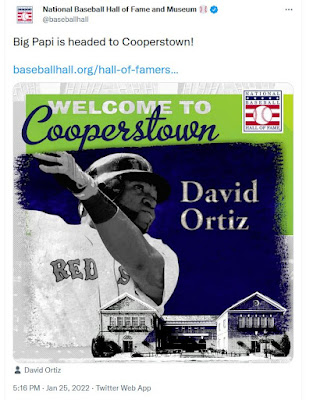
Don't get me wrong. I'm happy for David "Big Papi" Ortiz. He was a very gifted player; his stats are very good. A career WAR of 55.3 puts him 29th on the list of all-time great first basemen (which is where he played on the field, when he played on the field, which was not all that often). Behind many all-time greats, ahead of a few.

But Big Papi's career WAR of 55.3 pales besides the career WAR of 162.7 put up by Barry Bonds. Big Papi finished in the top 10 of MVP voting seven times; Bonds won the MVP award seven times. Big Papi finished with 541 career home runs, good for 17th place on the all-time list. Bonds, of course, is the all time home run leader, with 762.

David Ortiz got elected to the Hall of Fame yesterday -- the first time he was on the ballot. But Barry Bonds did not get elected to the Hall of Fame yesterday, on his 10th, and last, year of eligibility.

This makes no sense to me. None.

Also denied entry into the Hall of Fame yesterday, on his 10th and final time on the writers' ballot, was 354-game winner and seven-time Cy Young Award-winner Roger Clemens, the most dominant pitcher of his generation. Perhaps any generation. In 1986 he won the Cy Young and the MVP.

Oh, sure, you say. You know how to explain the difference between Ortiz, on the one hand, and Bonds and Clemens on the other: In a word, Steroids.

Except... David Ortiz tested positive for steroids in 2003. In a clear HIPAA violation, which to my knowledge was never investigated or prosecuted, the results of confidential steroid tests taken voluntarily by several players in 2003 (including Ortiz and his current Fox Sports studio partner Alex Rodriguez) were leaked to the press in 2009.

And, again, I'm not raining on Big Papi's parade. I'm happy he's in. In a piece this morning on Yahoo!sports, Hannah Keyser writes (and I agree),

None of this is to cast aspersions on Ortiz’s election. He played well into the current era of regular standardized drug testing and, after that survey testing in 2003, “I never failed a test,” as he said. “So what does that tell you?”

Bill Madden, in today's New York Daily News, does rain on Big Papi's parade:

In his 2018 book “Baseball Cop”, Eddie Dominguez, a high ranking Boston police detective and former FBI and DEA task member who was part of MLB’s since-abolished internal investigation unit, chronicled his three-year investigation of Big Papi and the Red Sox’s DH’s close association with an alleged Dominican drug dealer called “Monga,” who was in the U.S. illegally.

As part of the investigation of “Monga” and his involvement with PEDs, it was discovered that he was a frequent visitor to a Dominican barbershop in Boston with a gambling parlor in the basement, where witnesses said, he was placing large bets on Red Sox games in 2005. Just after Ortiz was presented with this information by MLB investigators, the barbershop abruptly closed. Dominguez reported that he was finally able to get “Monga” banned from the Red Sox clubhouse (where he’d been Ortiz’s constant companion), only to see him on TV, on the field at the 2006 All-Star Game Home Run Derby in Pittsburgh, toweling off Big Papi and the other Dominican players. When Dominguez voiced his outrage to his superiors at MLB, he was informed that Ortiz had told then-Commissioner Bud Selig and his deputy, [current Commissioner Rob] Manfred, that if “Monga” and his posse were not allowed on the field, he would not participate in the Home Run Derby. Not long after, “Monga” was arrested at Ortiz’s house, where he was staying, and deported for immigration violations.

But so what? People in New York are always hating on Boston players.

Besides, that's not the point.

The point, if you read Madden's linked column, is that he eliminated all the "PED cheats" from his ballot before making any selections.

Just like a significant number of his sportswriting brothers and sisters.

Sanctimonious hypocrites all.

Look, I lived through the Steroid Era. I remember. I remember the hype when Sammy Sosa and Mark McGwire both went for 60 home runs in a season. Baseball officially promoted the heck out of this. I remember the ad campaigns -- like "chicks dig the long ball." I remember Sosa showing up to Spring Training one year looking more like the Michelin Man than a baseball player and the sportswriters asking him where he got his new muscles. "Flinstones Vitamins," he said, and all the sportswriters guffawed.

But they knew. They knew then. José Canseco did not have to write his book for the sportswriters to know. Anybody with eyes could see how enormous Sosa had become, and Bonds, and others.

The writers didn't care. The owners didn't care. The sponsors didn't care. They celebrated home runs and the man-mountains that hit them. Because these behemoths brought the fans back to the National Pastime after the 1994 strike.

Look: I am not saying steroids are good. Or that they should be legal for players to take. Or that taking steroids wasn't cheating, even during the Steroid Era.

Obviously, taking steroids is bad. When not medically necessary, steroids are bad for the persons taking them. Looking the other way at steroid users was not fair to the persons who didn't take them, and who were forced out of baseball by walking chemistry experiments. It was, in fact, cheating.

So is throwing a spitball. And, yet, the most successful spitball pitcher of the modern era, Gaylord Perry is in the Hall of Fame. He never got caught -- nudge, nudge, wink, wink -- and, yet, somehow, everybody knew.

Baseball was never a gentleman's game. There has always been a notion in many sports, and in baseball in particular, that if you ain't cheatin' you ain't tryin'. Eventually, some things may be ruled beyond the pale. As has happened now with steroids. And that's all well and good.

But sportswriters should not pretend to be shocked or appalled or outraged or even a teensy bit upset about players accused of juicing during the Steroid Era, not when they were celebrated and admired and lauded and applauded even as they looked less and less like standard-issue humans. You might contend that some of the sportswriters having ballots now were not sportswriters then and this is undoubtedly so. But they should know, better than most, that their predecessors ignored or at least winked at steroid usage until MLB finally decided to clamp down for real.

The bottom line is this: You have this museum supposedly honoring the greatest players ever to play baseball -- and then you deny entry to baseball's greatest players because maybe they juiced. Oh... and maybe they were jerks, too, especially to the writers. If this is the standard, let's change the name from Hall of Fame to Hall of Sportswriters' Favorites.

And one more thing. What with FanDuel and DraftKings and every casino and sportsbook in the nation having official sponsorship deals with MLB or MLB teams... does it make any sense to still keep Pete Rose out? How about Joe Jackson?

No... it doesn't.

Today, the Hall of Fame is a farce, now more than ever. That doesn't mean Big Papi isn't a Hall of Famer. He is. And was, before yesterday's votes were announced. But so is Barry Bonds. And Roger Clemens. And Joe Jackson (who, even if his share of the gamblers' money was left on his hotel bed, never did one thing to hurt the White Sox in the 1919 World Series). And even Pete Rose, who bet on baseball before it was permitted. Put 'em all in the Hall. Put asterisks on their plaques if you must. But tell the whole story. Or close the Hall down.

Wednesday, January 19, 2022

The removal of content from Nexis threatens us all

It was just another email, one among hundreds, many of them survey requests of one sort or another.

At least this one was from a company with whom I do business.

I was probably never going to answer it. I know the Millennials and Zoomers respond to surveys as a matter of reflex. When no one thinks to ask their opinions, Millennials and Zoomers write reviews anyway. But this is not how I was brought up.

I imprinted on Mike Royko's position (paraphrasing here): If trapped into answering a survey (or poll), lie. But better by far not to get trapped.

I will admit that I have read online reviews from time to time. There are so many gizmos I know nothing about; sometimes I think that maybe, just this once, reading reviews will help me decide if I want to buy this product or that one. But then I read the reviews: About half seem as if they were written by the seller's mother; the other half appear to have been written by the seller's competitors. Or worst enemy from junior high.

Not helpful.

I looked at the first question on the survey:

As a valued Lexis customer, your feedback is very important to us and will help us prioritize improvements to our products and services.

Please begin our short survey by answering the first question below:

How likely are you to recommend Lexis to a colleague, associate or friend?

I was supposed to respond on a scale of 0 to 9 where 0 means "not if you put a gun to my head" and 9 means "with me around you'll never need to pay for advertising."

If I answered that question, the survey would continue online.

But I wondered whether completing the survey would give me a real opportunity to express my serious issues with Lexis/Nexis -- and, if I did, whether anyone in authority would read and address my concerns.

After I stopped laughing at myself for having such a ridiculous thought, even for a nanosecond, I concluded that I would have a better chance of reaching the decision makers at RELX, Inc. (the current corporate overlords of Lexis/Nexis) if went into my backyard and screamed my concerns into an indifferent wind or if I wrote about it here. Writing about it here seems less likely to trigger the involvement of the police, so here we are.

I pay several hundred dollars a month for the privilege of access to Lexis and Nexis. There are far more economical ways to keep track of Illinois case law. But, from time to time, when I have had insurance coverage work (as I used to, anyway, before the Pandemic) I have discovered that, while the reviewing courts of Illinois might not yet have had an opportunity to weigh in on the meaning of a particular policy provision or endorsement -- some court in Oregon or Florida or Montana has. If you promise to pay Lexis enough money each month, Lexis will grant you search capabilities for all federal courts and the reviewing courts of all 50 states.

I promised to pay.

To get the best possible (i.e., lowest) price for this access, I had to agree to a term of years.

But, to overcome my resistance, I recieved access to Nexis as well.

At one time, Nexis had a comprehensive library of every major newspaper in the world, and most of the minor ones. Maybe I couldn't read today's Washington Post or New York Times on Nexis -- but everyting would become available in a day or two.

Having access to the Tribune and Sun-Times archives was particularly helpful for me when researching judicial candidates. Lawyers in private practice routinely put all sorts of stuff on line hoping to snag a unicorn, such as a client with a good case and the means and willingness to pay for it -- but career prosecutors or PDs don't have those concerns. And, at one time, though our newspapers very seldom covered a civil case, they published all sorts of stuff about doings in the Criminal Court.

But that was then.

As newspapers have erected paywalls around their content, they have also stopped sending content to Nexis and, in many cases, removed their content entirely. The Chicago Daily Law Bulletin was one of the first to disappear. I may still have been on Westlaw when that happened. Not only did I lose an invaluable resource for keeping track of judicial candidates, a decade's worth of columns I wrote for that paper disappeared as well. Vanished down the memory hole. But I had my original (unedited) articles. So my work was not entirely lost. Also, I still had a subscription to that paper (though it has since lapsed) and, while I missed the ability to conduct proper searches on judicial wannabes, I coped.

Recently I had a story idea that required me to search past issues of major newspapers in an effort to confirm my recollection of events a year or two past. But Nexis was the online equivalent of a ghost town. I could find nothing.

Sure, sure, you say. If I weren't such a cheapskate, I'd have bought subscriptions to all these 'papers of record' and then I'd have access to the information that I sought. Granted, I've made no secret of my disdain for digital subscriptions and the random pricing thereof. And because I don't have separate subscriptions to each of these publications, I can't say with certainty that they are less searchable than was Nexis. But, the truth is, I was already paying for subscriptions to all these papers, via Nexis.

And now Nexis has been effectively emptied. Though the price Lexis/Nexis (or RELX, Inc.) charges me has not decreased by a penny.

If you've stayed with me to this point, you may be experiencing pangs of regret: Why should you have to put up with my whining about paying for services not received? You have problems of your own.

And I'm sure you do. But, I humbly submit, whether you know it yet or not, this problem with Nexis is another problem for you. How can a newspaper be a 'paper of record' if there's no independent record of what it said on any given day? Libraries will have pre-Nexis microfilms; we've all used these at one time or another in our pasts. But did libraries continue to microfilm newspapers that were available on Nexis?

I've never been entirely comfortable with putting our official reports -- our Illinois case law -- online only. I'm sure the court system has the best possible security. But computer security evolves, action and reaction, strike and countermeasure. But this much remains certain: No hacker can ever change a book.

Now our courts have every reason to ensure the veracity and accuracy of our case law. In a profession that celebrates the doctrine of stare decisis (if sometimes only in the breach) we need to know what was said, and by whom, and how, before we can follow or abandon the principles espoused in the cases.

A "media" company is under no such obligation, legal or moral. Without a Nexis to preserve it, if a past story becomes embarrassing, it, too, can be pushed down the memory hole. Times change. Opinions change. Opinions that were mainstream a century ago, or even a decade, or maybe even a year ago, may now be inconvenient or worse. An old article may be jettisoned. Or rewritten to suit current fashions. And who will be able to contradict it without Nexis or some comparable national archive? New ownership may wish to 'sanitize' the unsavory opinions expressed in the property just acquired. If the Murdochs ever fade away, their successors may be mighty tempted....

We celebrate newspapers as the 'first draft of history.' But if we are to understand our history, and learn and grow from it, we need convenient access to those unedited first drafts.

Wednesday, January 12, 2022

Chicago Christmas Tree recycling available until January 22

Here are the locations (click on the image to expand or clarify). At six of these parks you can take some mulch home with you:

And, yes, I know the graphic refers to "Holiday" trees, not Christmas trees. But I doubt that anyone who has actually put one up has ever referred to their tree as a "Holiday tree." And, if you don't put one up, you presumably don't care what the thing you don't have may be called.

----------------------------------------------------
Related: Where to recycle broken holiday lights

Tuesday, January 11, 2022

Ephemera on Facebook triggers a memory

The late Avy Meyers, of blessed memory, used to suggest that this blog (he was talking about page one, not this adjunct, though it has the same name) was named for the Buffalo Springfield song.

Of course, I never contradicted him -- though, truth to tell, the real reason for the name was more lawyerly. Particularly in a bench trial, when a judge receives a piece of contested evidence, perhaps of dubious provenance or relevance, usually over the vociferous objection of opposing counsel, and to just get on with it already, the learned jurist will say (often with some exasperation) that the evidence will be admitted "for what its worth." Often signalling that its worth may not be much at all.

Still, when I saw this on Facebook this morning, I couldn't help but think that Avy would have liked it:

Tuesday, January 4, 2022

Testing our patience, but not testing potential patients

I think the virus is mocking us. It is surely testing our collective patience.

I'm fully vaxxed and boostered and so, now, as of yesterday, I can go to any restaurant or gin mill in the City of Chicago and/or the County of Cook and eat and drink to my heart's desire. Which I have absolutely no desire to do.

Near as I can tell, most people in my shoes (in my quivering boots, some may say) are reluctant to venture out in the world lest the virus follow us home. It has to be tough to own a bar or a beanery right now.

Part of the timidity of so many among our fully-vaccinated is the deliberately frightening tone of the media coverage. (If you have an extra 4:23 or so, you may wish to watch the video embedded in the linked Substack article by Matt Taibbi and Matt Orfalea -- very dark, but humorous.)

I do not take lightly a disease that has killed more than 820,000 of my fellow Americans (according to figures published by the CDC) since it first came to our shores in early 2020... or maybe late 2019.

But things have changed since COVID-19 first imposed itself on our collective consciousness, right?

We have a vaccine now -- several vaccines, actually, and more in the pipeline -- which, while not always preventing Covid infection entirely, seem very effective at protecting vaccinated persons from the worst consequences of Covid -- like death, for example, or even hospitalization.

Of course, hospitalizations are rising -- soaring, actually, in many places, including right here in Illinois: An IDPH press release dated December 30 states that, as of the evening of December 29, "5,689 individuals in Illinois were reported to be in the hospital with COVID-19. Of those, 1,010 patients were in the ICU and 565 patients with COVID-19 were on ventilators."

But, we are told, repeatedly, that the overwhelming majority of those hospitalized for Covid have not been vaccinated. They are the scoffers. The deniers. The quoted IDPH press release ends with a familiar mantra: "Vaccination is the key to ending this pandemic."

That's right... isn't it?

The scoffers should be a self-correcting problem. Please understand: I am not some ghoul, thirsting for the demise of my 'less enlightened' fellow citizens. There are such persons, as even casual reference to Facebook or Twitter will document. But I am not one of these. Nor am I referring to the several, widely reported deathbed conversions of committed anti-vaxxers.

All I'm getting at is that many scoffers who may not believe there's a serious problem -- who reflexively discount as overblown or even fabricated much of what they see or hear online or in the media (except that which agrees with their preconceived notions) -- will, according to the law of averages, and the relentless spread of the virus, eventually catch the Covid, or someone near and dear to them will. At that point, they will presumably 'get religion' and seek out their shot. It's one thing to refuse to believe in the MSM, it's quite another to deny the evidence of one's own eyes. Or lungs. However -- if the only people they know who get the virus suffer no ill effects or have only mild symptoms -- that's fine, too. It is a matter of scientific fact that some people are naturally more resistant to viruses than others. And if some scoffers possess a natural resistance to COVID-19, then, despite their refusal to be vaccinated, these persons will not clog up the healthcare system. The point is, the pool of susceptible scoffers will continue to diminish and, eventually, dry up.

And, maybe, sooner rather than later.

Because the virus seems to have changed, too.

Several sources -- including, tentatively, provisionally, even Dr. Fauci himself -- are suggesting that the new omicron variant of the Covid bug is more contagious... it will spread around like wildfire, just as current figures would indicate... but it is also less likely to result in death or serious illness.

That's good news. Not that I want another cold virus running through the population each winter -- but I'll take that any day over a potentially lethal virus, especially one with lingering consequences for many of those who ostensibly 'recover.' As Covid first presented.

We've learned a lot about how to deal with Covid... haven't we?

It's not just vaccines: The benefits of mask-wearing -- once controversial even among scientists -- are widely accepted now. It turns out the Japanese, among others, were way ahead of the game on this. I may never ride the subway again without a mask.

And I would like to think we always knew about the benefits of hand-washing. Certainly our mothers did.

Modest measures make a difference.

So why aren't things back to "normal" yet?

Besides the fact that there are so many scaredy-cats like me, and the fact that media outlets get more bucks and clicks if we stay scared, there is the slight problem that COVID-19 is a master of disguise.

Unless and untill it turns serious, Covid resemmbles an ordinary cold in many cases, or a normal flu in others. The list of typical Covid symptoms is basically a list of complaints that virtually all Chicagoans have between November and April: Clogged sinuses, alternately stuffy and runny nose, sore throat. Some people have Covid and never show any symptoms at all.

How can you stay home when you're sick if you don't know you're sick?

Fever may be an indicator that one has more than a normal cold. But it may be only the flu.

Vomiting or diahhrea may indicate Covid... but may be just a norovirus.

The CDC says testing is the key to determining whether one has Covid or something else.

But existing Covid testing is not recommended, and not as reliable, until five days after potential exposure. Which prevents the early intervention of treatment strategies that may stave off the worst consequences of Covid. And one is contagious with Covid for a day or two before any symptoms appear -- if any appear at all -- so the date of exposure may be difficult, or impossible, to pinpoint. Because of the absence of timely testing, and despite the best of intentions, an infected person, even a vaxxed and boostered one, may wander about unwittingly infecting everyone around.

If there were enough tests to go around, and if these weren't as invasive as the nasal and throat variety that seems to predominate currently, maybe then we could confirm our non-Covid status every time we wish to go abroard in the world. Or perhaps to a saloon.

But the tests would have to be available for the vaxxed and unvaxxed alike. And they'd have to be reliable. And then unicorns would dance in the fairy glens and we would all have jetpacks, too.

Realistically, because reliable, prompt, ubiquitous testing is not and will not be available anytime soon, the only solution may be (a) get your shots, (b) wear masks in crowds or in public indoor spaces, and (c) hope that Covid continues to moderate.

Monday, December 27, 2021

Lessons from the Funny Pages, Part 456

Yesterday's installment of Tim Rickard's Brewster Rockit: Space Guy. I've been thinking this for some time, too. You probably have as well:
This seems like a good idea, but there's not enough booze to make this work. From recovering lawyer Stephan Pastis' December 23 Pearls Before Swine:
Ed Kudlick, the fictional lawyer in Dustin, by Steve Kelley and Jeff Parker, engaged in this bit of wishful thinking on Christmas Day:
Ed Crankshaft is a great-grandfather in Crankshaft, by Tom Batiuk and Dan Davis. But, I can attest from personal experience, this works for mere grandfathers as well:

Wednesday, December 8, 2021

Here is the text of the Potential Candidate Agreement, Promise and Pledge that the Cook County Democratic Party is asking all candidates to sign by Friday

A story about this document is at this link on Page One.

POTENTIAL CANDIDATE AGREEMENT,
PROMISE AND PLEDGE

  1.   I, the undersigned, recognize and understand that both the inherent and explicitly stated purposes of the Cook County Democratic Party (“Party”) include the following:
  (a)   That it attracts, endorses, and supports qualified Democratic candidates for election to public office; develops positions on issues of public importance; advances the ideals and principles of the Democratic Party; and seeks to improve the lives of the people of Cook County through effective, efficient, and fair government;

  (b)   That it welcomes persons who volunteer, contribute to, support, advance the interests of, or participate in, the activities of the Party;

  (c)   That the collective interest of the Party is best achieved by the coordinated and unified effort by Party members in all 80 wards and townships standing together in support of all those persons ultimately endorsed by the Party who form a cohesive slate of candidates reflecting the rich diversity within Cook County regarding race, color creed, national origin, gender, geography, physical ability and sexual orientation; and

  (d)   That the Party has the right to organize under rules and procedures of its own choosing; to exercise discretion in conducting its affairs, and selecting and disciplining its leaders, members, and nominees; and to enforce its own By-Laws.

  (e)   Further, the right of the Party to make nominations and endorsements is a political privilege which is exercised in accordance with the will of the Party, as expressed through its By-Laws, customs, conventions, caucuses, policies, procedures, and rules;

  (f)   The Party, through the Cook County Democratic Central Committee has the right to make endorsements for public office and to withdraw endorsements previously made; and

  (g)   The Officers of the Executive Committee of the Party, as well as the 80 Cook County Ward and Township committeepersons, serve the Party as managers of the political campaign and they are charged with the responsibility of advancing, organizing, and supporting efforts to secure the election of the Party’s endorsed and nominated candidates.
  2.   I acknowledge that Party endorsement is not a right but sought at my request. If earned, it is a political privilege. By freely and voluntarily seeking Party endorsement for nomination for a Cook County political or judicial office appearing on the ballot at the June 28, 2022 Primary Election, I understand that I am obligated to, and hereby agree, promise, and pledge to:
  (a)   abide by the Party processes and procedures for seeking such endorsement;

  (b)   produce such biographical, professional, and other materials, and supporting credentials documentation, evaluations, and recommendations as may be requested;

  (c)   accurately and honestly respond to any questions or inquiries made of me;

  (d)   if endorsed, timely provide my allocated proportionate share of financial contribution necessary to support and underpin the Party’s efforts on behalf of my candidacy and that of the entire endorsed slate of candidates.
  3.   In addition, should I be endorsed for a Cook County office by the Party for the June 28, 2022 Primary Election, I further agree, promise, and pledge as follows:
  (a)   I will not personally (or through my campaign committee or operatives within my control) engage in any activity “actively opposing” any other person who has been endorsed by the Party for nomination and election to a Cook County office. The term “actively opposing” shall mean to aid and/or assist a non-endorsed candidate with direct or indirect financial contributions, political workers and volunteers, political paraphernalia or advertising, and/or media, consulting, technical, polling, direct mail, social media or telephone-banking or similar support. Such adverse efforts serve to advance the interests of a non-endorsed candidate and simultaneously oppose the interests of an endorsed candidate.

  (b)   I will not personally (or through my campaign committee and operatives within my control “endorse” or “support” any other person who is running against anyone endorsed by the Party for nomination and election to a Cook County office. Consequently, I will not permit the use of my name, campaign advertising (including billboards, handbills, mailings, political paraphernalia, print, radio, signage, telephone-banking or robotic calls, television), campaign letterhead or literature, personal likeness/photograph, public statements, posts or communication on social media (including Facebook, Instagram, Twitter, and the like, or email and text-messaging), and personal or campaign website to be used to aid, assist, advance, or promote a non-endorsed candidate.

  (c)   Specifically, if seeking endorsement for judicial office, and I am not endorsed but I am designated as an “alternate”, I will not run against any person who has been endorsed by the Party for any Cook County judicial office. My failure to abide by this provision shall result in forfeiture of my “alternate” status and withdrawal of any anticipated Party support.
  4.   I, the undersigned potential candidate, hereby voluntarily accept, endorse, subscribe to, and solemnly agree, promise, and pledge myself (and my campaign or operatives within my control) to act in accordance with the above principles. I understand failure to do so shall result in withdrawal of any endorsement which I may have received from the Party and exclusion from any of its activities or efforts which would have otherwise been undertaken on behalf of my candidacy.

[Signature line omitted]

Thursday, November 18, 2021

You know what? This guy makes a lot of sense

Not me, certainly. I refer to the creator of the above Facebook meme (I believe that's a correct usage of the technical term).

We are, as of this morning, five weeks out from Christmas.

Granted, those five weeks will pass by in a flash -- an eyeblink -- a heartbeat -- unless, of course, you're six years old. In which case, these weeks will seem to drag interminably.

It always amazes me that former six-year olds get to high school and claim to be baffled when the physics teacher instructs that time is relative. Somehow they most always forget their own personal experience of relativity. (They will be forced to learn the truth of the teacher's words later on, too, such as when they stop off at a tavern on the way home from work: Inside only a few happy minutes will seem to have gone by, while, outside, dinner plans will be ruined -- but that's outside the scope of our discussion today.)

Unless you work in retail, the Christmas season can not and should not start until after Thanksgiving.

The creator of the above Facebook meme refers to the "war" on Christmas.

There are grumblings and rumblings about this "war" every year. But the battlefield has certainly changed in my lifetime.

When I was young, the perceived problem was that Christmas had become too commercial. That was the central complaint in the 1947 classic, Miracle on 34th Street. (One further necessary digression: Miracle on 34th Street is perhaps the greatest movie ever made about lawyers, if you think about it -- in what other movie are all the lawyers good guys?)

Commercialism was still on the front lines of the War on Christmas in 1965, when A Charlie Brown Christmas first aired.

Now, though, commercial establishments are themselves the front lines of the "War on Christmas," because some people take umbrage when store clerks say "Happy Holidays" instead of "Merry Christmas." Aren't we making Christmas less commercial when we use the generic "Happy Holidays" greeting?

Christmas is originally a religious holiday, obviously (we'll leave aside, for the moment, the discussion over whether the early Church coopted the Roman feast of Saturnalia or decided to celebrate the birth of Jesus on the proclaimed birth date of Sol Invictus), but, over the years, Christmas has acquired an enormous, even overwhelming, secular overlay -- Ebeneezer Scrooge (and his many spectral visitors), Christmas trees (pagan in origin, popularized by Queen Victoria and Prince Albert), Santa Claus (popularized by Clement Clarke Moore, Thomas Nast, and whoever drew the artwork for Coca-Cola), Rudolph the Red-Nosed Reindeer (originally a promotion for Montgomery Wards), chestnuts roasting on an open fire, Frosty the Snowman.... So many non-Christian stories and customs have been piled onto Christmas that it can be arguably compatible with the traditions of persons of any faith or none at all. Anyone who aspires to peace on earth and good will toward humanity can celebrate it, regardless of whether they believe the message was delivered by angels we have heard on high.

But, however you want to celebrate the holiday season, just hold off until after Thanksgiving, OK?

Monday, November 8, 2021

Apparent complicity: The fatal flaw in streaming

Today's Dustin comic (by Steve Kelley and Jeff Parker) illustrates a dilemma that may be familiar to many readers: trying to figure out what program to stream.

The old joke was that, when we were kids, there were five channels (2, 5, 7, 9, and 11) and there was nothing on. (Channel 26 came later -- remember the bullfights? In an apparent nod to American sensibilities, they always cut away before the bull was dispatched. Still later came Channels 32 and 44, the latter with White Sox games, Harry Caray and Jimmy Piersall, and Falstaff beer commercials.)

Anyway, once upon a time, there were five channels, with nothing on. But at least it was free. Then came cable, with 500 channels, and still nothing on. And we had to pay for the privilege. And now we have streaming... 50 different streaming platforms, some free, some for-a-fee, 5,000 channels, and it's harder than ever to find something to watch. The Office and Friends are more popular now than ever as the Ed Kudlicks of the world often settle for the TV equivalent of comfort food.

But the extravagant number of choices alone is not the only thing that makes choosing a program so difficult: When we choose to stream a Hallmark Holiday movie, or the Tiger King, or the Honey Boo Boo Reunion Tour (if that's not a thing yet, I'm sure it will be) we are in a real sense endorsing the content.

Statistics are kept. Numbers are crunched. And you, the viewer, are branded.

And it's worse than tuning into a rerun of Gilligan's Island on a UHF nostalgia channel. Yes, estimates are made of who has watched that show, and perhaps, if the channel was accessed via cable, a record is made of your particular visit to that station for that purpose. That record may or may not be entirely anonymous.

However, should you happen to turn on your cable or broadcast TV again, your last visit to Gilligan's Island will not be displayed for anyone watching with you to see: "Because you watched Gilligan's Island" -- and the streaming home screen will offer all sorts of allegedly similar video offerings. I know it's meant to be helpful, allowing you to make new choices more quickly. But you are labeled just the same.

I suppose we will get used to it in time. Just as we got used to the pharamacy knowing when our medication refills were coming due. Or how we got used to Amazon knowing when we probably need razor blades or books we are likely to read or movies we are likely to buy. But it's creepy nonetheless.

Besides, whether you flip over to Green Acres on UHF late at night or not, it will still be broadcast. Until someome takes it out of the programming rotation. But when you select that same show from a streaming platform, not only will the next person who looks at your TV know what you did, you are in some personal sense complicit in keeping that particular show available. You have voted for it. You have endorsed it. It adds a degree of difficulty, and an extra burden of responsibility, to making that streaming choice. Which, whether you realize it or not, or whether, in the comic above, Ed Kudlick realizes it or not, makes the choice of a program to watch that much more difficult.

Wednesday, November 3, 2021

We can't blame this on 'supply train disruptions' but it's happening anyway

The warnings are everywhere, even in this morning's edition of Curtis, by Ray Billingsley: Supply chain disruptions are threatining the giddy consumer excesses of the forthcoming Christmas holiday.

Also in USA Today: "Christmas trees, sweaters, gifts in shipping mess: How supply chain issues will affect holiday shopping." So, too, on Bloomberg.com: "Christmas at Risk as Supply Chain ‘Disaster’ Only Gets Worse."

Untold numbers of ugly Christmas sweaters, plastic geegaws for the kiddies, and coffee mugs with pithy slogans that would make great stocking stuffers or office grab bag gifts -- all these and so much more are marooned off our Pacific coast, trapped in wallowing container ships, escalating our holiday anxieties. And it may not just be the stranded ships. Thanks to COVID-19 realignments, there aren't as many truckers or warehouse workers or order takers or anyone else willing to get what you want to get for Christmas to a store (or front porch) near you. Apparently you are best advised to grab whatever you can get right now, paying full price if necessary, because, this year, unless you get what we got now, there won't be anything to get when you'd otherwise be ready to get it.

So "they" say.

But we need not wade into the thorny dispute over whether immediate Christmas shopping, even before the neighborhood squirrels have finished gnawing all the Halloween pumpkins, is really and truly necessary. Time will tell whether supply chain hysteria was or was not warranted.

One thing we know for sure: There is and can be no supply chain disruption involving Christmas music. Christmas music will be readily available when Advent starts, at the end of this month. Mariah Carey, Elmo and Patsy, and Dominick the Christmas Donkey can wait in the wings a while longer yet; we will certainly be able to find them when the time comes.

Nevertheless, despite the fact that no supply chain issue threatens its ultimate availability, Robert Feder reports that WLIT will start playing Christmas music today. This afternoon, in fact. Starting at 4:05 p.m.

Did it really need to be this way?

Wednesday, October 13, 2021

Today's Blue Origin flight successful; this Shatner picture is now funny

This morning's suborbital Blue Origin flight, carrying 90-year old William Shatner, a/k/a James Tiberius Kirk, to the edge of space was a success (linking to CNN coverage), and all hands have returned to terra firma whole and intact.

Accordingly, now I can enjoy (and share) this picture:

(Photo obtained from Captain Kirk: The Man, the Myth, the Legend via Facebook.)

Thursday, October 7, 2021

October 8: The 150th Anniversary of the Great Chicago Fire

This is an edited reprint of a post that I first ran here on October 7, 2014. Not only is this the 150th anniversary of the Great Chicago Fire, I just put up a review of a new book by a college classmate on page one that suggests that Chicago was burned by a band of Confederate die-hards. So, naturally, this post does not address that theory -- but it does provide a number of other anecdotes that the reader may enjoy. Links have been updated or removed where necessary. A lot of the original links are no longer active, seven years down the road.

Currier & Ives lithograph obtained from the Chicago Historical Society

You probably remember that October 8 is the anniversary of the Great Chicago Fire.

State and Madison after the Fire
School children are probably not required to memorize the gruesome statistics of the fire anymore, but they are readily accessible on Wikipedia: The fire destroyed an area about four miles long, averaging averaging 3/4 of a mile in width. Roughly 17,500 buildings were destroyed; property damage was estimated at $222 million. One in every three Chicago residents -- roughly 100,000 of the City's total 300,000 population -- was made homeless by the fire. There were 120 bodies recovered after the fire, but authorities estimated the actual death toll at up to 300.

Most folks don't remember this, but the Chicago fire destroyed the records of two Illinois counties -- Cook, of course, but also DuPage. In 1871 Naperville and Wheaton were literally up in arms over which town should be the seat of DuPage County and the county records were removed to Chicago for safekeeping.

Ooops.

And yet -- believe it or not -- the Great Chicago Fire was, in many ways, the smallest of three major fires in the Midwest on October 8, 1871. Over on the Lower Peninsula of Michigan, a number of cities, including such widely scattered burgs as Holland, Manistee, and Port Huron, were damaged or lost entirely in a series of fires collectively referred to as the Great Michigan Fire. There were not as many lives lost in the Michigan fires, but more land and timber was damaged in these fires.

Mass grave at Peshtigo. © Deana C. Hipke.
There may have been 300 people killed in the Great Chicago Fire, but the mass grave shown in this picture, in a picturesque cemetery next to the converted church that serves as the Peshtigo Fire Museum, is the final resting place of roughly 350 unidentified victims of the Peshtigo Fire.

At least 1,200 people died in the Peshtigo Fire, some 800 in the town of Peshtigo alone (roughly half the population of the town); the total death toll may have been as high as 2,500. Whole families were wiped out; in many cases there was no one left, after the fire, to remember who'd been lost.

The firestorm was so intense that the flames jumped right across Green Bay, damaging large portions of the Door Peninsula. It also spread into the nearby Upper Peninsula of Michigan, ultimately damaging an area twice the size of Rhode Island.

One area that was not involved in the Peshtigo Fire, though it was in the path of the flames, was the Shrine of Our Lady of Good Help, in New Franken, Wisconsin.

Many believe that the Virgin Mary appeared at this site on October 9, 1859 to Adele Brise, a young Belgian woman. A church and school were built there because the Virgin told Brise to teach religion to children. In 2014, when this post originally appeared, the website of the Catholic Diocese of Green Bay recounted:
When the Peshtigo Fire spread across Green Bay on Oct. 8, 1871, area residents walked around the chapel grounds all night praying the rosary and carrying a statue of Mary. Everything outside that five-acre area was burned.

Every year on Oct. 8 people reenact the procession at the Shrine.
A church was also saved from disaster in Chicago, too, but that story is somewhat less impressive.

Fr. Arnold Damen, S.J. founded Holy Family Church in 1860 and St. Ignatius College in 1870 (the immediate ancestor of both St. Ignatius College Prep, which is still at the original site, and Loyola University Chicago) in what was then the middle of nowhere. But that isolated location was uncomfortably close to the infamous O'Leary barn when the Great Chicago Fire broke out, only about 3/4 mile away. Cecil Admams picks up the story in a Chicago Reader Straight Dope column from 2009 (emphasis in original):
When the Great Fire began, the wind was blowing out of the southeast. Holy Family and Saint Ignatius were directly west, and arguably would have escaped the flames had conditions remained unchanged, but Father Damen was taking no chances. In the version of the story I initially heard, he stood on the front porch of Saint Ignatius and prayed to the Almighty to spare his life's work. This was embroidery. In reality his prayer was offered up in Brooklyn, where he was preaching at the time. No matter; the Lord could hear him there just as well. Father Damen vowed that if his prayers were answered, he would keep seven vigil lights burning before an image of the Virgin.

The wind shifted. Formerly it had been driving the fire toward the outskirts of town; now it began to blow out of the southwest, pushing the fire northeast. You see the implications of this. The church and school were saved. Instead, the conflagration burned down the rest of Chicago.
But, Adams adds, the City Council did not hold a grduge: Damen Avenue was eventually renamed in Fr. Damen's honor.

Wednesday, October 6, 2021

How are YOU celebrating World Space Week?

According to the United Nations, World Space Week runs this year, and every year, from October 4-10.

Why? Because on October 4, 1957, the old Soviet Union launched Sputnik 1. Then, on October 10, 1967, the Treaty on Principles Governing the Activities of States in the Exploration and Use of Outer Space, including the Moon and Other Celestial Bodies (sounds like something the UN might draft, doesn't it?) entered into force. (Yes, in case you're wondering, the United States has ratified this treaty.)

So... how are you celebrating this year?

For one of my favorite comic strips, Tim Rickard's Brewster Rockit: Space Guy!, pretty much every week is Space Week. But this week Mr. Rickard is recycling a plot first served up in Douglas Adams' The Restaurant at the End of the Universe and melding it with the sneering news coverage of billionaires venturing into space:

You may not immediately recall what happened to Ship B of the Golgafrincham Ark Fleet and its millions of telephone sanitizers, hairdressers, "tired TV producers, insurance salesmen, personnel officers, security guards, public relations executives, [and] management consultants" -- fully a third of the planet's population -- traveling in suspended animation. (They crash-landed on Earth two million years in the past, leaving the indigenous, evolving hominind population terminally depressed and bound for extinction.)

You likewise may not recall the sad fate of Golgafrincham. (Having conned all the useless members of their society off the planet with wildly varying stories about the planet being doomed -- my favorite was that an enormous mutant star goat was going to eat the planet -- the "other two-thirds stayed firmly at home and lived full, rich and happy lives until they were all suddenly wiped out by a virulent disease contracted from a dirty telephone.")

But even without catching the literary reference, most readers will probably smirk right along with the idea that billionaires should be banned from space or, if allowed to go at all, given one-way tickets only. Har har. And let's change the rules about who qualifies for official astronaut wings so that the person who bankrolled Blue Origin, Amazon's obscenely rich Jeff Bezos, can be denied his wings for putting his life at risk riding just past the internationally recognized boundary of outer space on his own rocket. Even though that meant that, once again, Wally Funk was denied official recognition.

In the first modern Age of Exploration, the analogs of the Bezoses and Bransons and Musks of today did not venture out in their wood and canvas ships in search of trade, gold, or glory. Oh, no, they limited their personal risk by staying home, directing affairs from London coffee houses and, in the course thereof, inventing the insurance business to limit their financial risks as well.

Who else -- besides governments -- could afford any sort of space exploration except for these flamboyant, egotistical billionaires? Hate on the uber-rich all you want, but governments have done a lousy job of space exploration because (surprise, surprise) they made it political: Richard Nixon couldn't wait to cancel the Apollo Program at the first possible opportunity precisely because it was perceived as the signature achievement of the Kennedy Administration. And the pattern hasn't changed any time the White House has changed hands: The new administration will announce its own grand plan -- and cancel those wasteful plans promulgated by its predecessor. It's a wonder the Space Shuttle ever launched or the International Space Station ever got built. But, by now, it must be no suprise to even the dullest among us that next year will mark the 50th anniversary of humankind's last trip to the Moon.

Compare that, if you will, to the development of aviation in the 50 years following Kitty Hawk. Governments contributed substantially to the development of aviation in that first half-century (see, World War I and World War II) but governments did not completely control it. As the governmental death-grip on spaceflight has lessened in recent years, even only slightly, the pace of development has finally quickened. And is becoming ever more rapid.

Which brings us back again to Wally Funk. This summer Funk became the oldest person ever to fly in space (at 82, she was five years older than was John Glenn, when he made his second trip to Earth orbit, in 1998, aboard the space shuttle Discovery).

If all goes as planned, Wally Funk's record will fall this coming Tuesday, October 12, when William Shatner, 90, better known as James Tiberius Kirk, will boldly go to space in a sub-orbital flight aboard another Blue Origin capsule.

Which leads to the funniest take I have seen about Shatner's upcoming flight. This is from an often funny, if sometimes juvenile, Facebook site called Captain Kirk, The Man, the Myth, the Legend:

OK... so I'm a nerd. But, if you got this far, maybe you are, too. In which case, live long and prosper, and enjoy the rest of World Space Week.

Wednesday, September 29, 2021

All PDFs are not created equal... at least not for e-filing

You might have read, or been told, somewhere along the line that PDFs are the universal file format. Everyone has at least Adobe Reader (to the point where we giggle smuggly at websites that offer users a chance to download the "Free Adobe Reader" program -- can we still say program instead of app?) and every device can open a .pdf file.

When e-filing started to menace the legal world, more than a decade ago, the concept was that all documents would have to be converted to PDFs. And even before that: I kinda, sorta recall turning in a 3.5" floppy disk with a brief I filed in the 7th Circuit back in 2003. I had to have help doing that from the good folks at Kinko's. I remember the employee in the clerk's office figuratively patting me on the head. "At least you tried," he said.

It wasn't too long after that when I went out and bought Adobe Acrobat. And at some point, relatively early on, I figured out that WordPerfect would print a file to PDF. Between Adobe and WordPerfect I eventually got pretty good at creating and efiling my documents (not that there weren't hiccups on the way). And there was one time that I scanned a lengthy Memorandum Opinion and Order into a .pdf file never noticing that, while trying to scan the two sided-pages, I somehow got them all jumbled. I used the Record copy in preparing my brief... but included the .pdf I had on hand in the Appendix, never noticing the problem... until I started printing out the court's paper copies. Kinko's again. Now FedEx Kinko's, but you know what I mean.

But, for the most part, I've struggled along, lurching awkwardly into the 21st Century.

Not too long ago, the Illinois Courts website started putting up Appellate and Supreme Court opinions and orders in .pdf files that my venerable copy of Acrobat would no longer open. That's not right -- "universal" standards should surely be backward compatible -- but Adobe Reader provided a free and easy workaround, so I didn't complain. Much. Where anyone could hear me, anyway. I probably should upgrade my copy of Adobe -- but when was the last time you saw Adobe Acrobat on the shelf in the store? (Noooooo... everything is a subscription download these days... but I'll spare you that rant, for now.)

The latest problem began just a few months ago. I needed to file a motion in an appeal in which I'd already appeared -- just a half dozen or so pages including the motion, supporting affidavit, proposed order, and proof of service -- nothing I hadn't done, without incident, dozens of times before. And the "envelope" was rejected -- not by the Clerk, mind you, but by Odyssey. Today, they called it a "submission failure." I didn't save all the emails from my initial encounters with this phenomenon, but I believe the terminology then was similar, if not identical.

Experienced and stubborn fellow that I am, I probably re-submitted my envelope a dozen or so times, always getting the same result, albeit at a steadily increasing pulse rate.

Eventually, I printed out my papers, handscanned each page into a new .pdf file, and submitted that. This, finally, went through.

But what had changed? I went looking for answers online. This is what the Odyssey site is saying today (click to enlarge):

"Enhancements"? That's an Orwellian use of a word; in the real world, an "enhancement" means something got better, not worse. WordPerfect may no longer be the leading word processing program; obviously, thanks to the monopolistic oppression of Microsoft, it hasn't been the industry leader for many years. But it is an infinitely superior program, IMO, to Word. (Indeed, Word has one---and only one---actual advantage over WordPerfect, namely, the Track Changes feature.) For an attorney, the chief advantage of WordPerfect is its flexible formatting: WordPerfect lets you set up a page or paragraph the way you want; Word lets you format any way that Mr. Gates wants -- and he evidently has a limited imagination. And woe betide you if you try and change or modify the least little aspect. I get it... people can get used to anything. They conform. They think they're doing things "right." But they are only doing things the Microsoft way.

Here's the link to the "Online Help Article" referred to in the screengrab above. Among the "common reasons" for submission failure is use of "PDF Producers other than Adobe Acrobat or Microsoft Word." Some "universal" standard, eh?

With a brief due date looming, I'd begun dreading another filing attempt. But reading the article gave me hope. This passage in particular suggested a way out: "When your document fails submission, you will need to recreate the file before resubmitting. The most common method of doing so is to print the document and scan it back into your computer."

I wasn't going to hand scan each page of a brief... but I could create a new PDF by 'printing' my unacceptable WordPerfect-generated copy of my brief to a new PDF. And I could do that with and from Adobe Acrobat -- supposedly one of the last remaining acceptable PDF-creators in Odyssey-land.

That's what I thought. But, of course, this morning... "Submission Failed."

A call to the Odyssey help line got me over the finish line. And for anyone else who uses a real word processor, you, too, may find this helpful.

The problem was that I had printed my brief from Adobe Acrobat to Adobe PDF. Despite the plain language of the Odyssey help article, this was ineffective.

Microsoft gets its oar in no matter what: There's a print option in Acrobat for "Microsoft Print to PDF." That's what I used... and that's what worked. It took a file that was a cozy 4.6 MB in size as originally created (and only 1.5 MB when reprinted to Adobe PDF) and huffed and puffed it into an elephantine 16.5 MB. But that was still within the Odyssey file size limits... and the filing went through.

And, as near as I can tell, the reprinting via "Microsoft Print to PDF" didn't screw anything up. Of course, my required paper copies are being run off at FedEx Kinko's this evening... so I guess I'll find out for sure tomorrow. But, in the meantime, there's an apparent workaround for this latest "enhancement."

O brave new world, that has such enhancements in it....

Tuesday, August 31, 2021

More on the distinction between mental health and behavioral health

The Supreme Court's hiring of the Executive Director of the McHenry County Mental Health Board to be the first Statewide Behavioral Health Administrator is covered in a post this morning on Page One.

In the course of reporting that announcement, I got sidetracked on the distinction, if any, between "mental health" and "behavioral health." One of the things I saw, which was frequently cited in the course of my clicking through the Ether, was this 2009 Psychology Today article, by Elena Premack Sandler, "Behavioral Health Versus Mental Health."

At the risk of probing the outer limits of "fair use" I offer this lengthy excerpt from Sandler's article which may be helpful for the reader who, like me, is struggling to grasp whatever difference there may be between the terms:

Three things I like about the term behavioral health:
  1. It's inclusive. Behavioral health includes not only ways of promoting well-being by preventing or intervening in mental illness such as depression or anxiety, but also has as an aim of preventing or intervening in substance abuse or other addictions.

  2. Perhaps the term "behavioral health" is less stigmatized than "mental health," so a kinder, gentler name opens doors that might otherwise remain closed for folks.

  3. Behavior is an aspect of identity that can be changed, so "behavioral health" might be a more hopeful concept for those who experience mental illness or addiction and who may have felt that these diseases were permanent parts of their lives.


Three things I don't like about the term behavioral health:
  1. The frame of behavioral health places the onus on the individual to change, rather than examining and working to change external, environmental factors that influence an individual's well-being., such as poverty, discrimination, or abuse.

  2. In a related vein, behavioral health doesn't seem to imply that there are root causes for what we see as behavior. Within the field of suicide prevention, for example, we don't just want to prevent the behaviors that lead to suicide, but the underlying causes of those behaviors.

  3. Finally, "behavioral health" seems like a concept that was created by someone who works for an insurance company, rather than someone who has struggled with mental health issues.

Tuesday, August 24, 2021

Friday, August 13, 2021

I don't think I'll be applying for this position....

I get lots of emails every day, some of which I actually want to see. I've been added to any number of political emailing lists because of the judicial elections stuff I write about here (and, mostly, on page one). Somewhere along the line I started getting emails from Daybook, which purports to list political jobs, not just in Cook County, but across the country and, as seen above, around the world.

The timing of this listing seems less than optimal.

But, no, it's not something that has sat and lingered -- I checked. When I clicked on the link in the email I found out that the job was just posted yesterday:

Somebody should tell those nice folks at the American Embassy in Kabul to turn on CNN or something.

Thursday, August 5, 2021

In which the experienced lawyer provides excuses for not being headhunted

I closed my downtown office early in 2019 and started working from home. Thirteen and one-half months later, the rest of you did this also, albeit involuntarily.

When I closed the downtown office I had a plan – a hope, anyway – at least an aspiration: Free from as much of my monthly overhead as humanly (and contractually) possible, I would be (as I put it then) more “nimble,” better “able to pivot,” and “more readily able” to “respond to any opportunities that may arise.” I would wind down my ‘retail’ practice and try to find some different work – in a bar association, perhaps, or some trade or professional group – some setting where my interest in writing, and my 41 years of litigation experience, concentrated in insurance defense and coverage, might be put to good use.

Instead, 2020 happened.

But, OK, 2020 is over, finally, and most businesses are finally starting to emerge from the shadow of last year’s COVID-19 shutdowns. I don’t think even the now-resurgent Delta variant, or the Delta Plus variant, or even the new Lambda variant is going to shut us down completely again and, besides, I have my own genuine, unforged vaccination card and a variety of face masks that I can wear... somewhere.

But where?

I’ve been on LinkedIn now for close to a decade. I have well over 500 connections, several of whom I’ve actually met. LinkedIn is quite useful for finding out about first-time judicial candidates and some of my kids have told me that they have received contacts from headhunters, finding them through their LinkedIn profiles.

Oddly enough, despite 41 years of experience, I have never found it necessary to fend off headhunters on LinkedIn.

Part of that may have been my own fault. It turns out there’s a setting on LinkedIn where you can discreetly signal your availability for a career change. (Like scent-marking by leopards or ring-tailed lemurs, only more sanitary.) You can even post your CV. I did both of these a few months back... but still no headhunters.

It seems, however, that my, um, experience level isn’t the only problem. There’s a language barrier, too.

I’ve officially been a solo practitioner now for 18 years. The vast majority of my time, before that, was spent in a small firm. As a result, I never learned to speak more than a few words of Corporate. I found the job descriptions in want ads incomprehensible long before LinkedIn came along.

Initially, I didn’t understand this to be a serious problem. But the dangers of my linguistic limitations were made clear to me a few years back when I took a deposition in an insurance coverage case.

Now you ordinarily don’t need or want depositions in coverage cases; that, for me, has always been one of the attractions of that sort of work. But, in this case, after reading the depositions of the eyewitnesses in the underlying case, it became apparent that I would need to ask some questions that had hitherto not been asked.

One of the witnesses was a 20-something with a marketing degree from DePaul. I don’t think he was yet working when he was deposed in the underlying case. So I had no idea what was coming.

While mine was a limited scope deposition, I asked, as I always ask, basic foundation questions. I do this simply to get a “feel” for how the witness handles non-controversial answers, so I can see whether, or how, the witness’s demeanor may change when we move to more contested areas of questioning. Easy stuff – usually – name, age, address, highest level of education, by whom are you employed, what do you do for them.... Every lawyer who has ever taken a deposition does something similar.

Except, in this case, a half hour into the testimony, I still hadn’t penetrated the mystery of what this young man was doing to earn his daily bread. I thought it had something to do with wine and retail stores, but that was all I could figure out. My every attempt at clarification failed utterly. It was too late to call Berlitz. I was drowning in a sea of jargon, but I had to move on.

Fast forward, then, to a few months ago when I tried to tell LinkedIn what sorts of jobs I might be looking for. I waded through the possibilities. I was disappointed that there was no specific category for Eminence Grise. Eventually, I thought that “Researcher” looked promising. Not this kind of Researcher, of course:

But I have picked up some research skills over the years. Not only have I used Westlaw and Lexis, I have even used books. Books in libraries. You can’t write appellate briefs without knowing something about research. So that seemed reasonable.

The other seemingly attractive possibility was “Consultant.” Actually, over the years, I have been asked to consult on cases for other lawyers, sometimes even getting paid for it. And the term “Consultant” implies a certain discreet distance from the stomach-churning battles of day-to-day, retail practice. As a “Consultant” maybe I could employ my experience in setting policy and general direction, perhaps in an educational context. Or so I thought.

From that day to this LinkedIn has sent me at least two emails every day, one with job listings for “Researcher,” the other with listings for “Consultant.”

“Consultant,” I now know, often means “salesman.” In fact, if the emails I’m receiving are any indication, consultant almost always means salesman. The terms are paired together so frequently that they are becoming redundant. Someone should notify the Oxford English Dictionary.

The daily LinkedIn emails have suggested still a third reason why I’ve not been contacted by headhunters, despite my ‘signaling’ availability. In addition to my, er, experience level, and my lack of fluency in Corporate, it seems headhunting firms must be terribly understaffed at the moment. This ad, for example, seeking a “Senior Sales Consultant,” turned out to be for a job as a headhunter. A brief excerpt:

We differ from other firms, by working on localized, specialized, and targeted searches for selective clients, partnering with them to headhunt the best passive talent in the industry.

I wonder whether cold-calling may be involved: Reaching out to find “passive talent” sounds suspiciously like calling people who haven’t lit the available-signal on their LinkedIn profiles....

Headhunting firms may also be looking for new headhunters by soliciting for “Researchers,” too. At least if the ad I recently received for a “User Experience Researcher” is indicative.

From the title, I thought this might be a solicitation for the person that you might talk to if you agreed to stay on the line and answer a brief survey after placing your order for a new refrigerator, or, perhaps, a sandwich (every industry seems to be doing this of late). But I was wrong again. Reading the description, I learned that this staffing (i.e., headhunting) firm was telling applicants:

You will work in the Research & Insights Team to conduct strategic and tactical research to help shape the vision for what the future of selling should be.

I’m going to have forget about looking for work as a researcher. I don’t have the first clue about the difference between “strategic” and “tactical” research.

But it’s an ill wind that blows no good.

I may have found out what that marketing major was doing back when I attempted to depose him.

One of the ads I got recently (for a “Consultant” position) was really for a liquor salesman:

As a Sales Consultant, you will cultivate and grow account relationships to maximize the sales of supplier Wine brands through effective planning, selling execution and communication resulting in the achievement of company and supplier objectives.

If you share our passion for exceeding customer expectations and being on a winning team – and have a car to drive to our customers’ locations – then come join our fun, family-based culture.

I’m not at all certain how one can be passionate about customer expectations; I’ve had clients that drove me crazy but I’m pretty sure that’s not the same thing. Even with my lack of corporate business experience, I’m pretty sure that C-suite jobs don’t generally require applicants to have their own cars to drive to sales calls. Their own yachts, maybe, or airplanes. But not cars. And the successful applicant would be well advised not to have too much “fun” sampling the wares on offer.

Anyway, a lot of the jargon in that ad reminded me of what I think that DePaul marketing major was trying to explain to me back in that coverage case. So I may have learned something from this experience. But I haven’t turned my new-found knowledge into gainful employment... yet.

Monday, August 2, 2021

"I want to create trading algorithms that make money purely on speed, providing no improvement in resource allocation but still extracting wealth"

(From SMBC, by Zach Weinersmith. The original has an embedded post-punchline comment: "It's the only way to be sure.")

This comic would be funnier, of course, if it weren't so obviously true.

Of course, there's also a certain... irony?... hypocrisy?... in a lawyer lamenting the pursuit of wealth acquired without creating anything tangible. On the other hand... lawyers can help develop sane, human laws that may be able to direct our financial institutions into more productive (or at least less destructive) channels.

Tuesday, July 20, 2021

Congratulations to Blue Origin and Wally Funk and Jeff Bezos: New Shepard goes up, and comes down again, without a hitch

Logic students have a name for what is depicted in this cartoon, false dilemma or false dichotomy or something like that. Who cares? It's amusing. It's funny. It's just not true.

If only it were true. If only we could push a button -- or if Bezos or Musk or Buffett or Gates could just write a check -- and end child hunger.

Gazillionaire Jeff Bezos launched himself into space this morning, and returned safely, with his brother, the 18-year old son of a fabulously rich Dutchman, and an 82-year old woman (Wally Funk) who was part of a plan to shame NASA into taking women into space years before Sally Ride rode.

From a technology standpoint, today's Blue Origin launch is kind of primitive: Not only was the flight suborbital, the New Shepard capsule was of the Spam-in-a-can variety that our captured German rocketeers wanted to foist on the original Mercury astronauts (albeit with safeguards that couldn't have been imagined in the 1960s). The four persons launched this morning had no control over any aspect of their flight; they had no controls on their craft at all. The real Alan Shepard and his colleagues used their star power to acquire the power to navigate in their capsules -- which ultimately proved vital to the success of several subsequent manned flights. Go watch The Right Stuff again.

But Jeff Bezos, as you've perhaps read elsewhere, has a sense of history. Naming the suborbital craft New Shepard. Launching on Moon Day -- today is the anniversary of Neil Armstrong's one step for [a] man, one giant leap for mankind. Bringing Wally Funk along -- the historic and cultural significance of including a "Mercury 13" aspirant -- who finally gets her astronaut wings today, as the oldest person ever to go to space.

There will be those that criticize today's venture as a stunt, which it was, but it was an inspirational stunt and a true and courageous bet: Bezos did not send up some recycled NASA astronauts; he was daring enough to go himself. Because today's flight says volumes about how safe and reliable spaceflight can be -- where the billionaire funding the venture feels secure enough to put himself on top of the rocket.

Bezos is and will remain a controversial figure, just as is Elon Musk, his main competitor in the corporate space race.

Most of the rest of us will spend years recovering, if we ever do recover, from the financial disruptions of the COVID-19 pandemic. Thanks to his other company, Amazon, Bezos emerged from COVID-19 richer than ever -- even after the world's most costly divorce. And there is the scandal and shame of Amazon employees who have to take government food assistance or insurance subsidies because Amazon doesn't pay enough to live without these benefits. I hope he pays his Blue Origin employees better. I'll bet he does.

Yes, there are grounds on which to roundly criticize Jeff Bezos. In many ways he is a perfect symbol of corporate profits run amuck. He exemplifies the truly appalling wealth gap between himself and his least well paid employees.

And he'll probably wear his astronaut pin everywhere now. Maybe even in the shower. He could well be insufferable.

But stow those criticisms for tomorrow. Today is a day to celebrate the achievements of Bezos and his Blue Origin team. It was a textbook flight. It was, in the understated lexicon of the NASA pioneers, nominal.

I know there are those -- the artist who drew this cartoon, for one, and most of the people who shared it on Facebook, where I saw it -- who will question why anyone goes to space when we have so many problems to solve here. But remember the old days, when you would have to leave your house for work? Were all your problems at home solved first? Maybe you made your bed... but was the living room painted? Was the grass even cut? Why would you leave and do something else when there was still so much to do at home?

Why? Because you had to -- that's why. And we, as a species, have to explore the Universe God gave us. And, today, Jeff Bezos joins Elon Musk as one of those leading the way for all of us. Congratulations, Blue Origin.

Monday, July 12, 2021

COVID trends: Riding for a fall this fall?

It hasn't gone away, you know.

The 'rona is still out there, causing mischief.

Gosh, that makes me sound like a scare-monger, and that's not my intent.

But six rescue workers at the terrible Surfside, Florida condo collapse recently tested positive for COVID-19. They're gone, now, from the site. It was unclear, according to the linked New York Times story, written by Jesus Jiménez, whether any of the six had previously been vaccinated.

That same Times story says that 65% of all Florida residents aged 18 and up have received at least one dose of a coronavirus vaccine, while 56% are fully vaccinated.

Despite it being a much "bluer" state, the Illinois figures seem pretty comparable: More than 72% of all Illinois "adults" have received at least one vaccine dose, while 57% of all Illinois "adults" are fully vaccinated, according to a July 9 announcement from the Illinois Department of Public Health. (Adults is the word IDPH uses, as opposed to persons 18+ or 21+ so I can't say authoritatively, from this, that our comparisons are exact. They must be pretty close, though.)

According to a Times database cited in Jiménez's article, new COVID cases in Florida have risen 55% in the last two weeks.

What would you expect from one of those crazy Red states, right?

Except... in a June 25 report, the IDPH reported 1,744 new COVID-19 cases in Illinois during the preceding week. Two weeks later, in the July 9 weekly update previously linked, IDPH reports 2,945 new or suspected cases... which works out to a nearly 69% increase in a comparable two-week span.

The City of Chicago doesn't report its figures the same way. As of today, however, the City's COVID Dashboard reports a 21% increase in the average number of new COVID cases over last week -- 41 as opposed to 34. So a small number, but increasing nonetheless.

The number of vaccinations is declining in Chicago on a week to week basis -- with 56.5% of all Chicago residents having at least one vaccine dose -- and only 50.5% fully vaccinated. (Why do the City totals continue to lag behind the State? I thought most of the Fox News-viewing Republicans were located outside the City of Chicago.)

On the other hand, Illinois is reporting, as of July 9, "The preliminary seven-day statewide positivity for cases as a percent of total test from July 2-8, 2021 is 1.5%. The preliminary seven-day statewide test positivity from July 2-8, 2021 is 1.7%." That compares favorably with the 5.5% national positive test rate reported by the Mayo Clinic.

That same Mayo Clinic site---as of today---does not show Illinois as a COVID hot spot, not compared with Florida, or Missouri, or Arkansas, or Louisiana. Even Iowa is worse off than we are in Illinois, on a number of COVID cases per 100,000 residents basis, according to the Mayo Clinic site.

But for how long?

We're starting to see---and enjoy---in-person events again. In my corner of the City, some people still wear masks. (I don't... but I almost always have a mask with me, just in case I wind up in a crowd or among strangers from whom I can not keep a distance... and I am fully vaccinated, thank you.) In suburban areas, according to my kids, very few seem to be wearing masks anywhere.

And yet... there are specific indications here, not just in Florida, and not just in IDPH press releases, that COVID cases are continuing to pop up. Last Friday the Chief Judge's Office announced another case, this one afflicting an employee of the Adult Probation Department in the Skokie Courthouse.

I know this is not how it is supposed to be... and I can't prove it, certainly... but my hunch, based on lifelong experience, is that, these days, the vast majority of those people still wearing masks are almost certainly vaccinated. Which would mean that a lot of unvaccinated persons are not.

Which, in turn, would presumably mean that things will get worse again... soon?